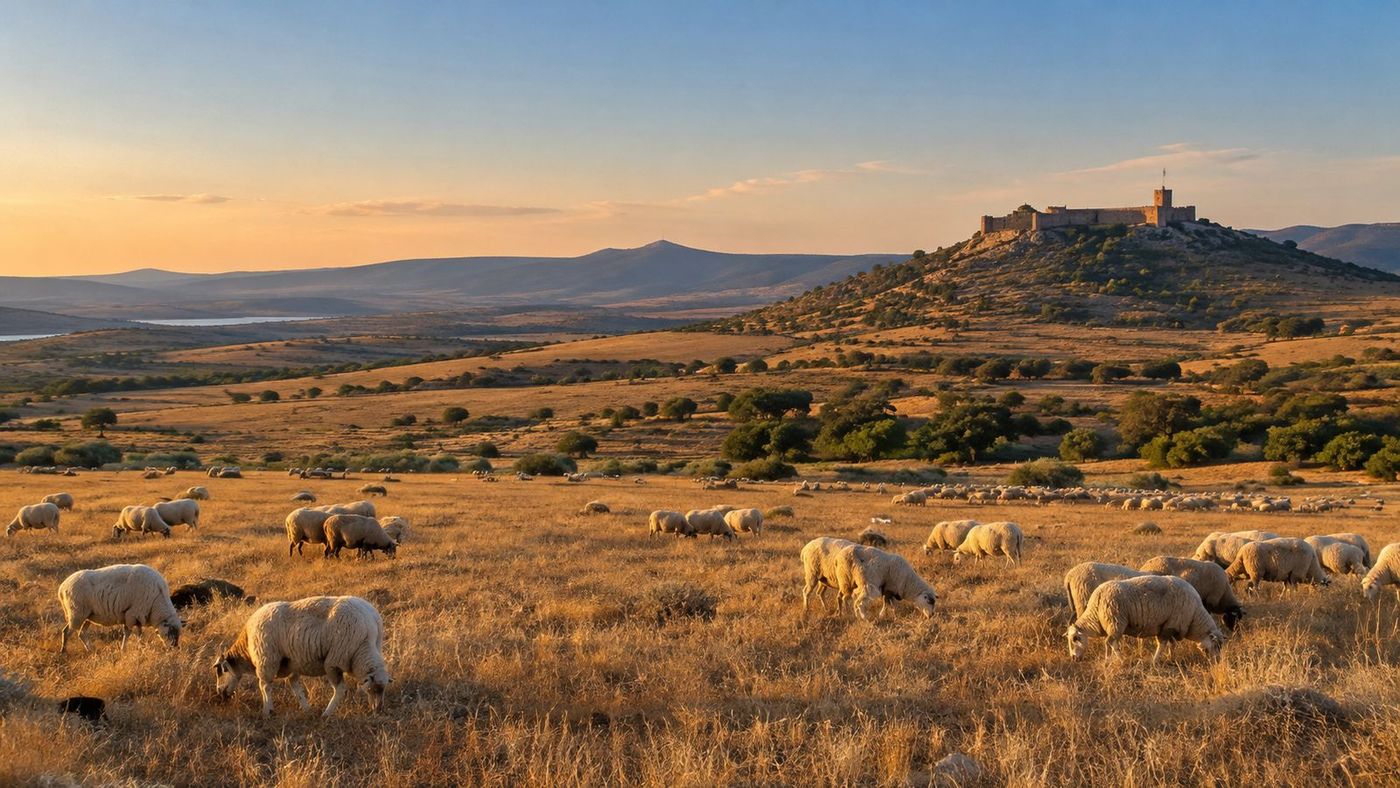
It is a district of pasture plains with poor soils and granite, famous for the merino sheep and La Serena cheese. For anyone looking for area at a good price it is one of the first options.
Where it is and what it is like
La Serena occupies the east of the province of Badajoz, between the Vegas Altas del Guadiana, La Siberia and the border with Ciudad Real. Its reference points are Castuera, Zalamea de la Serena, Cabeza del Buey, Quintana de la Serena and Campanario, with the N-430 as the main axis. Mérida is a little over an hour by car from Castuera and Badajoz city about two hours: that distance from cities is one of the reasons for its low prices.
The landscape is a rolling plain of grassland and cereal, with very scattered oaks, granite outcropping in the berrocales (boulder fields) and large reservoirs on the horizon. It is a depopulated district, of small villages and large estates: here it is normal to talk about hundreds of hectares, not plots.
Which estates are common
- Livestock estates of 100 to 500 ha.
- Open dehesas with scattered holm oaks.
- Dryland olive groves and small plots near the villages.
The typical unit of sale is the whole livestock estate, often with several cadastral references, corrals and a farmhouse. Watch the buildings: many farmhouses are old and do not always appear in the deed, so it is worth checking their status before valuing them (see what to look at in an estate with a house).
The merino sheep and La Serena cheese
The sheep flock is the engine of the district. The merino breed gives milk for La Serena cheese, with its own designation of origin and national fame, and lambs for the market. For a buyer this matters for three reasons: there are cooperatives and milk buyers nearby, there are skilled workers (shepherds, shearers, vets) and the PAC entitlements linked to sheep have a market in the area.
If you are buying to farm, ask about the current flock, any leased pastures that may come with the estate and the historical milk deliveries. If you are buying as an investment, a livestock lease on an estate well supplied with water is a usual use and relatively easy to manage from a distance.
Water: the point that decides the purchase
Summers are long and very dry, and the pasture disappears between June and September. The district is surrounded by large reservoirs (La Serena, Zújar, García de Sola and Orellana are in its surroundings), but the vast majority of estates are dryland: drinking and stock-watering water comes from wells, boreholes and ponds.
That is why the first question in La Serena is not how many hectares the estate has, but how many water points there are and what state they are in. A 349 ha estate next to Castuera with five wells, like one the catalogue has had, is a good example of what the market rewards here. Before doing the numbers, read the guide to water on rural estates and check that each well is legalised or on its way to being so.
Price
In the catalogue there are plots of 2 ha for 10.000 € up to estates of several hundred hectares with a hunting ground. Example: a 349 ha estate next to Castuera with five wells. See the lowest prices.
As a general reference, the district's pastures sit in the low brackets of the range of prices per hectare in Extremadura, and large, well-equipped dehesas approach the regional median for their type. Within the district, what moves the price most is water, the quality of the pasture, access and, where applicable, the hunting ground.
What to check
- Water: summers are very dry.
- Soil: poor pasture in granite areas.
- PAC entitlements associated with sheep.
- Protections: La Serena has ZEPA zones for steppe birds (see Natura network).
Add to the list the state of the fences and corrals, winter access (dirt tracks suffer with the rains) and whether there is any current grazing or lease contract that comes with the sale.
ZEPA and steppe birds
A good part of the district is included in Natura 2000 for its steppe birds, with the great bustard and the little bustard as emblematic species. In practice this does not prevent grazing or traditional cereal growing, which are compatible, but it can condition new ploughing up, conversions to irrigation or infrastructure such as solar plants, which will need an environmental report. In return, there are agri-environmental subsidies linked to these zones that can add income to the farm.
Who La Serena suits
| Goal | What to look for |
|---|---|
| Own sheep | 200 to 500 ha with several wells, corrals and good access |
| Investment with a lease | Flat estate, with plenty of water and an interested local livestock farmer |
| Small-game hunting | Cereal and fallow plains with ponds |
| Budget leisure | Small plots with a house near villages or reservoirs |
The future of the district
La Serena is attracting projects linked to energy and irrigation on its perimeter, and its reservoirs put it on the map for fishing and water sports tourism. It does not change the essence of the district, which will remain livestock-based, but it does sustain demand for well-connected estates. For the patient buyer it is a value bet: cheap area today, with uses that may improve.
When to visit and how to negotiate
The best time to see an estate in La Serena is between February and May, when the pasture is at its best and the quality of the soil can be appreciated; a second visit in August shows the opposite: how the estate stands up to summer and whether the wells still give water. If you can only go once, go in spring and ask for summer photos or videos.
In negotiation, the seller is usually a livestock farmer who is retiring or an inheritance. There is room on estates that have been advertised for months, but little competition from buyers also means little hurry: before making an offer verify the nota simple, the Cadastre and SIGPAC and follow the usual purchase steps. On estates of this size, a topographic survey or at least a walk round with the cadastral map in hand avoids boundary arguments later (see easements and boundaries).
If you are interested in hunting, see hunting estates. And if you are torn between this district and others in the region, the guide Cáceres or Badajoz helps you compare.