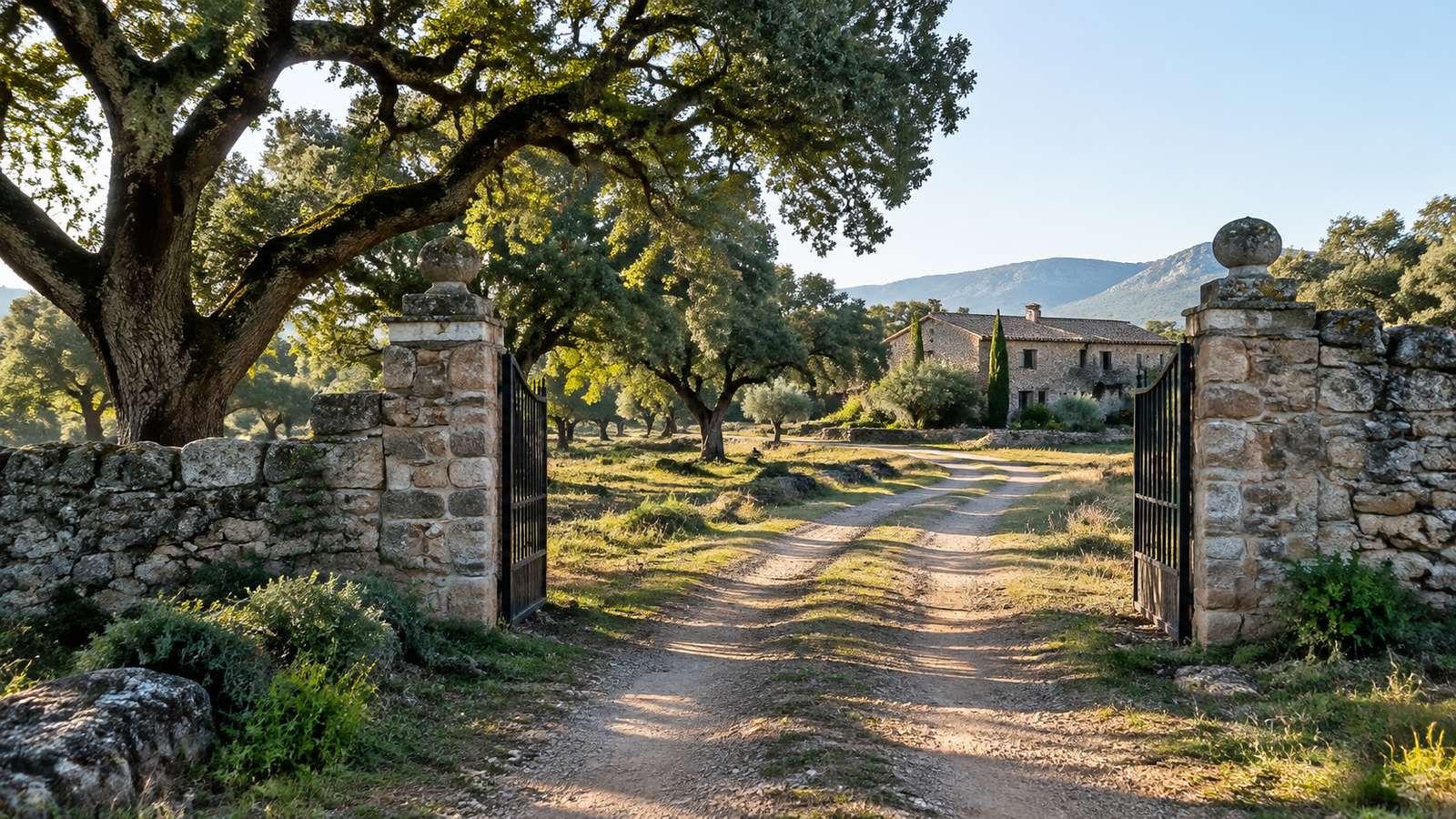
1. Check the estate before negotiating
- Nota simple from the Land Registry: owner, registered area, charges, mortgages and easements.
- Cadastre and SIGPAC: cadastral reference, polygon and plot, enclosures and uses. Compare the area in the Cadastre with the one in the Registry; they often do not match.
- Water: ask for the registration of wells and concessions with the relevant river basin authority (Tajo, Guadiana or Guadalquivir).
- PAC and livestock: basic payment entitlements, farm registers (REGA) and quotas, if the sale includes them.
- Environmental protections: if it lies in Natura 2000, a natural park or a biosphere reserve, there will be limits on use.
We have a specific guide for these three checks: nota simple, Cadastre and SIGPAC step by step. Do it before talking about price: it costs a few euros and it is the filter that prevents the most bad deals.
2. Visit and check on the ground
Walk the boundaries and access routes, look at the state of the fences, ponds and buildings, and ask the neighbours about water in summer. A right of way or a public track crossing the estate changes its use a lot. If you can, visit twice: once with the seller or the agent and once on your own, and in different seasons if the purchase drags on. Take the SIGPAC map on your phone to place what you see on the real enclosures.
3. Arras contract
Reserve the estate with an arras deposit (usually penitential) stating the price, the deadline to sign the deed and what is included: livestock, machinery, PAC entitlements, pending harvests. Also add:
- The cadastral reference and the exact registry data of what is being sold.
- Who pays each cost and the municipal capital gains tax if there is any.
- Conditions precedent: for example, that the deal is cancelled if the bank refuses financing (see mortgages for estates) or if an undeclared charge appears.
- What happens with current leases or rights of use (montanera, cork, hunting) that have already been contracted.
4. Deed and taxes
The sale is signed before a notary. On a second-hand estate you pay the Extremadura Property Transfer Tax in brackets: 8 % up to 360.000 €, 10 % between 360.000 and 600.000 € and 11 % on the part above 600.000 €. On top of that come notary, registry and administrative agent. Every year you will pay the rural IBI (property tax) to the town council.
There are reductions for priority farms and young farmers: check them with an adviser before signing.
Example of costs: a 250.000 € estate
| Item | Approximate amount |
|---|---|
| ITP (8 %) | 20.000 € |
| Notary | 800-1.200 € |
| Land Registry | 500-800 € |
| Administrative agent (optional) | 300-500 € |
| Total | ≈ 21.600-22.500 € |
As a quick rule, set aside between 9 and 10 % of the price for costs and taxes. If you buy between agricultural businesses waiving the VAT exemption, the scheme changes (VAT instead of ITP, with deductibility): this is a case to review with a tax adviser.
5. Registration and change of ownership
Register the deed in the Registry, notify the change to the Cadastre and, if there is livestock or PAC, carry out the transfers with the Junta de Extremadura. Do not leave it for later: without registration, your right is weaker against third parties and you will not be able to mortgage or sell easily.
How long the whole process takes
With the paperwork in order and no financing, the sale of a rural estate can close in two or three months from the acceptance of the offer. The usual delays are: coordinating Registry and Cadastre when the areas do not match, tracking down all the owners in inheritances, waiting for reports from the river basin authority or the agricultural administration, and the valuation if there is a mortgage. For inherited estates or those with many owners, allow six months or more.
Who is involved and what they charge
- Notary: certifies the deed; their fees are regulated.
- Registrar: registers the purchase; fees are also regulated.
- Lawyer or agricultural adviser: optional but advisable for estates with water, PAC, hunting grounds or several owners.
- Estate agent: their commission is normally paid by whoever hires them, almost always the seller.
If you are buying from outside Spain
Non-residents can buy rural estates in Extremadura without special permission; they will need an NIE (foreigner identification number) to sign the deed and pay taxes, and it is advisable to open a Spanish bank account for payments and IBI bills. Later taxation (IRNR if you are not resident) is different from that of a resident: get advice before signing the deed.
Mistakes that are expensive
- Signing arras without having seen the nota simple: the estate may have seizures or more owners than you thought.
- Buying "half an estate" that is actually an undivided share (see undivided shares and inheritances).
- Taking the area in the listing as correct without checking Registry and Cadastre.
- Not putting in writing which rights of use (cork already sold, montanera contracted) are committed for the coming years.
With these checks done, buying an estate in Extremadura is an orderly process. And if you are looking at price, start with our guides to price per hectare and cheap estates.
The offer: how to present it and how much to knock off
With rural estates, negotiation is usually done verbally before anything is signed. Present the offer in writing, even if it is just a message, with price, deadline to sign the deed and conditions (financing, inclusion of PAC, livestock). As a reference, on estates that have been advertised for many months, reductions of 5 to 15 % on the asking price are common, while on well-presented leisure estates with demand the margin is minimal. The price per hectare data for similar estates is your best support: a reasoned offer gets rejected less often than a plain discount.
Special purchases that need more care
- Inheritances not yet divided: require that the estate be allocated or that all the heirs sign; otherwise you may end up in an undivided co-ownership.
- Estates with a tenant: the agricultural lease may remain in force after the sale and limit use for years.
- Hunting grounds: hunting title is managed separately from ownership; review the technical hunting plan and current contracts.
- Estates with tracks or livestock routes: a public track running through it conditions fences, crops and buildings.
After buying: the first formalities
As well as registering and notifying the Cadastre, register the IBI in your name at the town council, review the insurance (fire on wooded estates), change the ownership of livestock registers and water concessions if there are any, and keep a copy of the deed and the updated nota simple. These are small tasks that, if forgotten, block grants, mortgages and future sales.
Related guides
Details of each check in nota simple, Cadastre and SIGPAC, water, PAC and financing.