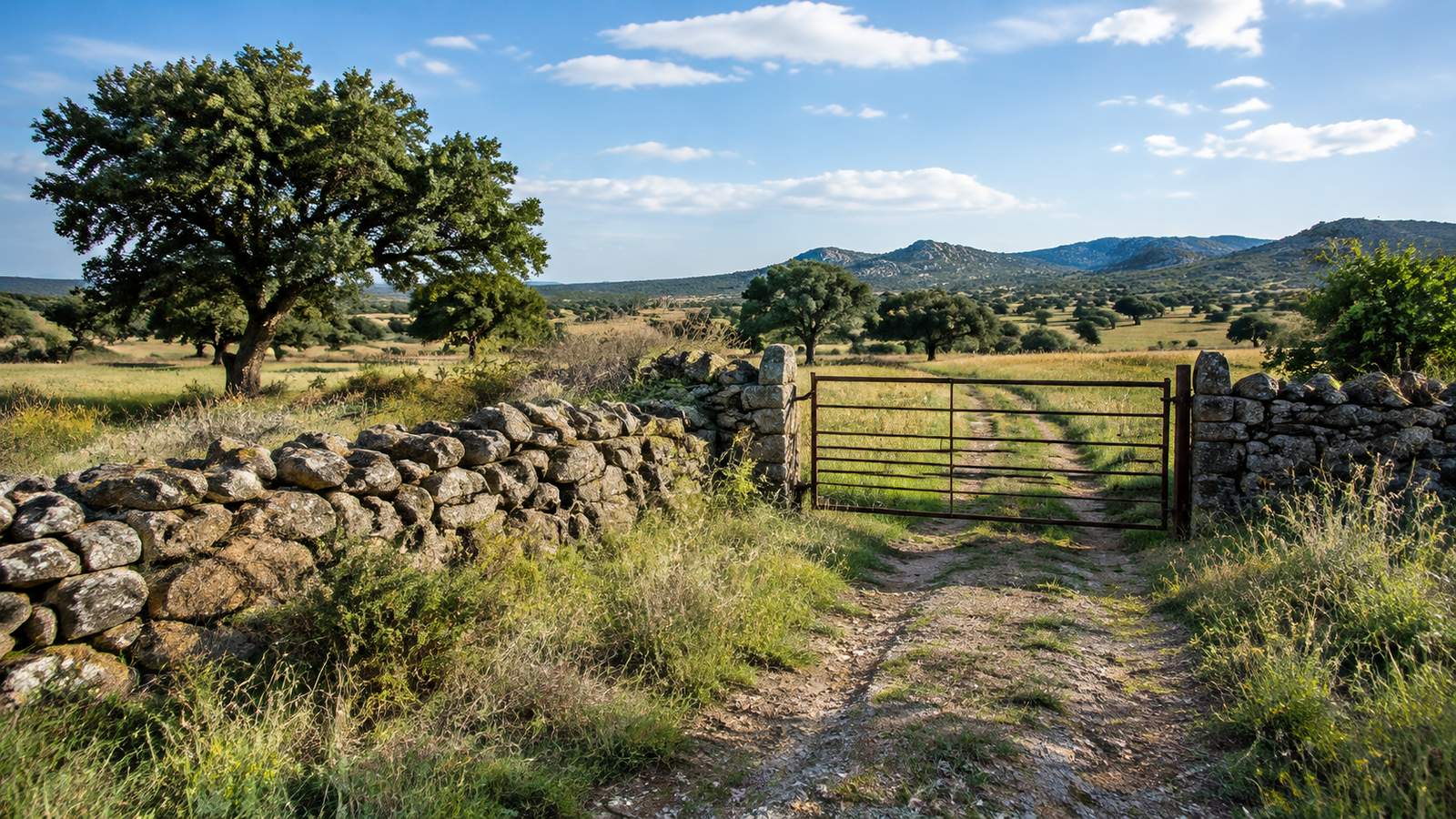
These are matters that are barely visible in listings but weigh a lot in the value of an estate.
Rights of way
A landlocked estate, with no exit to a public track, can demand passage across neighbouring ones, with compensation. Check in the nota simple whether there are registered easements and ask about de facto ones.
Rights of way are the most common easements, but not the only ones: there are water easements (carrying or receiving water across the neighbouring estate), easements to draw water from a shared well, grazing easements (other people's livestock grazing on your estate at certain times) and those arising from power lines or pipelines. Some benefit your estate and others burden it: in both cases you must know about them before buying.
Registered and de facto
Registered easements appear in the nota simple. De facto ones are not in the Registry, but they exist: a track that crosses the estate towards the neighbour's house, a pipe that carries water to another plot, a gate that "has always been used". They are detected by visiting the estate with your eyes open and asking neighbours and the town council. De facto easements can be proven by continued use and witnesses, so do not ignore them even if they do not appear on any paper.
Boundaries
Compare the cadastral map with the real fences. If they do not match, ask for a boundary survey or a topographic survey.
In the Extremaduran countryside it is common for what is fenced not to match what is in the Cadastre: fences moved decades ago, vanished boundary stones, pieces of ambiguous use. A friendly boundary settlement (agreement with the adjoining owners, signed and registered) is the quick route; a judicial one is the route when there is no agreement. A topographic survey with GPS leaves reality measured and is a modest investment compared with the size of the purchase.
The compulsory right of way
If your estate is landlocked and the neighbour does not want to give you passage, the law provides for the compulsory easement: a procedure that fixes the least damaging route and the corresponding compensation. It is an important guarantee for the buyer of a landlocked estate, but it is slow and has a cost, so the price of a landlocked estate should reflect it. The ideal is to buy with the easement already registered or at least agreed.
How much a boundary settlement costs and how long it takes
The topographic survey is the technical part and is usually affordable even on large estates; the serious cost arrives when the boundary settlement ends in court proceedings with expert reports, which can drag on for years. That is why the practical rule is: small disagreement, friendly agreement signed and registered as soon as possible; big disagreement, lawyer and realistic expectations on timing.
Pre-emption by adjoining owners
When a rural estate of less than one hectare is sold, the owners of the adjoining estates may have the right to buy it on the same terms. On estates of more than one hectare, like those in this search tool, this risk generally disappears, but consult a lawyer in doubtful cases.
The adjoining owners' right of pre-emption is a figure in the Civil Code designed to avoid excessive division of rural property: when a small estate is sold, neighbours have priority to acquire it paying the same. In practice, in sales of plots under one hectare it is worth notifying the transaction to the adjoining owners or allowing for that risk in the timelines. On large estates it does not usually apply, but the rule has nuances when there are several estates together in the same deed.
When access belongs to everyone: public tracks and livestock routes
Not every easement is between neighbours: livestock routes (cañadas, cordeles, veredas) and public tracks cross many estates and cannot be closed or occupied. In Extremadura there are extensive livestock routes, sometimes poorly marked on the ground. Before buying, check in the Junta's viewers whether any crosses the estate and in what state its boundary settlement is.
Pre-emption by co-owners
If you buy a share of an estate in undivided co-ownership, the other co-owners may have priority.
The law requires that anyone selling a share to an outsider notify the other co-owners, who can exercise pre-emption: take the share, paying the same. If you buy a share without that notice, the deal can be undone later. It is one of the reasons why undivided shares require so much prudence.
Party boundaries and shared pastures
In dehesa areas old uses of party boundaries survive (two estates sharing a fence or use) and grazing rights of neighbouring livestock at certain times. They are not always registered, but the neighbours know them well. Ask directly: "does anyone come in to graze or to take water or firewood on this estate?" The oral answer of several neighbours is usually more complete than the Registry on these matters.
Practical cases
Two frequent examples. First: you buy an estate "with its own track" and discover that the last stretch crosses the neighbour's estate with no registered easement; the solution is to negotiate registration or to take the judicial route of the compulsory easement if the estate is landlocked. Second: the real fence has been two metres inside your estate for twenty years and the adjoining owner considers that margin theirs; without a boundary settlement or clear proof, the conflict can last years.
The importance of visiting with witnesses
A large part of these problems is solved or avoided in a single morning in the field: walk the estate with the seller, the warden and, if possible, an adjoining owner. What everyone recognises on the ground (passages, boundary stones, old fences) is hardly disputed afterwards.
Checklist for easements and boundaries
- Complete nota simple: charges, easements, encumbrances.
- Cadastral map and SIGPAC compared with the real fences.
- Walk the boundaries with the seller or the warden.
- Ask about passages, shared wells and lines that cross the estate.
- On estates under one hectare or undivided shares, review pre-emption rights with a lawyer.
How to protect yourself in the purchase
Remember too that well-placed and recognised boundaries make the PAC, insurance and the future sale of the estate easier.
Three simple measures: walk the boundaries with the cadastral map and the seller, ask in the nota simple for the full list of charges and easements, and record in the contract or the deed the seller's statements about existing passages and uses. If something smells of conflict (recent fences, neighbours at odds), consult a lawyer before the arras, not after.