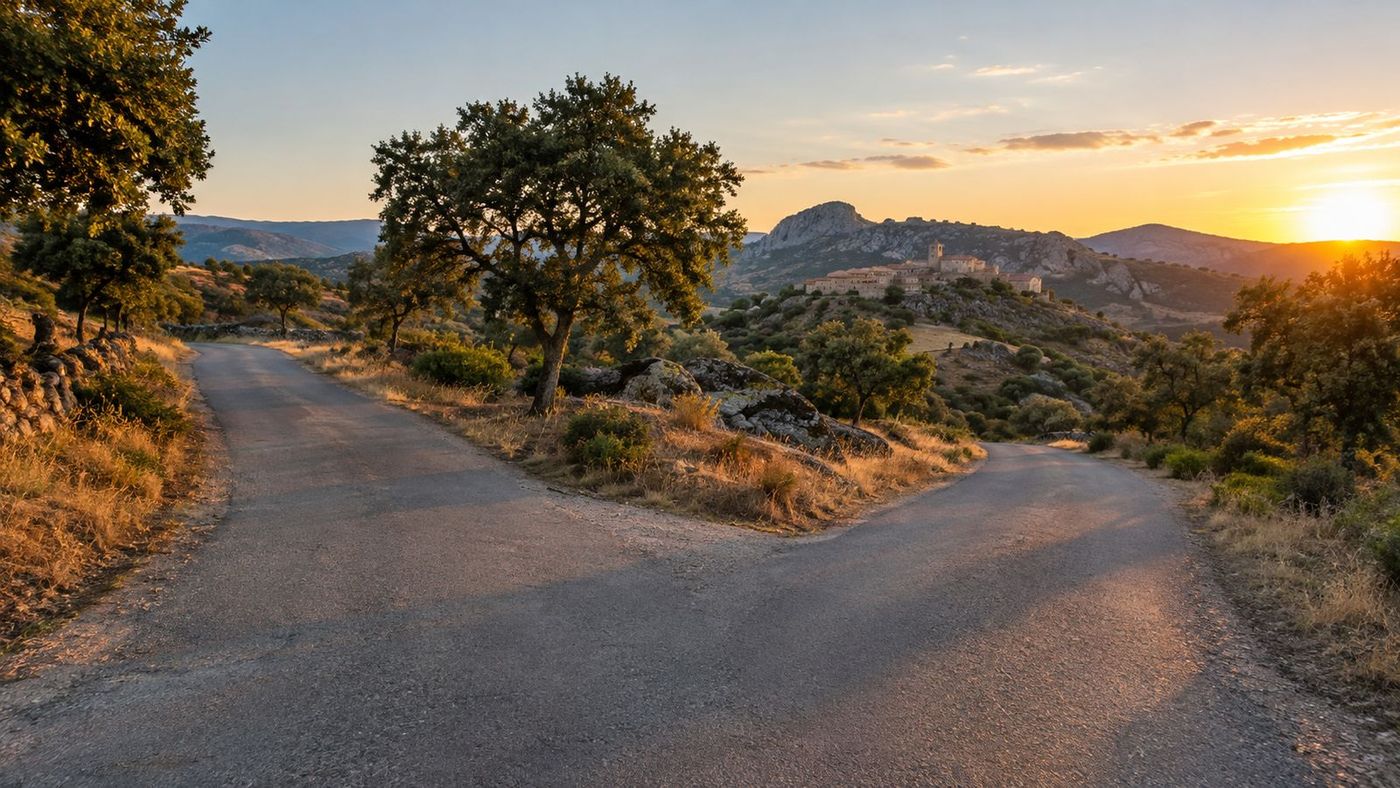
What this area is and where it is
Sierra de Gata and Las Hurdes occupy the north-west of the province of Cáceres, next to the border with Portugal and with Salamanca. They are two neighbouring but different districts. Sierra de Gata, with villages such as Gata, Hoyos, Robledillo de Gata, San Martín de Trevejo, Valverde del Fresno or Eljas, is a hillside range with olive groves, vegetable gardens, fruit trees and pine woods. Las Hurdes, with centres such as Caminomorisco, Nuñomoral, Pinofranqueado or Vegas de Coria, is a more rugged territory, of deep valleys and slate.
For the buyer of a rural estate the practical difference is this: these are not dehesas of hundreds of hectares like on the plains of Trujillo. The norm is plots of between half a hectare and a few hectares, on terraces, with old olive trees, some chestnut or cherry tree, a vegetable garden and, sometimes, a hut or a stone "chozo". Large estates exist, but they are usually woodland, with little production and a lot of fire risk.
What kind of estates you find
- Traditional terraced olive groves. It is the most characteristic crop of Sierra de Gata. The manzanilla cacereña olive gives an oil with the Gata-Hurdes protected designation of origin, which gives commercial value to an estate with olive trees in production. The terraces make mechanisation difficult: almost everything is picked by hand or with poles.
- Vegetable gardens and fruit trees. Near gorges and streams there are gardens with channel irrigation, with orange, fig, cherry or plum trees depending on altitude.
- Chestnut and oak woods. At high altitudes, with use of chestnuts and timber. Their profitability is modest, but they bring landscape and coolness in summer.
- Low woodland and pine forest. Cheap per hectare, but with little income and more fire prevention obligations.
- Stone houses and cortinas. The "cortinas" are small plots enclosed with dry stone walls near the village. They are much sought after by those who want a refuge, although not all allow building.
Prices: what to look at and what not
According to our October 2026 catalogue, the median for Extremadura is around 11.300 € per hectare, but the regional median is of no use in this area. Here the price per hectare shoots up when the plot is small, close to a village or has a house, and falls a lot on woodland without access. Two estates ten minutes apart can differ several times over in €/ha.
The factors that move the price most are these:
- Access by car all year round, without a dirt track that is impassable in the rain.
- Own water or an irrigation right by channel or gorge.
- Olive trees in production versus abandoned olive trees or ones with regrowth.
- Existing building and its legal status.
- Distance to a village with services (health, supermarket, bank).
To compare, always use estates of the same size and use, as we explain in the guide to price per hectare in Extremadura.
Fires: the factor that does not appear in the listing
Sierra de Gata suffered a very serious fire in August 2015 that affected thousands of hectares of woodland and several municipalities, and since then forest prevention has been a central issue in the district. It does not mean buying here is a bad idea, but you must take it into account:
- Ask what happened on that estate and on the neighbouring ones in recent fires.
- Check the distance to dense vegetation and whether there are firebreaks or an access track for firefighters.
- Take out insurance covering fire to trees and buildings, and read what it excludes.
- Keep perimeter strips clear as indicated by the regional fire prevention regulations, which set obligations and danger periods.
Houses and building on rural land
Most of these estates are non-developable land, and building a new house is very limited. The usual thing is to buy an existing house or hut and renovate it. Before paying a high price for a "house", check whether it appears in the Cadastre, whether it is registered in the Registry and whether its use is residential or agricultural. The guide on building a house on a rural estate explains what is usually required. In areas with environmental protection, there may also be additional conditions: see the guide to Natura 2000 and protected areas.
Boundaries, parcelling and inheritances
In smallholding districts it is common for one estate to be made up of several small plots, for boundaries to be stone walls or old markers and for ownership to be split among several heirs. Three useful checks:
- Compare the area in the Registry, the Cadastre and SIGPAC. On old plots differences are common.
- Ask for the nota simple and see whether there are several owners. If you sell or buy a part, first read the guide on undivided co-ownership and inheritances.
- Review rights of way and water easements. In gardens with a channel, the irrigation turn is usually set by custom or by an irrigation community.
Daily life and renting
Many people buy here for their own use, not to produce. Think about everyday things: mobile coverage and fibre (variable by valley), electricity supply, distance to the reference hospital, state of the road in winter and the high tourist season in summer and bank-holiday bridges. If you are considering renting the house to tourists, the guide to rural tourism on an estate summarises the registration requirements.
How to plan the visit
Visit the estate more than once and, if you can, in summer and after heavy rain. Walk up to the last boundary, look at the state of the walls, ask the neighbours about water and photograph the olive trees to assess their age and pruning. Before signing arras, carry out the document check described in the guide how to buy a rural estate in Extremadura and leave in the contract everything that is included in the sale: tools, pending harvest, water tank or whatever implements there are.
Summary to decide
Sierra de Gata and Las Hurdes fit if you are looking for landscape, your own oil, a vegetable garden and a quiet setting on a moderate budget. They fit badly if you want a large mechanised farm, a high income or a liquid investment. Define the use, calculate the total cost with taxes and renovation, and compare with other districts in Cáceres or Badajoz: where to buy an estate.