Water is the first thing that raises or lowers the price of an estate. A dehesa without water in summer forces you to bring tankers for the livestock; irrigated land without a concession is, legally, dryland.
Types of water you will see in listings
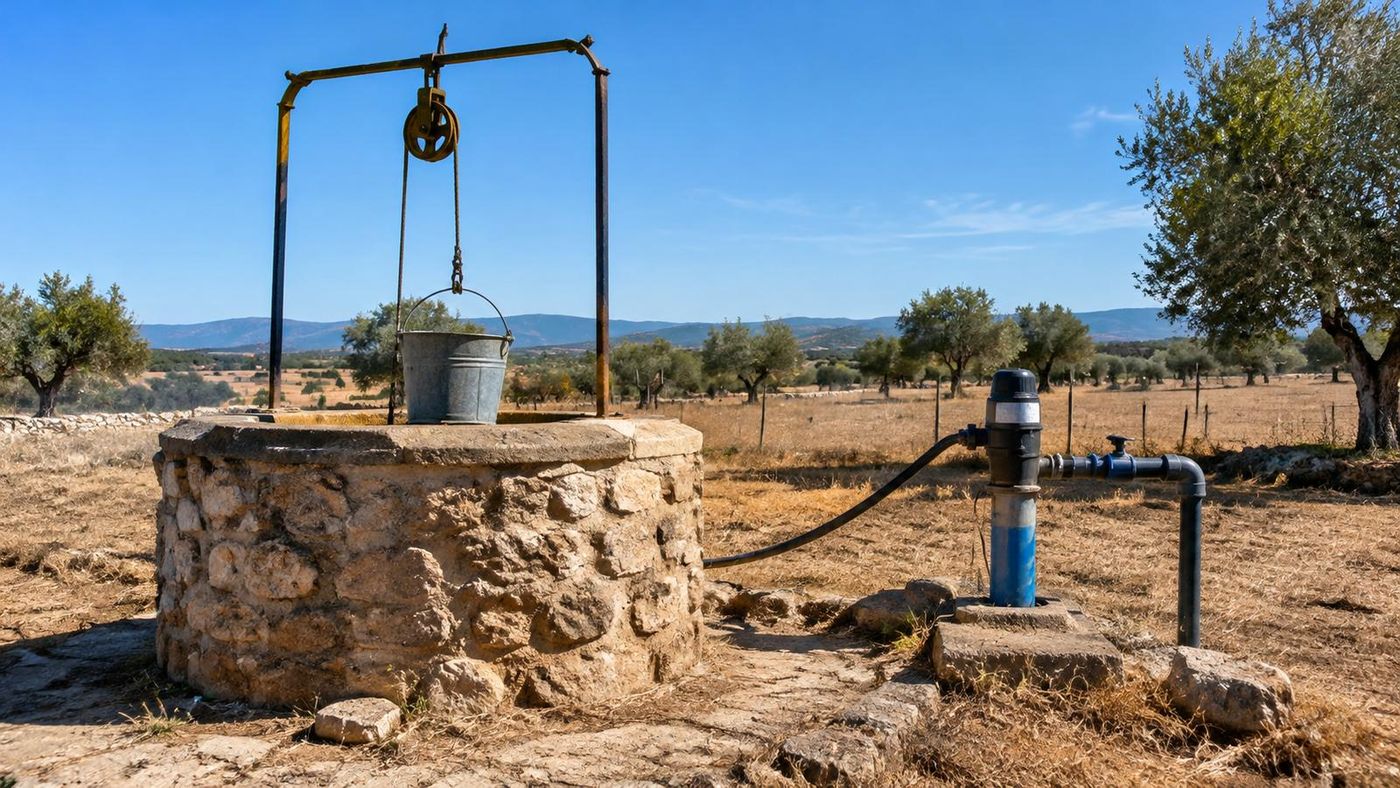
- Traditional wells (dug by hand): shallow, useful for watering animals.
- Boreholes: deep drilled holes with a pump, more flow.
- Ponds: hold rainwater for the livestock.
- Streams and gorges: highly valued in La Vera and northern Cáceres.
- Irrigation concessions: the right to use a specific volume from a river, canal or aquifer.
The legal framework in four ideas
In Spain surface and groundwater are public domain: using them requires an administrative title (concession or authorisation), apart from minor exceptions. The Water Act and the river basin hydrological plans set who can use how much water and for what. In practice:
- Watering livestock and domestic uses on the estate usually get more flexible treatment, but must also be registered.
- Irrigating with groundwater requires the borehole to be registered with its annual allocation.
- Irrigation from watercourses or canals requires a concession with volume, period and irrigable area.
- Titles are reviewed: a well used for decades without papers is not "legal by age", it is a latent risk.
Which river basin authority applies
It depends on the basin: the Tajo covers most of the province of Cáceres; the Guadiana, a large part of Badajoz, including the Vegas; and the Guadalquivir, areas in the south of Badajoz such as the Campiña Sur. There you can check registrations in the Water Register.
What to ask the seller
- The registration or authorisation of each well or borehole, with its annual volume.
- If there is an irrigation concession, its holder, irrigable area and flow.
- Receipts from the irrigation community, if there is one.
- Water analysis if it is going to be used for human consumption.
How it is checked
With the cadastral reference or the coordinates of the well, the river basin authority can say whether it is registered and with what allocation. For wells, there is also a catalogue of private waters inherited from the reform of the 1980s: many old wells are there and not in the public domain register. A technician or agent used to these files knows where to look in each case; it is money well spent before the arras.
Legalising a well without papers
Sometimes it is possible to regularise an existing well through a procedure with the river basin authority, but it is not guaranteed: it depends on the state of the aquifer, the available allocation and the declared uses. The golden rule: never pay for the estate as if the well were legal until it is. If the seller says it "is easily legalised", let them do it before the deed or let the price discount the full risk.
Warning signs
- "Plenty of water" with no paperwork at all.
- Undeclared wells inside the house.
- Irrigation on an estate classified as dryland in SIGPAC.
The summer visit, the acid test
If you can, visit the estate in August. The ponds that last through August are the ones that last through everything; the well that gives flow in the driest month is the one that sustains a farm. Ask the neighbours on adjoining estates: in the countryside, the water history of each estate is known and discussed openly. That conversation is worth more than any sentence in the listing.
Approximate costs of securing water
Making a new borehole (drilling, casing, pump and legalisation) costs several thousand euros depending on depth and area, and not all boreholes find enough flow. Building or cleaning a pond also has a cost and may need reports. Budget for these items before buying an estate "without water but with potential", and make your offer accordingly.
If you are looking for irrigated land, see our guide to the Vegas del Guadiana. And remember that water is also key for montanera.
Irrigation communities and fees
In irrigable areas (Vegas del Guadiana, Campo Arañuelo) the water is usually managed by an irrigation community that distributes the watering, maintains the network and charges fees per irrigated hectare. When buying irrigable land, ask for the community's latest receipt and confirm that the estate is up to date and registered in the census: an "irrigated" estate that has lost its effective water right is worth as much as dryland. The annual fees are a fixed cost that must go into your farm numbers.
Drought, restrictions and planning
The basin plans provide for restrictions in dry years: the river basin authority can reduce allocations when reservoirs fall below certain levels. A serious buyer looks at the history of restrictions in the district and asks the irrigation community how the last hard years were shared out. Two estates with the same nominal concession can have very different real water if one is at the end of the canal. The intake point and the priority of the right matter as much as the written volume.
Water for the house and for drinking
If the estate has or will have a house (see building on rural land), water for human consumption requires additional health guarantees: periodic analysis and, often, a purification unit. A well that is good for livestock is not automatically good for drinking. Budget for the first analysis in the checking phase, not after buying.
Transfers and shared uses
On large estates it is common for one well to serve several plots or for a pond to supply the neighbouring estate by old custom. These verbal agreements are inherited badly: if you buy, put in writing in the deed which water uses are included and which are not, and whether there are registered water easements (see easements and boundaries). A shared well without paper is a postponed dispute.
Water in price negotiation
Documented water is the strongest price argument a seller has, and undocumented water is yours as a buyer. Before negotiating, ask for the papers in writing; each gap (unregistered well, expired concession, unpaid receipt) is an item you will have to pay for and which must come off the price. An estate with legal water, more than enough for your use, is worth the premium it asks; one with water by word of mouth, is not.