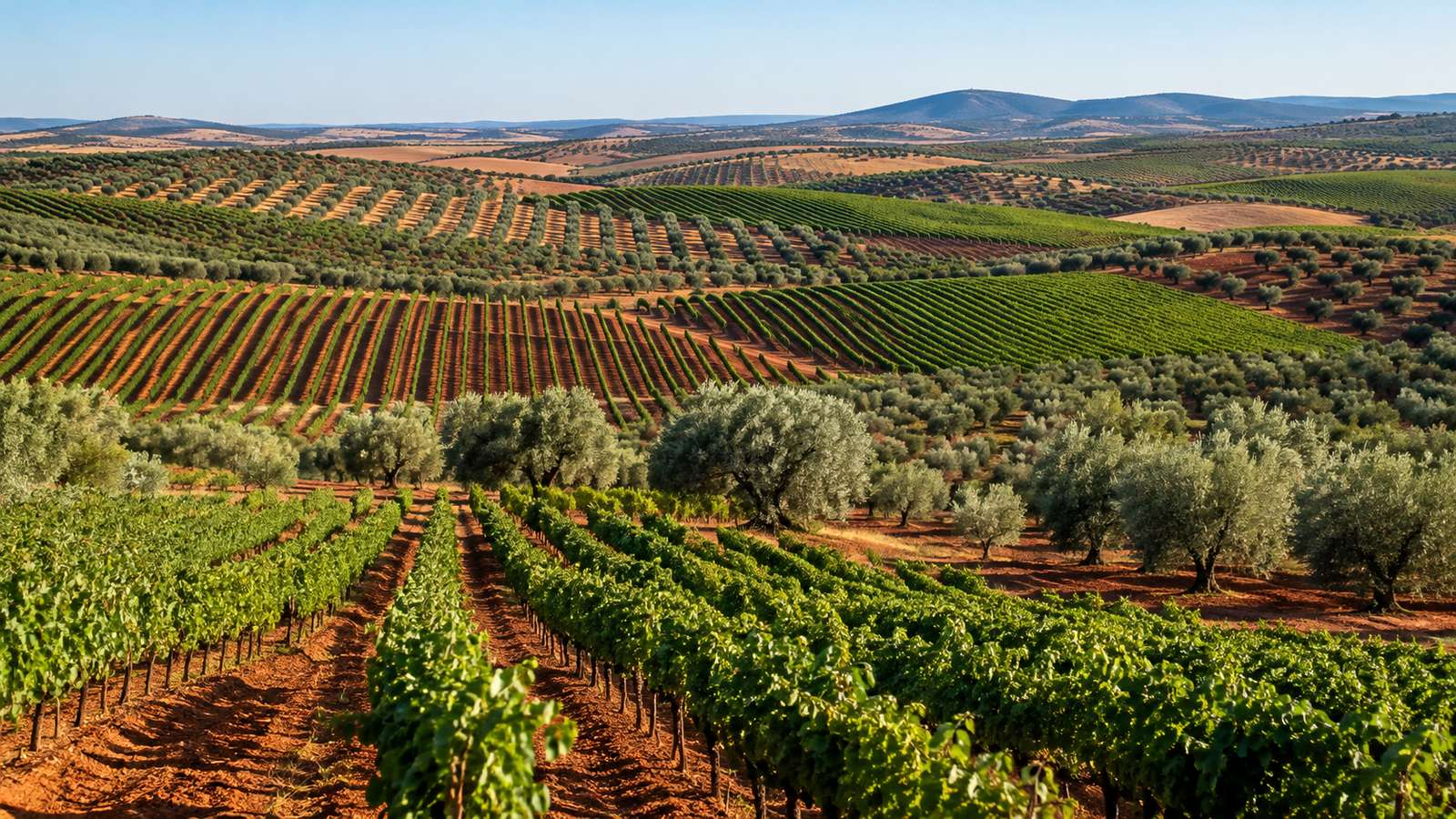
Its name comes from the barros, reddish clay soils that retain moisture. Almendralejo, Villafranca de los Barros, Alange, Solana and Santa Marta are its centres.
Where it is and what it is like
Tierra de Barros occupies the centre of the province of Badajoz, west of the Vegas del Guadiana and south of Mérida, crossed by the A-66 motorway and the N-630. It is one of the most populated agricultural districts in Extremadura with the most economic fabric: Almendralejo is its de facto capital and has cooperatives, olive mills, wineries, agricultural workshops and all the services a farm needs.
The landscape is open, ploughed plain, almost without woodland: lined-up olive groves, vineyards trained as bush vines and on trellises, and cereal in rotation. Anyone looking for holm oak dehesa or woodland for hunting should look at other districts; anyone looking for productive farmland is in the right place.
Soil and climate
The barros are deep, clayey soils with a good capacity to retain winter water, which allows regular dryland harvests in normal years. Rainfall is moderate and summers very hot; late spring frosts are the main risk for the olive tree and the vine in flower. When buying, ask about the frost and hail history of the specific estate.
What is grown
- Olive groves, traditional and intensive (see types of olive grove).
- Vineyards, bush-trained and on trellises.
- Cereal in rotation.
The district's olive groves rely on local varieties such as Carrasqueña, Corniche and Morisca, with olive mills and cooperatives in almost every village. The vineyards largely belong to the Ribera del Guadiana Designation of Origin, whose Tierra de Barros subzone is one of the largest: many estates have grape delivery contracts with wineries and cooperatives in the district.
Prices
There are small olive groves of 1 ha for about 20.000 € and farms of more than 100 ha above a million. The median of farmland estates in the catalogue is around 23.000 €/ha (more data).
Within the district, the price is set by the state of the trees, demonstrable production and water. A young olive grove in production with drip irrigation is worth much more than an old abandoned dryland one; a vineyard with authorisation and a delivery contract is worth more than an old one that has not been reconverted. Always compare €/ha between estates with the same crop and condition.
Olive grove or vineyard: which planting to choose
The olive grove needs less annual labour than the vineyard and tolerates dry years better, but takes years to come into production if newly planted. The vineyard gives an annual harvest with stable contracts in the district, although it needs more treatments, pruning and harvesting. Many owners combine both to spread risk and the work calendar.
If you are thinking of planting a new vineyard, bear in mind that in Spain vine planting is subject to administrative authorisation: check that the estate has planting rights available or that the seller transfers them, and confirm it with the administration before closing the price.
What to check
- Age and planting frame.
- Average production and deliveries to the cooperative.
- Whether the vineyard has planting authorisation.
- Legal irrigation or dryland (see water).
- PAC and associated subsidies.
Also ask for the receipts from the cooperative or olive mill for recent years: they are the most reliable proof of real production. Check the state of the irrigation if there is any (drippers, reservoir, connection), the presence of pests such as the grape moth in the vineyard and whether the estate is up to date with fees in its cooperatives.
What the purchase is like in practice
Most estates are sold between private individuals or through brokers in the district, and it is common for the seller to be a retiree with no successor in farming. Timelines are usually reasonable and there is room for negotiation on estates that have been advertised for some time. As with any rural purchase, before signing arras you should review the nota simple, the Cadastre and SIGPAC and follow the general purchase steps.
The season and labour
The district lives to the rhythm of two seasons: the grape harvest, at the end of summer, and the olive harvest, in autumn and winter. In those weeks labour is scarce and rises in price, something worth budgeting for if you are going to farm the estate. Mechanisation helps: machine grape harvesting and olive picking are common on trellises and in intensive olive groves, and greatly reduce dependence on crews.
If you are not going to work the estate yourself, the usual option is to lease it to a local farmer or to deliver the harvest to a cooperative with field services. Ask in the village who works the neighbouring estates: in Tierra de Barros the local network is the best job market.
Logistics and services
Few agricultural districts in Extremadura have better logistics: the A-66 connects Almendralejo with Mérida in under half an hour and with Seville in a little over an hour and a half, and there are train stations at Almendralejo and Villafranca. Olive mills, wineries, canneries, plant-protection stores, workshops and spare parts are a few kilometres from almost any estate. That lowers running costs and makes it easier to sell the harvest without long transport.
For a second home or a country house with some olive grove, the district offers villages with all services and small estates at affordable prices; if that is your plan, review the checklist for estates with a house.
The district's wine
The wineries of Almendralejo and the surrounding villages have moved from bulk wine to bottled brands with recognition, and that has improved contracts for quality grapes. A well-managed vineyard, georeferenced within the DO, has a better outlet today than a decade ago, another argument for reviewing delivery contracts carefully before buying.
Insurance and farm risks
Agricultural insurance is almost essential in the vineyard and highly advisable in the olive grove: it covers hail, frost and drought depending on the line taken out, and in the district there are offices and brokers with experience. Ask which lines the estate has had in recent years and whether it has received compensation, because that tells you its real risks better than any listing.
As in any agricultural purchase, close the tax and administrative side properly: ITP, notary and registry according to the purchase steps, and registration of the farm in your name if you are going to apply for subsidies.