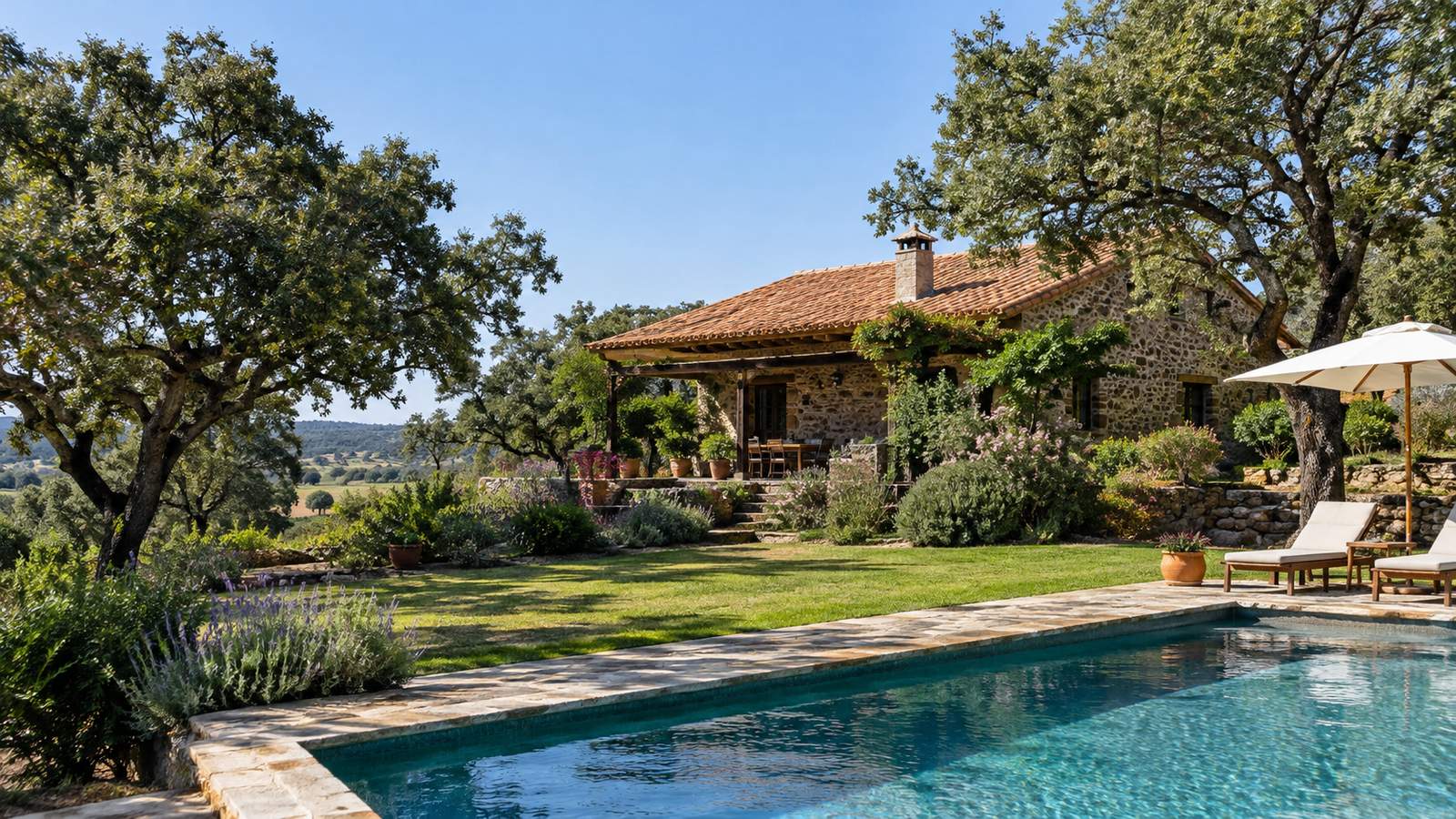
It is the most emotional purchase and the one that gives the most surprises. This list summarises what causes the most problems.
The house
- Legality: that it appears in the deed and Cadastre, with a licence or time-barred (see house on rural land).
- Condition: roof, damp, electrical installation.
- Habitability certificate or first-occupation licence.
- Swimming pool declared.
Utilities
- Water drinkable and legal (water guide).
- Electricity: grid or solar with batteries; cost of bringing the grid.
- Internet and mobile coverage.
- Sewage: septic tank or treatment plant.
Surroundings
- Access in winter and easements.
- Distance to services and hospital.
- Fire risk and protection strips.
- Annual costs: IBI, insurance, maintenance.
Use the "With house" filter in the search tool and the "Total cost" tab of the AI analysis. Typical areas: La Vera.
The papers that prove the house is legal
The phrase "the house is legalised" has to be checked with documents. The minimum: that the dwelling appears in the deed and in the nota simple with its area, that the Cadastre reflects it in its descriptive and graphic certificate and that the town council confirms its planning status in writing. If the house is old and has no licence, there are routes to regularisation depending on the municipality and its age, but it is better to resolve them before the deed, not after.
Be wary of recent renovations without a licence: a closed porch, an annex or a new swimming pool not declared can be inherited as a problem. What is not in the deed or in the Cadastre, ask for in writing in the contract, with the person responsible.
How much it costs to get it ready
Every estate is a world of its own, but it is worth budgeting with a margin: the full renovation of an old country house can approach the cost of building a new one if the roof and structure are involved; bringing the electricity grid from far away can cost much more than a good solar installation with batteries; and a new well, with borehole, legalisation and pumping, is a serious item. Ask for quotes before closing the purchase price, not after.
Internet and coverage in the countryside
Fibre rarely reaches isolated estates. The real options are amplified 4G (check coverage with your phone on the estate itself, at different points and times), rural Wimax where it exists and satellite internet, which works well almost anywhere in exchange for a monthly fee. If you are going to work remotely, test a video call from the estate before buying.
The real maintenance of a leisure estate
| Item | Frequency |
|---|---|
| Rural IBI and house insurance | Annual |
| Estate cleaning and fire prevention | Annual, before summer |
| Swimming pool, garden and irrigation | From spring to autumn |
| Well, treatment plant and solar panels | Periodic checks |
Anyone who buys thinking "we will go at weekends" underestimates the work: an estate abandoned for two years shows in the vegetation, the installations and the opportunistic squatters. If you do not live nearby, consider a local caretaker.
How to do the visit properly
Always visit twice if you can: once in good weather and once after rain, to see the access at its worst and the areas that get waterlogged. Talk to the neighbours and the town council before making an offer: they will tell you things the listing does not. Check the real distance to the doctor, the supermarket and the school if you are going to live there all year round, and ask about the frequency of power and water cuts in the area.
Security of an isolated estate
Isolated estates with long absences are targets for theft of copper, tools and firewood. Discreet and common measures: a caretaker or neighbour who drops by, alarms that alert your phone, solar lighting with a sensor and not leaving valuable machinery in view. Ask locally how things stand; it varies a lot from district to district.
The mistakes that repeat most
Buying by the photo without seeing the winter access; assuming the well gives drinking water without analysing it; assuming the house can be extended when the planning does not allow it; and not calculating the total cost of getting it ready before negotiating. Most purchases that go wrong fail on one of these four points, and all of them can be checked before signing the arras.
Living there all year or coming at weekends
It is not the same estate. For weekend use, what matters most is quick access from your city, low maintenance and security during your absence (alarms, neighbours, caretakers). For living there all year round, other factors rule: real distance to schools, doctor and shops, quality of drinking water all year, heating and insulation of the house and an internet connection that can handle daily work. Be honest with yourself about the real use: it completely changes the list of priorities.
The house inside: what to look at calmly
Bring a torch and time. Look at the roof from inside if there is an attic, look for damp stains in corners and skirting boards, open taps to see water pressure and colour, check the electrical panel and ask how old the installation is, and tap walls looking for partitions added without a licence. In old houses of the area it is common to find snow wells, ovens and attached stables: charming spaces that also count as construction and should be declared.
And if you want to make income from it
Many leisure estates are bought with the idea of renting them to tourists part of the year. It is a good supplement, but it requires tourist registration and a dwelling that meets requirements; read it in the rural tourism guide before counting on that income in your plan.
The exit: thinking about resale
Even if you buy it for life, buy with selling in mind: leisure estates with a legal house, plenty of water, paved access and less than an hour from a city resell well; those that fail on one of those points stay years on the market. The same twelve-point list that serves you today to buy will be the one your future buyer uses.