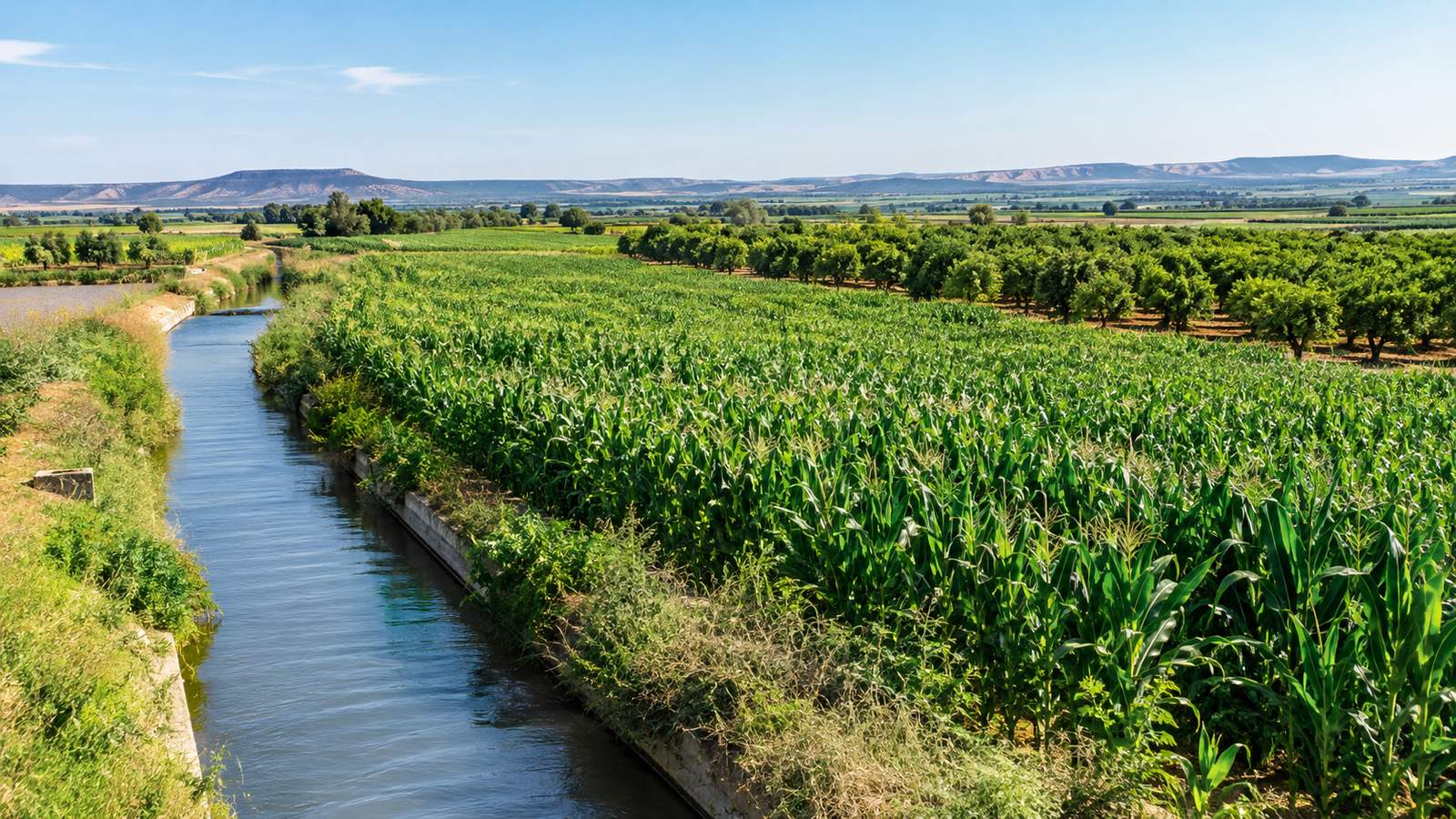
They stretch along the Guadiana between Mérida, Montijo, Don Benito, Villanueva de la Serena and Badajoz, irrigated by canals built in the 20th century.
The origin of the irrigation
The Vegas del Guadiana are the result of the Plan Badajoz, the great transformation to irrigation begun in the second half of the 20th century from the reservoirs of Orellana, García de Sola, Zújar and Montijo, among others. The main canals feed the irrigation communities, which distribute the water to each plot. The Guadiana River Basin Authority is the authority that grants and oversees water rights.
This explains why land here is not valued like dryland: the irrigation right, the infrastructure and a much larger and more stable annual production are added to the price of the soil.
What is grown
- Processing tomatoes, maize and rice.
- Stone fruit and almond.
- Intensive and super-intensive olive groves (see olive groves).
The processing tomato of the Vegas supplies much of the region's canneries and the rice of Vegas Altas has its own designation of origin. In recent years super-intensive olive groves and stone fruit have gained area because of their higher value per hectare. When valuing an estate, ask which rotations have been done and which delivery contracts exist, because they condition income in the first years.
The most important thing: water
Check membership of the irrigation community, the annual allocation and that there are no debts. Read water on rural estates.
In practice, this means asking for three things before buying. First, the booklet or registration of the plot in the irrigation community, with its recognised annual allocation. Second, a certificate of being up to date with fees: the community's debts can go with the estate. Third, the state of the intakes and connections, because a plot with a water right but without an intake in good condition needs investment. In drought years the allocation can be reduced by decree of the River Basin Authority, something to take into account in forecasts.
Soils and drainage
Not all irrigated land is the same. The best soils are the loamy, deep ones of the lower vegas; in some areas there are problems of salinity or a high water table that require drainage. Ask about the plot's history, look at the yields declared in the PAC and, if the investment is large, commission a soil analysis before signing.
Prices
In the catalogue there are irrigated estates from 1,9 ha for 85.000 € up to large farms worth several million. Far above the regional median.
The range is wide because a small tomato plot is not the same as a super-intensive olive farm in production. As an internal reference, Extremaduran irrigated land sits well above the 23.000 €/ha median of the farmland estates in the catalogue, and the best land with consolidated rights clearly exceeds that figure.
Current leases
Many irrigated estates are sold leased, because irrigated land rents are among the highest in the Extremaduran countryside. A current rural lease is transferred with the estate: check the contract, the rent, the duration and who the tenant is before buying, and if your plan is to farm it yourself, make sure the contract ends when you need it to.
Other checks
- Installations: hydrants, drip irrigation, reservoirs.
- Current leases.
- PAC.
Add to that the review of the nota simple and SIGPAC to confirm area and boundaries, and the energy cost of irrigation: pressurised drip uses electricity or diesel and is a major item in the farm accounts.
The annual costs of irrigated land
Irrigated land produces a lot, but it also costs a lot to maintain. The usual items are the irrigation community fee (per hectare and per consumption), pumping energy, inputs (seed, plant-protection products, fertiliser), labour for the seasons and maintenance of the drip network and reservoirs. Before buying, ask for the farm accounts of recent years or, at the very least, the community's and the cooperative's receipts: a beautiful estate with bad accounts is a bad purchase.
The PAC weighs heavily on profitability: the basic payment entitlements of an irrigated estate with a track record are an asset that must be recorded in writing in the sale.
A note on the towns
The district lives from the countryside and for the countryside: Don Benito and Villanueva de la Serena concentrate cooperatives, canneries, warehouses and services, and Mérida provides administration and hospitals less than an hour away. Buying close to these centres makes the hectare more expensive but makes staff, spare parts and shipping of goods easier.
Who buys in the Vegas
The typical buyer is a local farmer expanding, an agri-food company or an investor who leases to established farms. Sale times are faster than for dryland because there is stable demand, but the price requires justifying production: yields, contracts and documented water. If it is your first purchase of irrigated land, rely on an agronomist or on the irrigation community itself to read the numbers properly before signing.
Drought and the future of water
The water of the Vegas depends on the reservoirs of the Guadiana and its tributaries, and dry years bring allocation reductions announced by the River Basin Authority. It is not a reason to rule out the area (its reservoirs are among the largest in Spain), but it is a reason to scrutinise two things: the recognised allocation of the plot and its priority, and whether the estate has the support of legal wells to complete irrigation in bad years.
Irrigation modernisation (replacing gravity with pressurised drip) improves efficiency and can give access to subsidies; ask whether the estate's irrigation community has projects under way or pending fees for those works.
The visit: what to look at on the ground
On the visit it is worth seeing the estate with irrigation running if possible: you can spot leaks, waterlogged areas, blocked drippers and uneven ground. Also look at the internal tracks (harvest logistics are daily in irrigated land), proximity to industrial estates or canneries and the state of the margins against flooding of the river or the canals.
In Cáceres, the equivalent area is the Campo Arañuelo; compare them in Cáceres or Badajoz.