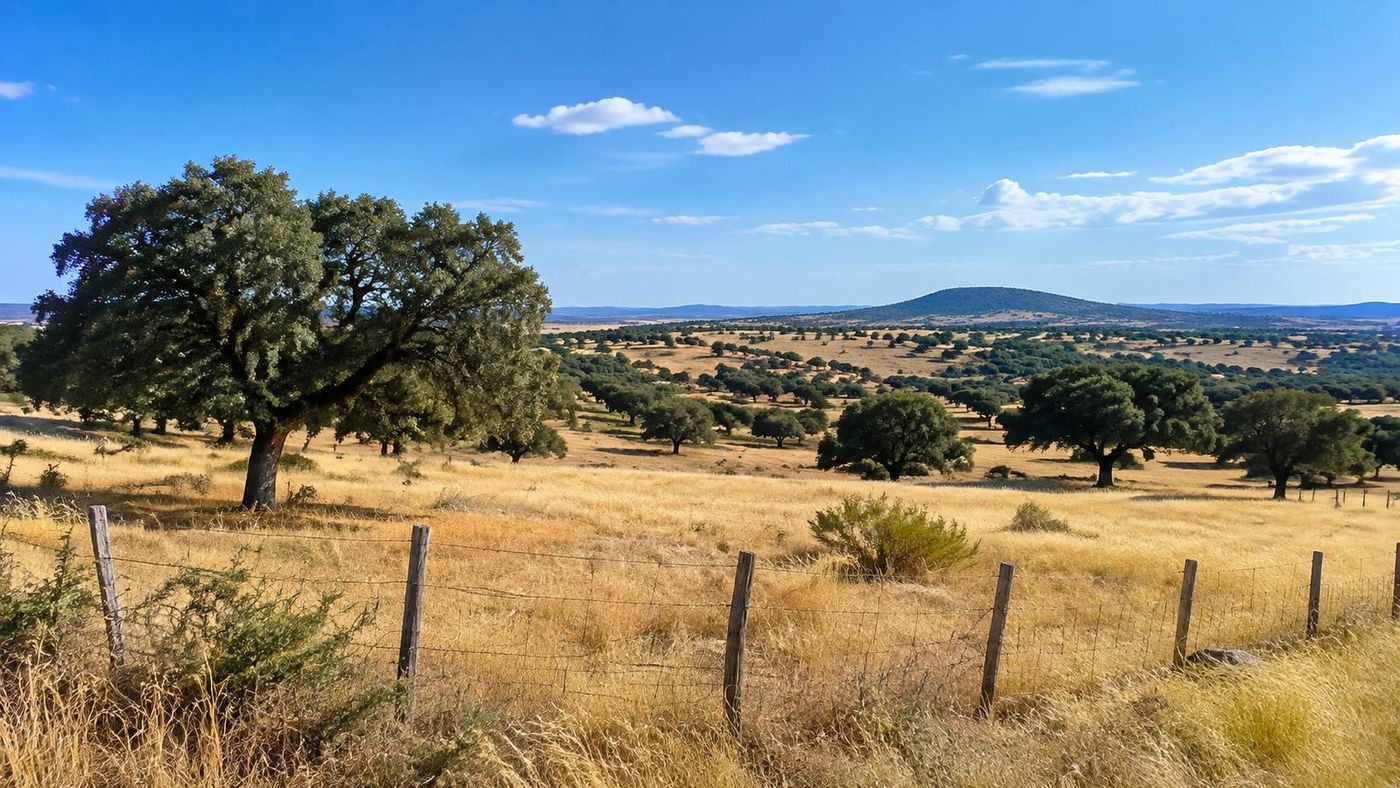
Price depends mostly on use, not on province
When people talk about the price per hectare in Extremadura, very different estates get mixed together. A 400 ha dehesa for cattle and a 2 ha plot with a house and swimming pool are not valued the same way, even though both are "rústica" (rural) land. In our October 2026 catalogue, the difference between uses is far bigger than the difference between Cáceres and Badajoz.
| Type of estate | Listings | Median €/ha |
|---|---|---|
| Dehesa and livestock | 69 | ≈ 7.500 € |
| Hunting | 8 | ≈ 5.300 € |
| Forest and plots | 5 | ≈ 5.200 € |
| Farmland (olive groves, irrigated land, fruit trees) | 44 | ≈ 23.000 € |
| Leisure and tourism | 35 | ≈ 84.500 € |
By province, the median is higher in Badajoz (about 12.500 €/ha) than in Cáceres (about 10.000 €/ha), mainly because Badajoz has more irrigated farmland in the Vegas del Guadiana and more leisure estates in its northern half.
Why we use the median and not the average
The arithmetic average is distorted by two or three extreme listings: a 2.000 ha estate at 3.500 €/ha or a plot with a villa at 90.000 €/ha moves the average without representing the market. The median is the value that leaves half of the listings above and half below, and it better describes what you will actually find. Even so, within each type of estate there is a lot of dispersion: two neighbouring dehesas can differ by 50 % because of water, the state of the fences or the quality of the trees.
Why large estates are cheaper per hectare
The price per hectare falls as the estate grows. A dehesa of more than 100 ha normally sits between 3.000 and 10.000 €/ha, while estates of less than 5 ha can exceed 20.000 €/ha if they have water, electricity or a building. When comparing, always look at estates of a similar size.
- Less than 5 ha: the price is driven by residential or leisure use. Comparing them per €/ha with large estates makes no sense.
- From 5 to 50 ha: middle ground; water, proximity to a town and whether there is a building weigh heavily.
- More than 100 ha: bought by livestock farmers, companies and investors; €/ha is the central figure and it is negotiated on return.
What raises the price of a rural estate
- Its own water: legalised wells, boreholes, ponds or a stream that does not dry up in summer.
- Irrigation with a concession: in the Vegas del Guadiana or the Campo Arañuelo it multiplies the value of the land.
- A legal house and mains electricity.
- Productive trees: holm oaks with acorns for montanera, cork oaks with cork, olive groves in production.
- Access by paved road and proximity to Cáceres, Mérida, Badajoz or Plasencia.
And what lowers it
It is also worth knowing the factors that drag the price per hectare down, because they explain most of the "bargains":
- Proindivisos (undivided shares): a percentage of the estate is sold, not a delimited plot, and that is worth much less.
- No road access or a complicated right of way.
- No water in summer, which forces you to bring in tankers for the livestock.
- Diseased or burnt trees: oak decline (la seca) and fires remove decades of production.
- Encumbrances, current leases or ceded rights of use (montanera or cork sold in advance).
The listing price is not the purchase cost
You have to add the costs of the transaction to the price per hectare. On a second-hand estate in Extremadura, the ITP (transfer tax) is set in brackets (8 % up to 360.000 €, 10 % up to 600.000 € and 11 % above that), plus notary, land registry and administrative agent. On a 300.000 € dehesa, costs are around 27.000-30.000 €, that is, about 100 € more per hectare on a 300 ha estate. Always calculate the total cost per hectare, not just the cost on the deed. Our guide to the steps and taxes when buying breaks it down.
How to use this data to negotiate
Before calling an advertiser, calculate their €/ha and compare it with estates of the same use and size. In our search tool each listing shows it, and we mark with "Good €/ha" those that are clearly below their bracket. If an estate is 20 % above the median of its group, ask them to justify the difference: sometimes a new well or a legal house explains it, and other times it is simply a trial price that allows negotiation. Listings of large estates have often been online for months and sellers accept reductions; your target €/ha is your best argument.
An honest warning
This data comes from asking prices, not closed deeds, and from a specific catalogue in a specific month. Take it as a starting reference, not as a valuation. For a serious transaction, commission a valuation from an expert appraiser or an accredited valuation company, especially if you are going to apply for financing (see mortgages for rural estates).
What the official statistics say
The Ministry of Agriculture publishes the land price survey every year, which collects average prices of real transfers by province and type of crop. Official average land prices in Cáceres and Badajoz are usually below asking prices, because deeds include many transactions between relatives, large dryland estates and sales without an intermediary. The practical reading is twofold: the official figure helps you spot inflated listings, and the listing figure tells you what sellers are asking today. If there is a big gap between the two, there is usually room to negotiate.
Buying land is not automatically buying a return
A low price per hectare does not guarantee a good investment: a dehesa at 5.000 €/ha with no water, no PAC and diseased trees can yield less income than one at 8.000 €/ha with a montanera contract and cork in its cycle. Before deciding, estimate the annual income per hectare (livestock, montanera, cork, PAC, hunting) and work out what gross return the asking price implies. Well-managed dehesas usually deliver modest but stable returns; anyone expecting the return of a rental flat will be in for a surprise.
Keep reading
Water and trees are the factors that move the price most: read water on rural estates, montanera and cork. Before buying, review the buying steps.