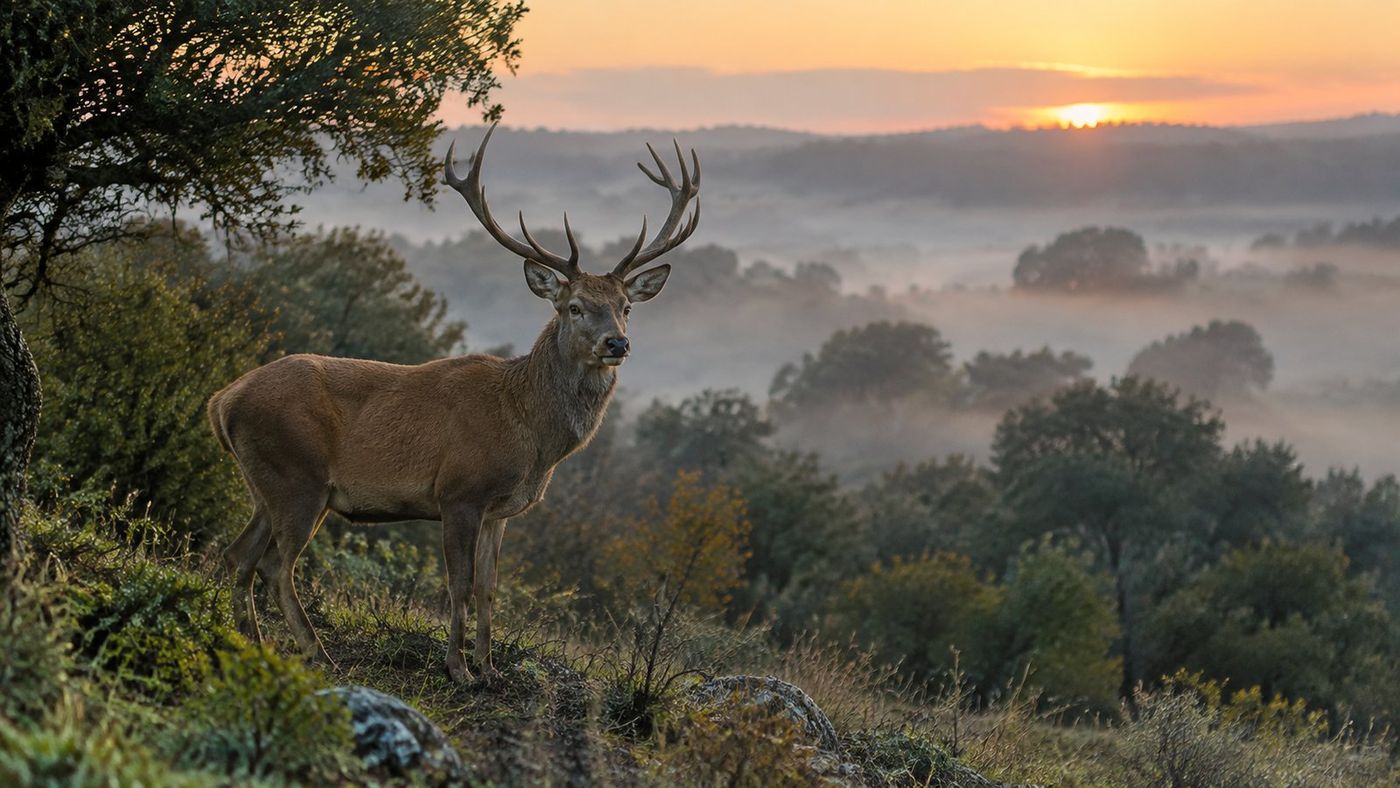
Extremadura is one of Spain's great hunting regions. Many estates combine livestock and hunting, and some are bought only for monterías.
Big game and small game
Big game (deer, wild boar, fallow deer, mouflon) requires area and woodland; small game (partridge, rabbit, hare) suits more open estates such as those in La Serena.
Big game looks for dehesas with low woodland, scrub and water, normally from 300 ha upwards when you want a serious hunting ground, although there are societies and groupings that add up neighbouring estates. Small game needs less area but more management: crop residues, sheltered edges, drinkers and predator control. Many estates combine the two types, and that multiplies their value and income potential.
How a hunting ground is managed
Hunting use in Extremadura relies on the technical hunting plan, a document approved by the regional administration that sets which species are hunted, in what quotas and with what management measures. The hunting ground has a holder of the hunting rights (who may not be the owner of the land) and each season a report with the results is submitted.
When buying an estate with hunting, it is not enough for the listing to say "coto" (hunting ground): ask for the current technical plan, the reports of the last seasons and who holds the hunting rights today. If there is a hunters' society with a contract, that relationship travels with the estate until it expires.
Monterías: the economic engine
The montería (driven big-game hunt) is the main source of income of Extremaduran big game. They are organised by stands, with a secretary, hound packs and a line of beaters, and the price per stand varies enormously depending on the fame of the hunting ground, the quality of the stags and the organisation: from moderate amounts in simple hunting grounds to high figures on estates with a track record and medals. An established hunting ground can hold several monterías per season and complete its income with roe deer and stalking.
If you are buying to exploit the hunting, the key question is what real results the estate has produced in recent years, not what it "can produce". Animals taken, medals and authorised quotas are in the reports.
Small game
The red-legged partridge is the queen of small game in Extremadura, with forms such as driven shoots, decoy hunting and walked-up hunting with dogs; turtle dove, thrush, hare and rabbit complete the calendar. Small-game estates sell less often, but their management (releasing partridges, feeders, safety at the stands) is more intensive and must appear in the technical plan.
What to look at
- Whether the estate is its own hunting ground or forms part of another.
- Current technical hunting plan and quotas.
- Hunting fencing and its condition.
- Water and feeders.
- Results of the latest monterías.
- Restrictions from protected areas.
Hunting in protected areas
Hunting is allowed in a large part of the Extremaduran Natura 2000 sites, but hunting management can carry additional conditions: temporary closures, restrictions on releases or limits on new infrastructure. If the estate is within a protected area, read its management document and consult the Natura 2000 guide before planning investments.
Hunting fencing
Hunting mesh fencing (about two metres high) is a considerable investment per kilometre of perimeter and a legal and management decision: full fencing conditions the management of the hunting ground and requires measures such as crossings and density management. Check the real state of the fence on the visit (knocked down by wild boar, stream crossings) because rebuilding it is a major item.
Reference areas
For big game, Monfragüe and Villuercas-Ibores, the Sierra de San Pedro and the hills of northern Badajoz stand out; for small game, the plains of La Serena and Tierra de Barros. The best-placed estates with a track record barely reach the open market; in the catalogue you can filter by "Hunting" and see those available with their €/ha.
Staff and security
A serious hunting ground needs a warden all year round, not just in season: estate security, poacher control and care of feeders are continuous work. Third-party liability insurance for the hunting activity and for each montería is not optional.
The annual costs of the hunting ground
Warden or wardens, feeders and drinkers, supplementary feed, maintenance of tracks and fences, hunting insurance, renewal of the technical plan and administrative procedures: a serious hunting ground has an annual expense account that you need to know before valuing the purchase. Ask for the accounts as you would for those of any business.
Hunting and livestock: the Extremaduran combination
Most of the large Extremaduran hunting estates are also livestock estates: beef cattle, Iberian pigs in montanera or fighting bulls in some areas. The combination spreads risk and keeps the dehesa in good condition, but it requires management: livestock competes with deer for pasture in dry years and hunting feeders must be designed so as not to spread disease. An estate that shows years of well-done joint management is worth more than the sum of its parts.
The purchase process for a hunting estate
Besides the general checks of any estate (nota simple, Cadastre and SIGPAC), a hunting purchase adds its own: ownership and validity of the hunting rights, contracts with societies or groupings of neighbouring hunting grounds, rights of way from other estates to their hunting grounds and the situation of the stands and fences. After the purchase, the change of holder of the hunting rights is notified to the administration, so it is worth planning for it in the calendar of the deal.
Prices
The median of hunting estates in the catalogue is around 5.300 €/ha, with estates of 250 to 1.500 ha. Filter them by "Hunting".
Estates with their own hunting ground and a good track record are often sold outside the portals, among people in the sector. If you are looking for something specific, it is worth working through hunting societies and brokers as well as looking at listings.
The price rises with the fame of the hunting ground, fencing in good condition, the houses and montería lodges and the combination with quality dehesa for livestock and montanera. An estate with good hunting and livestock numbers at the same time is the most sought-after asset in the Extremaduran countryside.