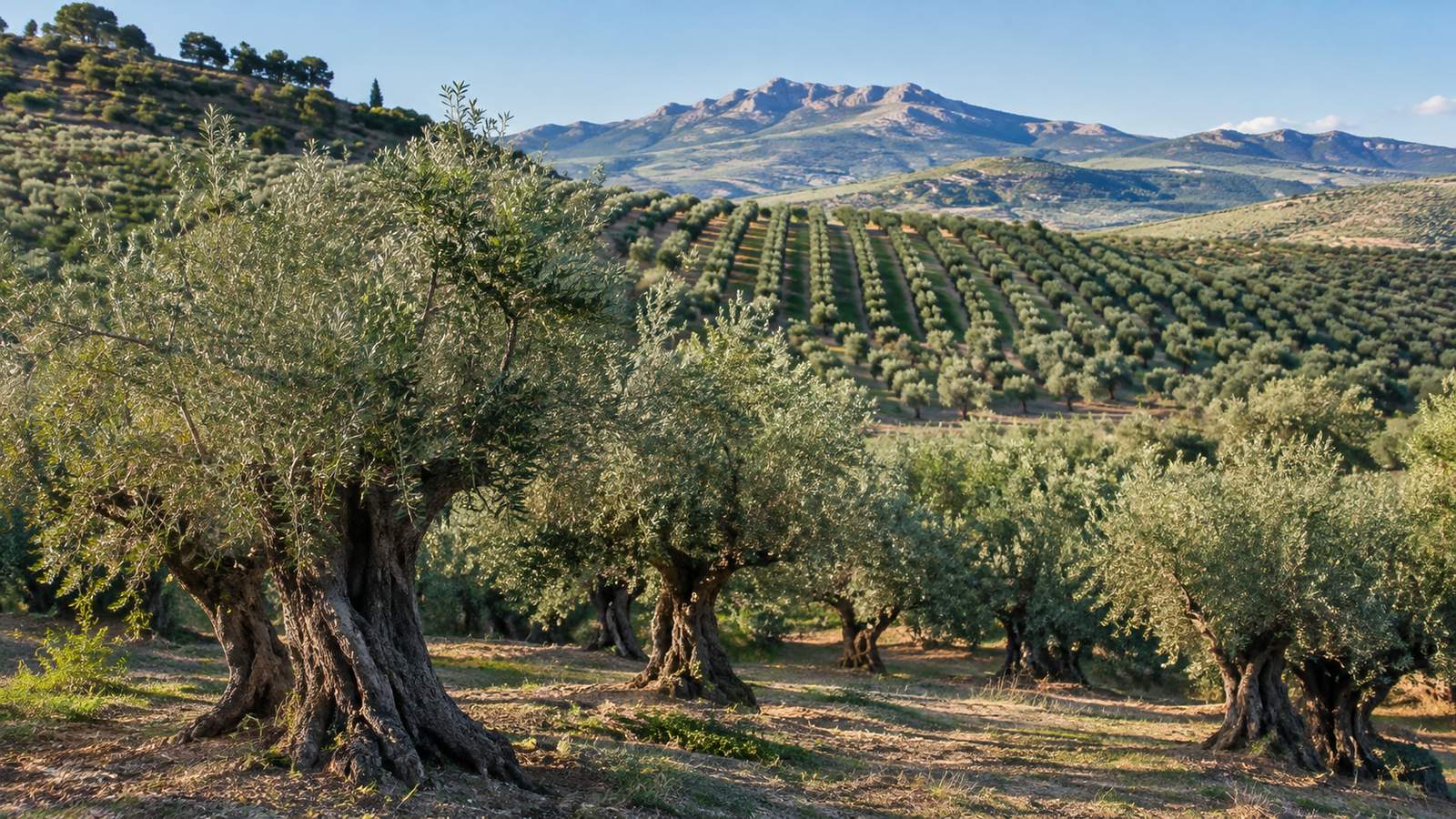
All three systems coexist in Extremadura: old dryland olive groves in the Sierra de Gata and Tierra de Barros, and intensive and super-intensive ones in the Vegas del Guadiana.
Traditional olive grove
Few trees per hectare, often centuries old. Less production and higher harvesting costs, but good landscape and low purchase cost. It suits someone looking for a cheap estate or a leisure estate.
The planting frame is wide and harvesting is done with poles and shakers, with a lot of labour per kilo. In return, the traditional grove holds up without irrigation, lives for decades and keeps local varieties highly valued for quality oil. It is the system that requires the least investment on entry and the one that yields least per hectare in bad years.
Intensive olive grove
Higher density, usually with drip irrigation and allows part of the harvest to be mechanised.
It is the intermediate step: tighter frames, productive varieties, supplementary irrigation and harvesting with shakers and umbrellas. It comes into production faster than the traditional one and labour per hectare falls considerably.
Super-intensive olive grove
Planted in a hedgerow, with irrigation and a harvester. High production from a few years in, but requires legal water and investment.
The hedgerow is planted with varieties such as Arbequina or Arbosana, comes into production very early and is harvested by machine in a few hours per hectare, which almost eliminates dependence on crews. Its weak points: it needs guaranteed water every year, the planting investment is high and the useful life of the hedgerow is shorter than that of a traditional olive grove.
The numbers, in a table
| Traditional | Intensive | Super-intensive | |
|---|---|---|---|
| Irrigation | Normally dryland | Frequent drip | Drip essential |
| Harvesting | Manual with shaker | Semi-mechanised | Harvester |
| Coming into production | Slow | Medium | Very fast |
| Initial investment | Low (already planted) | Medium | High |
Production per hectare varies a lot with the year, the water and the variety; as a prudent rule, the more intensive, the more average kilos, but also more annual fixed cost and more risk if water fails.
Varieties you will see in Extremadura
In old olive groves local varieties such as Carrasqueña, Corniche, Morisca and Manzanilla Cacereña predominate, well adapted to dryland. In new plantations Arbequina, Arbosana and other hedgerow varieties rule, geared to oil. The variety determines the destination (olive mill or table) and the price of the harvest: always ask.
Irrigating the olive grove: the delicate point
Turning a dryland olive grove into irrigated land is not just fitting drippers: irrigation of olive groves is subject to authorisation and to the availability of water in the basin, and in Extremadura there are limits on new allocations in certain areas. If your plan is to irrigate a dryland olive grove, confirm with the River Basin Authority and the irrigation community that the water is viable before paying an irrigated-land price for the estate.
Production and olive price
Olive production is alternate-bearing by nature: a good year is usually followed by a weak one, and the weather rules. The price of olives and oil is also very variable between seasons, with cycles that reward whoever has low costs and secure water. That is why buying an olive grove should not be done with the prices of the best season, but with a prudent average of several years and the olive mill receipts as proof.
Extremadura is one of the leading olive-growing regions of Spain by area, and its olive mills absorb both the dryland olives of the traditional districts and the increasingly large irrigated harvest. That guarantees an outlet for production in almost any part of the region.
Reconverting an old olive grove
A common operation is to buy cheap traditional olive grove and reconvert it: reinforce trees, graft varieties or uproot and replant as intensive or hedgerow. It is a legitimate way to create value, but it requires three checks: that legal water is available for the new system, that the soil and slope allow it, and that the investment numbers can withstand a few years without a full harvest. If one of the three is missing, the old olive grove should be bought at the price of an old olive grove.
What to ask
- Age, variety and planting frame.
- Average production over recent years.
- Destination cooperative or olive mill.
- Irrigation and PAC.
Add the health status (weevil, moth, tuberculosis in some areas), the treatments that have been applied and whether the estate is up to date at its cooperative. The olive delivery receipts of recent years are the best proof of real production.
The PAC and the olive grove
Basic payment entitlements and associated subsidies are a significant part of olive grove profitability, with particularities in the traditional olive grove because of its status as a woody crop. When buying, the entitlements must be transferred in writing and checked using the PAC guide: an estate without clear entitlements loses an important leg of its annual accounts.
Climate and the future of the crop
The olive tree is among the woody crops that best withstand heat, but prolonged drought punishes dryland and makes irrigation water more expensive. Districts with guaranteed water will tend to concentrate quality production; traditional dryland will remain viable in the hands of someone who buys cheap and manages with low costs. Buy with that horizon in mind, not with this season's oil price.
Labour and mechanisation
The availability of crews in the season is one of the limits of the traditional olive grove; that is why mechanisation decides so many purchases today. Ask what machinery the estate uses now and who works it: sometimes the tractor driver and his team are part of the real value of the farm.
Frequent mistakes when buying an olive grove
Confusing trees with production (an estate with many old olive trees can give fewer kilos than a well-planted one), paying an irrigated-land price for a dryland estate "with a well" that is not legalised, and not counting the full season of costs: pruning, treatments, harvesting and insurance eat a serious part of the income. The honest numbers of three seasons are worth more than any promise.
Which to choose according to your profile
For leisure or a second home with some production, the traditional one is the reasonable choice. For return with professional management and secure water, the intensive and super-intensive, especially near the Vegas del Guadiana or in Tierra de Barros.
More in Tierra de Barros.