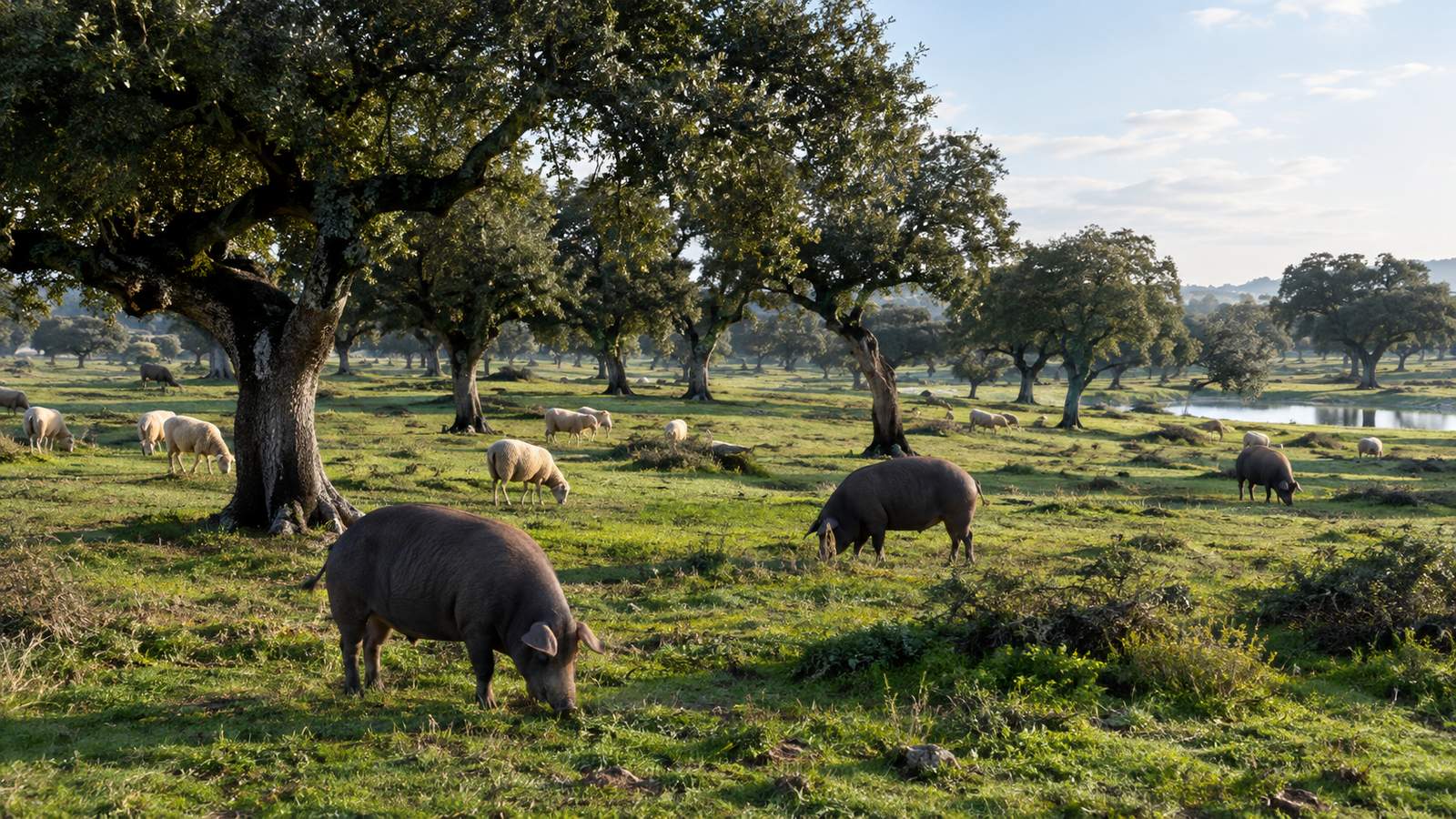
How a dehesa works
The dehesa combines trees, pasture and livestock. The oaks provide shade and acorns, the livestock keeps the pasture down and fertilises the soil, and people prune, clear scrub and regenerate the trees. It is an agrosilvopastoral system typical of the west of the peninsula, and Extremadura holds the largest area of dehesa in Spain: around a million hectares, according to the usual estimates of the sector. It is not an abandoned woodland: it is a managed estate, and its value depends precisely on how well it has been managed.
The dehesa calendar
- Autumn-winter: acorns fall and the montanera of the Iberian pig begins; it is also big-game hunting season.
- Winter: pruning of holm and cork oaks; firewood and charcoal as supplementary income.
- Spring: abundant pasture for cattle and sheep; scrub clearing.
- Summer: cork stripping in the cork oak woodland (see cork and cork oak woodland) and fire watch; water becomes critical.
Sources of income
- Montanera: the Iberian pig fattens on acorns in autumn and winter. The permitted stocking depends on each year's acorn production.
- Cattle and sheep in extensive systems, with fences to rotate pastures.
- Cork: cork oaks are stripped at least every nine years, which provides periodic income.
- Hunting, small or big game, if the estate is set up as a hunting ground.
- PAC subsidies tied to area and activity.
Return: what to expect
The return on a dehesa is the sum of several modest uses, not of one big one. Annual income per hectare varies a lot with the acorn season, the price of cork and hunting quotas, and most owners work with low but stable returns on the value of the estate, to which the PAC gives an important floor. Anyone buying a dehesa as a pure investment should do the numbers with the real track record of the estate, not with regional averages: ask for cork invoices, montanera contracts and PAC payment decisions for recent years.
How to tell whether a dehesa is good
- Density and age of the trees, and whether there is regeneration (young oaks).
- Water in summer: ponds, wells and streams.
- Fences and management: how many enclosures, cattle chutes, sheds.
- Farm registers and pig quotas, and PAC entitlements included.
- Oak decline (la seca): dry or diseased trees reduce value.
Oak decline, the silent problem
The "seca" is a decline of the trees associated with a soil fungus (Phytophthora) combined with droughts and intensive management. A dehesa with many dry or declining trees loses acorn production for decades, because replacing a mature oak takes generations. On the visit, look at the crowns of the trees: thin crowns, dry branches high up and shoots at the base are warning signs. Ask how many trees have died in recent years and whether there are replacement plantations protected from livestock.
The minimum management a dehesa requires
Buying a dehesa means maintaining it: periodic clearing of scrub (also for fire prevention), pruning, fence repair, pond cleaning and control of regeneration. If you are not going to run it yourself, budget for a warden or a service company, or grazing agreements with local livestock farmers, who in exchange for the pasture keep the estate in order.
Reference price
In our catalogue, the median of dehesas for sale in Extremadura is about 7.500 €/ha, with large estates below 4.000 €/ha (details in prices per hectare). Dehesas with good oak woodland, water and cork sit above that; those on poor hill land or with access problems, below. To value a specific one, also check the registry documents and SIGPAC.
The dehesa and the protected landscape
A good part of the Extremaduran dehesas lies within Special Protection Areas for Birds (ZEPA) or other Natura 2000 sites, precisely because their extensive management supports steppe birds and dehesas of great ecological value. This does not prevent livestock farming - in fact it protects it - but it can limit ploughing up, irrigated plantations or infrastructure. If you are looking for a dehesa to convert to intensive cultivation, first check the limitations: in many areas it is not allowed.
Buying a dehesa: on your own or with a livestock farmer
An increasingly common formula for those who do not want to manage: buy the dehesa and reach agreements with local livestock farmers for grazing, montanera or cork stripping, collecting rents and delegating the management. It works well if the estate has water, fences and access; it works badly if it is isolated or degraded. Ask locally before buying: in livestock areas such as Trujillo, La Serena or the Sierra de San Pedro there is demand for leases; in others, almost none.
The dehesa compared with other land uses
Compared with an intensive olive grove or irrigated land, the dehesa requires less initial investment and less water, but it also generates less income per hectare and takes years to respond to improvements in management. Its strength is diversification: acorns, cork, hunting, pasture and PAC balance each other out between good and bad years, and the asset value of well-kept land has historically held up. It is a conservation and long-term investment rather than a quick-return one.
Questions to ask on the visit
- How many hectares of trees are there and what is the average density of trees per hectare?
- How much acorn did the last good season produce and how many pigs entered montanera?
- What cork was taken in the last stripping and at what price?
- Are there ponds that last through August and legalised wells?
- Which use contracts (montanera, hunting, pasture) are in force and until when?
- Which PAC entitlements does the farm have and are they transferred with the sale (see PAC when buying)?
A dehesa whose owner answers with invoices and contracts is a well-run dehesa; vague answers often hide years of neglect that are later paid for in scrub clearing, fences and lost trees.
The dehesa as an asset
Beyond the annual income, the dehesa is a scarce asset: new dehesas are not made, the total area is protected and demand from livestock farmers, hunters and investors is constant. That explains why its price per hectare has stayed stable compared with other rural uses. For anyone buying with the long term in mind, the keys are always the same: water, healthy trees, access and clean paperwork.