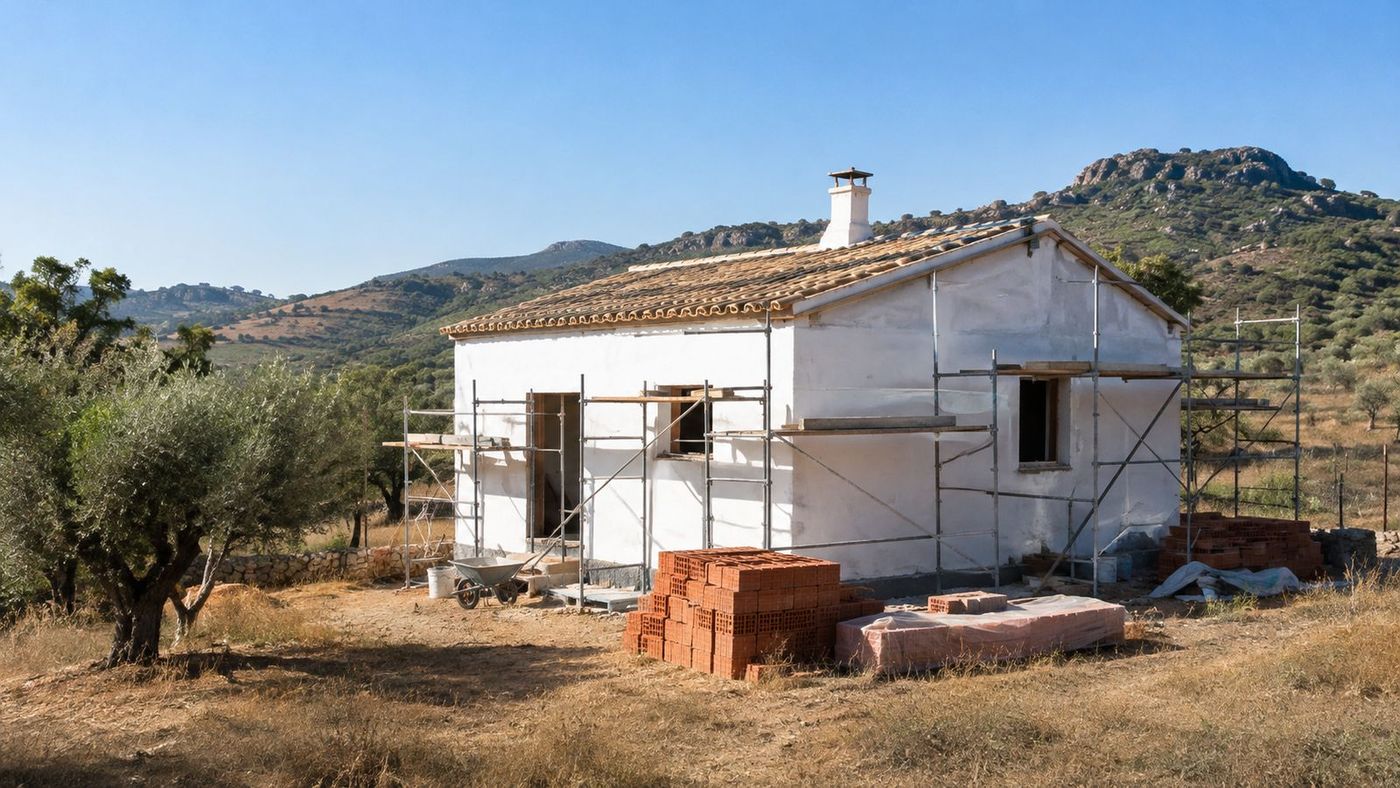
What decides whether you can build
- The class of land: protected rural land (for environmental, landscape or risk reasons) usually prohibits housing.
- Municipal planning: general plan or subsidiary rules, which set the minimum plot and the buildable area.
- Law 11/2018 on sustainable territorial and urban planning of Extremadura (LOTUS) and its implementing rules.
- Sectoral protections: Natura 2000, watercourses, roads or livestock routes.
Ordinary rural land versus protected rural land
The first fork in the road is the land category. On ordinary rural land, municipal planning may authorise housing linked to a farm or, in some municipalities, an isolated house with requirements on minimum plot, occupation and setbacks. On protected rural land - for natural or forest values, watercourses or flood risk - housing is in practice prohibited except for very narrow exceptions. Two neighbouring estates can be in different categories: that is why a listing saying "possibility to build" is worth nothing without a municipal document.
Houses already built: check that they are legal
If the estate already has a house, confirm that it appears in the deed and in the Cadastre, that it has a licence or that the infringement has expired under the statute of limitations. An undeclared house can block the mortgage or lead to penalties. In practice there are three situations:
- Legal house: appears in the deed and Cadastre with a consistent area. It is the only one you can mortgage and renovate without risk.
- House declared in the Cadastre but not in the deed: common; a new build can be declared before a notary and noted in the Registry, if it predates the planning limitation period.
- Completely hidden house: high risk of a planning enforcement case; negotiate the price assuming it might never be regularised.
Sheds and tool huts
Buildings linked to the farm (sheds, stores, huts) usually have fewer requirements than a house, but they also need a licence and cannot be used as a home. Turning a hut into a home "in fact" is the most common infringement on leisure estates: if you buy it like that, the risk becomes yours.
What to ask for before paying arras
A planning certificate or report from the town council with the land classification and permitted uses, and the exact cadastral reference. If the listing says "buildable", ask them to prove it in writing. Specific questions worth asking the municipal technician:
- Is the plot on ordinary or protected rural land, and is there any additional protection?
- What minimum plot does the planning require for a house or for agricultural buildings?
- Is there any enforcement case open on buildings on the estate?
- What minimum distance to watercourses, public tracks and livestock routes applies?
The report is usually free or carries a modest fee and takes from days to a few weeks depending on the municipality. In small villages, the municipal secretary is a very direct source of information.
Prefabricated houses, mobile homes and campervans
Installing a prefabricated house or a "tiny house" does not get around the rules: if it is anchored to the ground or used as a permanent home, it requires the same licence as a traditional building. Mobile homes without foundations occupy a grey area that town councils interpret differently; do not buy an estate counting on that legal gap.
If you already own the estate and want to build
The normal path is: prior consultation with the town council, a project by a technician (architect or engineer), building licence, execution, declaration of new build and final certificate. Real timelines in small municipalities are usually long, so plan with months of margin. And if what you want is a ready-to-use house, it is usually cheaper to buy an estate with an already legal house: in the search tool, filter by "With house" and compare with the figures in price per hectare.
Related: what to look at in a leisure estate with a house and Natura 2000.
The difference between building and renovating
A nuance that changes whole deals: renovating or extending an existing legal house is much simpler than building from scratch. That is why an estate with an old cortijo, even a ruined one, can be worth more than a clean estate where the planning allows nothing. If the house exists in the deed and Cadastre, you can normally rehabilitate it respecting use and volume; if it never existed, you start from the land classification, which is where almost everything is decided.
What happens if you build without a licence
The town council can open a case to restore legality, which on protected rural land can end in a demolition order, as well as a fine. Limitation periods exist but they are not insurance: on protected land, serious infringements may never expire, and even when the infringement has expired, the building remains outside the planning order, without full access to renovation licences or, often, to new utility connections. Before buying an estate with a house that "has been there all its life", ask the town council in writing whether any case is on record and what planning status it has.
Electricity, water and sewage: the other half of the problem
Even with a building licence, a house on rural land needs to solve services that are taken for granted in a village. Connecting to the electricity grid can cost thousands of euros if the nearest pole is far away (many opt for solar panels: see solar on estates). Water usually comes from your own well or borehole, which must be legalised (see water on estates), and sewage is solved with an authorised septic tank. Add these costs to the house budget: they are not small.
How long the paperwork takes and what it costs
As an order of magnitude, the municipal planning report can take from a few days to several weeks, drafting a basic project by a technician carries a professional fee that should be budgeted in advance, and the building licence in small municipalities can drag on for months when it needs sectoral reports (environment, roads, river basin authority). The IBI on the building, the licence fee and the construction tax add to the budget. Anyone who buys an estate "to build their own house" should count, between project, licences, utilities and works, on a timeline of years, not months, and on a financial cushion for the surprises of the land.
The question to ask before buying
It is not "can you build on rural land?" but "can you build what I want on this specific plot?". Only the municipal planning applied to that cadastral reference gives the answer, in writing. Everything else - the listing, the agent, the neighbour - is opinion. Buying with the planning report in hand is the difference between a project and a gamble.
If the estate is in a protected area, also read Natura 2000, and to rent it to tourists, rural tourism.