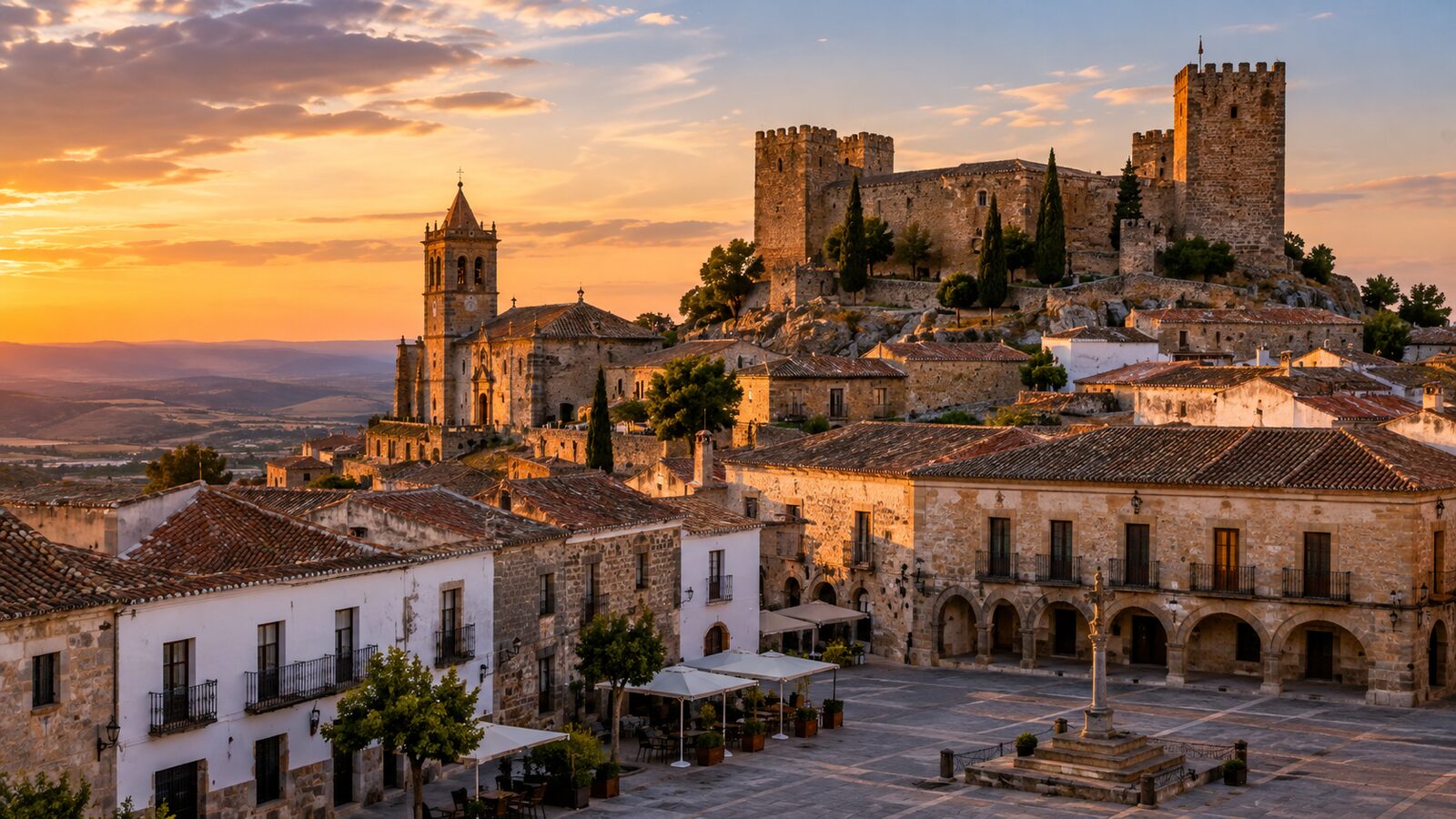
What the 1962 declaration says
Decree 2223/1962 of 5 September declared the urban ensemble of Trujillo a historic-artistic monumental city (BOE of 7 September 1962). The text highlights the ensembles within the Roman and medieval walls, the streets and squares that form the outline of those walls and the squares of San Marcelo, del Ayuntamiento, Mayor and San Marcos.
The special protection plan
The Urban and Territorial Planning Commission of Extremadura definitively approved, by resolution of 2 November 2005, the Special Protection Plan of the Historic Ensemble of Trujillo. Its planning rules include a title of general rules with volume conditions and hygiene-sanitary conditions, among others. If you plan to buy a house inside the historic ensemble, that plan is the document that regulates which works and which conditions apply, and you must consult it at the town hall before buying and before renovating.
Protected town and surrounding countryside
The plan and the declaration concern the historic centre. The rural estates of the municipality have another regime: that of their land classification, that of the environmental designations that affect them and that of the municipal rules. Do not assume that a nearby estate has the same conditions as a house on the square. For the area, read estates in Trujillo and the Llanos de Cáceres and, if a nearby natural space interests you, Monfragüe and the estates around it.
What to check in a house in the historic centre
- Ask the town hall for the protection grade of the building and the permitted works.
- Check that the cadastre area and the registry area match the real one.
- Ask about grants or licences linked to rehabilitation, which depend on each call.
- Hire an architect who knows the rules of Trujillo before signing a deposit contract.
- Calculate renovation costs with real quotes, not generic estimates.
What to check in an estate of the municipality
- Cadastral reference, registry extract and SIGPAC coherent. Read land registry extract, cadastre and SIGPAC.
- Access by public track or by easement, and the condition of the track.
- Water: legalised well, concession or mains.
- Constructions with title, and use permitted by the land.
- Environmental designations such as Natura 2000, in the guide to Natura 2000 and rural estates.
How to use the town in your search
Trujillo is useful for getting to know the area: talking to neighbours, seeing how people live and asking local professionals. Visit the district in more than one season, because a dehesa estate looks very different in spring and in midsummer. The guide to mistakes when buying a rural estate serves as a checklist before deciding.
Documents worth requesting
Buying the estate must rest on paperwork, not words. Request the up-to-date land registry extract, the cadastral record and the SIGPAC data, and compare them with each other. If the seller lacks any of them, ask them to obtain it before going further. To know what to look for in each document, read land registry, cadastre and SIGPAC.
Also ask about charges such as mortgages or attachments, and about rights of way or water easements. The guide to easements and boundaries helps you spot them, and the one on deeds and notary explains the final step.
How to visit the estate
One visit is not enough. Go in spring and summer, or in winter and autumn, and note what changes: water, pasture, mud on the track, noise and neighbours. Time the journey and check mobile coverage. Walk the boundaries with the plan in hand and take dated photos. Talking to local stockbreeders or farmers gives you information no listing includes.
Costs that do not appear in the listing
The purchase price is only part of the spend. Count the taxes on the transaction, notary, registry and administrative fees, and then the annual costs: property tax, insurance, maintenance and utilities. For the first block, see taxes when buying a rural estate; for the second, the maintenance calendar. Leave a margin for surprises and do not spend the whole budget at once.
Who to consult
Before deciding, talk to a local technician. For the purchase paperwork, find a lawyer experienced in local estates, and for licences and land use, ask the town hall in writing. Keep every answer. When one source contradicts another, do not pick the one that suits you: ask for written clarification.
Common mistakes
- Assuming that a designation, a crop or a famous landscape guarantees a good purchase.
- Not checking who the real owner is and what charges the estate carries.
- Accepting production or income figures without invoices or contracts.
- Budgeting only on the good year.
- Starting works or activities without a licence or without asking the administration.
The guide to mistakes when buying a rural estate expands the list.
Questions for the seller
Ask the seller concrete questions about the estate: how much the estate produces or yields, what part can be proven with invoices, what contracts it has and what aid it has received. Ask them to describe the two worst years they remember. Write down the answers and cross-check them with a neighbour or a technician. When something does not add up, do not let it pass: ask for clarification before committing a deposit.
Conclusion
Trujillo has official protection over its historic ensemble and a special plan that regulates works. That protection does not transfer to the estates of the countryside. Ask the town hall in writing, review the documents of each estate and do not take the fame of the town as a guarantee of anything in the purchase.