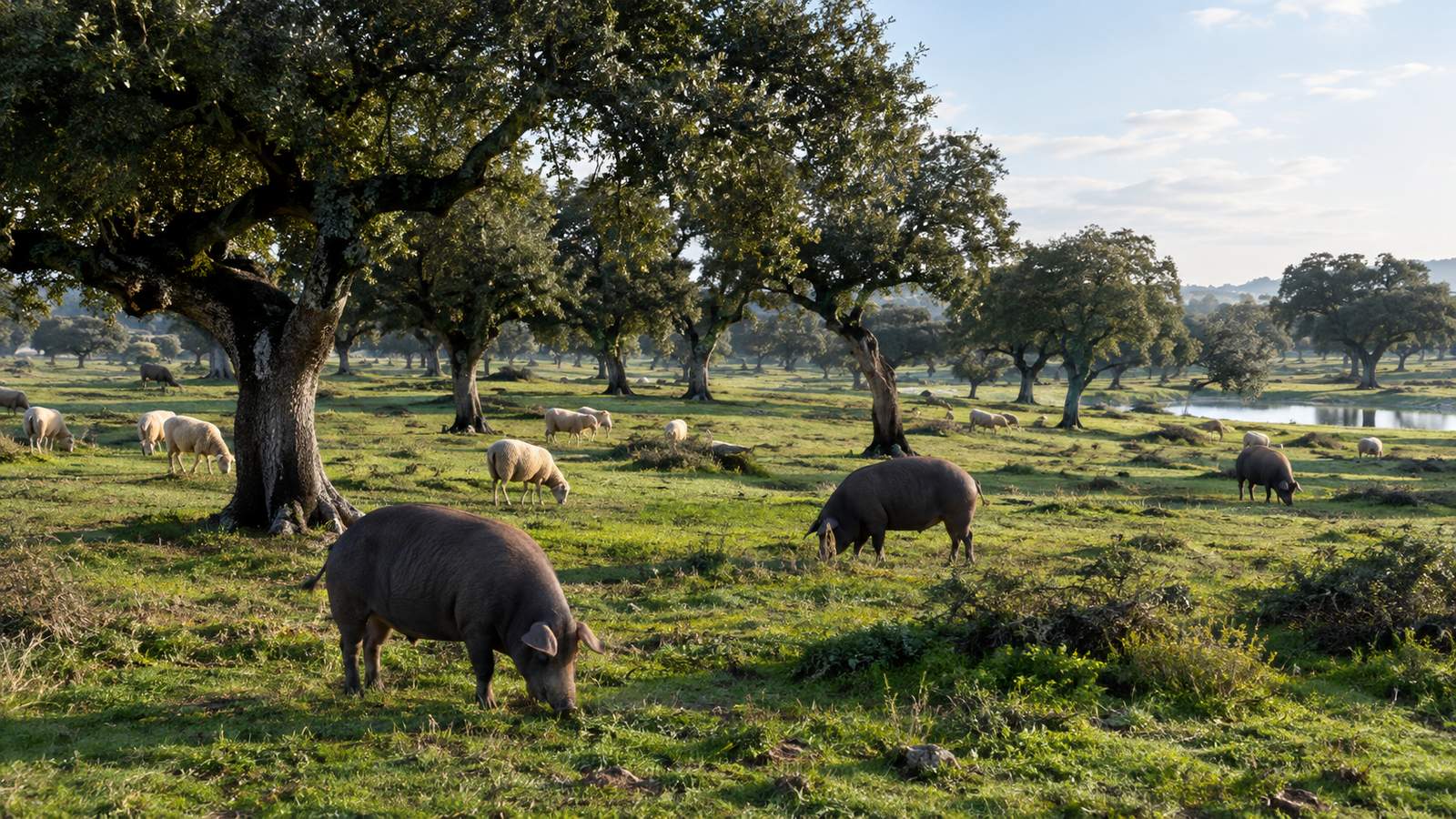
A district of dehesa and steppe
Between Cáceres city, Trujillo and Miajadas stretches a peneplain of poor soils, grasslands, holm oak dehesa and dryland crops. It is one of the most recognisable areas of the Extremaduran landscape: large estates with stone walls, ponds, scattered holm oaks, granite berrocales and flocks of sheep. The main centres are Cáceres, Trujillo, Santa Cruz de la Sierra, Zorita, Torrecillas de la Tiesa, Miajadas, Casar de Cáceres or Malpartida de Cáceres.
The district is well connected: the A-5 motorway joins Madrid and Extremadura and the A-58 connects Cáceres and Trujillo. This is an advantage for someone buying from outside, because Madrid is about two and a half or three hours by car, depending on the spot, and the cities of Cáceres and Mérida are close for services and market.
Which estates are sold
- Livestock dehesas of 100 to 600 hectares. Holm oak, some cork oak or pasture, sheep, extensive cattle, sometimes Iberian pigs. It is the star product of the area. If you do not know how it works, start with what a dehesa is and what return it can give.
- Pasture and dryland estates. Fewer trees, more pasture or cereal. They are cheaper and are usually bought by livestock farmers who already work in the area.
- Mixed estates with irrigation. Near Miajadas and irrigable areas there is the possibility of irrigation, which raises value, although it requires verifiable water rights.
- Hunting estates. Small game (partridge, rabbit, hare) and big game on more enclosed estates. See the guide to hunting estates and hunting grounds.
- Leisure plots near Cáceres and Trujillo. Small, with a house or hut. They are the most expensive per hectare.
Price: where it sits
According to our October 2026 catalogue, dehesas and livestock estates in Extremadura have a median around 7.000 € per hectare, and large estates are usually cheaper per hectare than small ones. The Llanos de Cáceres and Trujillo fit that logic: large dehesas at moderate prices, and notable rises when there is a house, water or proximity to the capital. Do not use the average as an offer: compare with estates of the same size and use.
What changes the price most in this district:
- Number and condition of the oaks, and whether they produce acorns for montanera.
- Enclosures, ponds and water points for livestock, in good condition.
- Presence of PAC entitlements linked to the farm (see the guide to PAC when buying an estate).
- Access tracks, electricity and the manager's house.
- Distance to a main road.
Steppe birds and environmental protection
Part of these plains is included in Natura 2000 as a special protection area for birds, with the presence of great bustard, little bustard, lesser kestrel and other steppe species. This does not prevent buying or farming the estate, but it can affect:
- New installations, power lines or photovoltaic parks.
- Changes of crop or ploughing up.
- Fencing, hunting fences or earth moving.
- Timing of certain farm tasks during nesting.
Before making an offer, ask in writing for a report on the environmental impact on the estate and see the guide to Natura 2000 and protected areas. If your plan includes solar panels, first read solar panels on a rural estate: in steppe bird areas the processing can be much more demanding.
Livestock and farm
If you are buying to farm, think about sustainable stocking rate. On poor-soil dehesas, excessive stocking degrades the pasture and the trees. Ask the seller how many head graze on the estate, of what species, since when and what supplementary feed they need in summer. Ask for the farm registers and check what part of the income comes from livestock and what part from subsidies. It is worth knowing whether the livestock, machinery and entitlements are included or sold separately, and putting it in the contract.
If you want Iberian pigs in montanera, the guide to montanera explains how many animals a dehesa supports and when acorn fattening begins.
Checks before making an offer
- Nota simple, Cadastre and SIGPAC, with matching area or the differences explained (guide).
- Rights of way, cañadas, livestock routes and public tracks that cross the estate, because they are common in this area. Review the guide to easements and boundaries.
- Current leases of pastures or crops, which may condition entry to the estate.
- State of wells and ponds and legalisation of water intakes.
- Status of the buildings: house, sheds, stables. Many are not registered.
- Possible encumbrances: high-voltage power lines, gas pipelines or renewable energy projects being processed.
Who it suits
The district suits livestock farmers looking to expand, buyers who want a large estate for family use and small-game hunting with good access, and prudent investors who understand that the income from a dehesa is modest and that part of the return is asset appreciation. It suits less well someone looking for intensive irrigation or someone who needs high yields from the first year.
How to compare with other areas
If you are torn between these plains and La Serena, which is cheaper and more sheep-oriented, see estates in La Serena. If you prefer Cáceres over Badajoz, the guide to Cáceres or Badajoz summarises the differences. And to understand the costs of the operation, go over the steps in how to buy a rural estate in Extremadura.