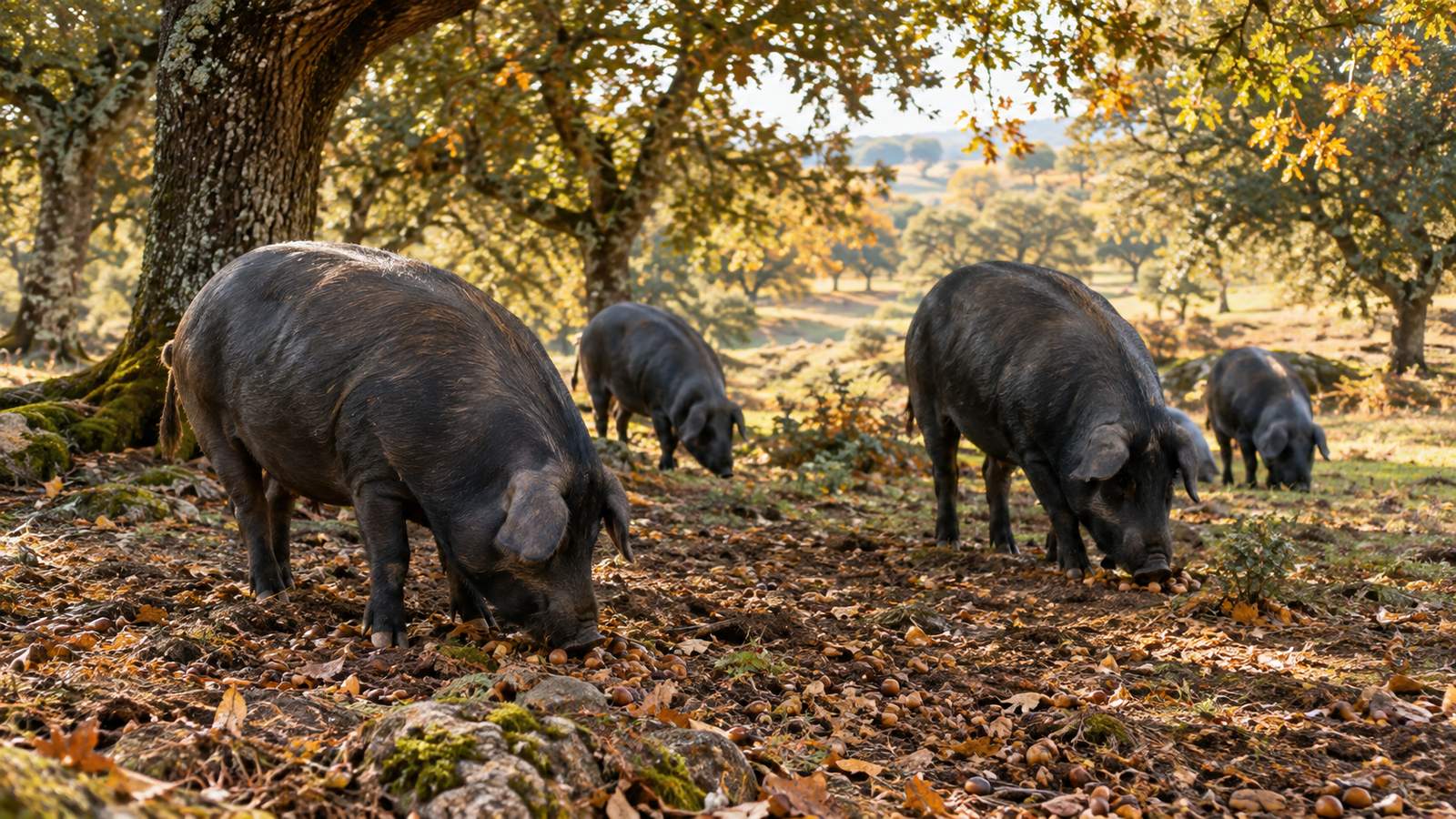
If you are looking for a dehesa in Extremadura, you will hear about montanera on almost every visit. It is the use that most sets the dehesa apart from other livestock estates and one of the reasons an estate with good oak woodland is priced above a simple grassland.
What exactly montanera is
It is the final fattening phase of the Iberian pig, in which the animal goes out into the dehesa and eats fallen acorns, grass and other natural resources. It begins when the acorns fall, normally between October and November, and ends when they run out, around February or March. The pig gains a good part of its final weight in those months, and that diet is what gives acorn-fed ham its characteristics.
The types of Iberian pig according to the standard
The Iberian quality standard (RD 4/2014) classifies the product by breed and diet, and it is worth knowing to understand what an estate can produce:
- Bellota 100% ibérico: 100 % Iberian parents and fattening in montanera on acorns and pasture. It is the top-category product.
- Bellota ibérico: crossbred (usually 50 % Iberian), also fattened in montanera.
- Cebo de campo ibérico: raised extensively but with supplementary feed, it uses pasture without relying only on acorns.
- Cebo ibérico: fattening in a feedlot on compound feed; it does not need a dehesa.
The standard also sets maximum stocking rates per hectare of montanera according to tree density and resources, to guarantee that the pig really feeds from the land. That is why an estate's capacity is not a fixed number: it depends on its trees and on each year's acorn season.
What an estate needs for montanera
- Productive trees: mature, healthy holm and cork oaks with a good crown. Acorn production varies a lot from one year to the next.
- Enough area: the Iberian regulations limit the animals per wooded hectare so that the acorns are enough. The real stocking depends on each year and each estate.
- Water in ponds, wells or streams. Read our guide on water on rural estates.
- Fences and management: enclosures for rotation, chutes and sheds.
- Farm register (REGA) in the owner's name, with capacity for pigs.
The calendar and the risk of the season
Acorns are a harvest and as such have good and bad years: frosts at flowering, droughts or the oak's natural alternate-bearing cycle (vecería) mean that some seasons support many pigs and others almost none. Anyone buying a dehesa for montanera should budget with prudent averages, not with the best year they remember. Local livestock farmers know this variability well: ask how many of the last five seasons were usable on that specific estate.
Leasing the montanera or running it yourself
Many owners do not raise pigs: they lease the montanera to local livestock farmers, who pay per season or per animal. It is a way to get income from the estate without owning livestock. If you are buying to invest, ask the seller how much was collected in recent seasons and ask for the contracts. If you prefer to run it yourself, you will need to register as a livestock farmer, hold the REGA, comply with animal welfare and health rules and, if you want the acorn-fed label, control and traceability under the Iberian standard.
How it affects the price of the estate
A dehesa with good trees, water and a pig register usually sells for more per hectare than one with only pasture or with old, sparse oaks. In our catalogue, the median for dehesas is around 7.500 €/ha (more in prices per hectare). Those that stand out for montanera are usually above that.
What to check on the visit
- Health of the trees: oak decline reduces production.
- Regeneration: protected young oaks that secure the future.
- History of montaneras and lease contracts.
- Associated PAC entitlements, explained in PAC when buying an estate.
The numbers to ask for
Montanera is valued with data, not adjectives. Before paying for an "acorn dehesa", ask for:
- How many pigs entered in each of the last five seasons and what was charged per head or per season.
- Current lease contracts: if the montanera is committed for several years, you inherit the contract.
- The farm's accounts if the seller is also the livestock farmer: costs of fences, water, warden and health checks.
- A map of the estate with the real wooded area, which is what determines the permitted stocking.
With those numbers you can compare the income from the montanera with the premium they ask for the estate and decide whether it is worth it compared with a simpler dehesa.
Montanera and designations of origin
Part of the Extremaduran dehesa falls under the Protected Designation of Origin "Dehesa de Extremadura", which certifies hams and shoulders from pigs raised and fattened in the region's dehesa under additional controls. For the owner, being inside the PDO production area can make it easier to place the montanera with livestock farmers who make certified product. It is one more point to ask about: if the estate has supplied acorns to PDO pigs in previous seasons, there is a track record and known buyers.
Frequent buyer mistakes
- Confusing "it has oaks" with "it has montanera": without water, fences and REGA, the oak does not turn into income.
- Valuing the estate with the best remembered season instead of the prudent average.
- Not checking whether the montanera of the coming years is already sold or leased.
- Forgetting that the season is short and maintenance is year-round: the estate must also be looked after from April to October.
Montanera in the life of the estate
Although it is the best-known use, montanera coexists with the rest of the management: the pasture the pig eats in autumn is the same that keeps cows or sheep the rest of the year, and winter pruning is planned with the crowns that will give acorns in mind. An estate designed for montanera is an estate with a complete management plan, not just oaks. Ask who has run it in recent years and whether that person (warden, tenant livestock farmer) would still be available after the sale: sometimes the real asset of the montanera is the local knowledge that comes with it.