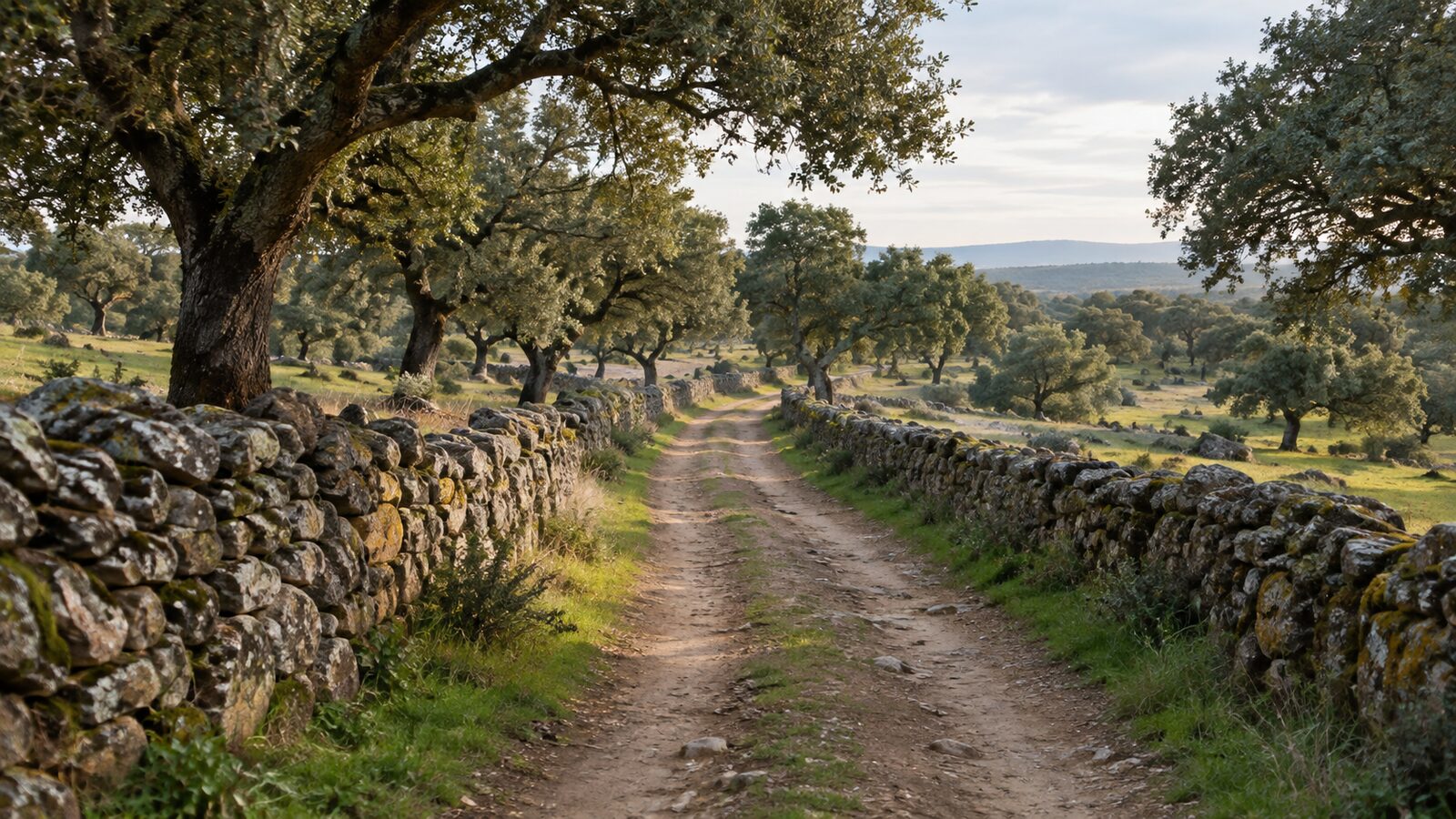
What a livestock route is
A livestock route (vía pecuaria) is a route or itinerary along which livestock traffic travels or has traditionally travelled. This is how Article 1 of Law 3/1995 of 23 March on Livestock Routes defines them; it sets the basic rules across Spain. They are the old transhumance paths along which flocks moved for centuries between winter and summer pastures. That is why, when looking at a pasture estate, it is worth asking whether a livestock route borders it or crosses it.
Cañadas, cordeles and veredas
The national law classifies livestock routes into cañadas, cordeles and veredas according to their width. For example, Article 4 defines cañadas as routes whose width does not exceed 75 metres. There are also other local names, such as cabañeras or azagadores. What matters to someone buying an estate is not the name, but whether the administration has classified a route in that area and with what width.
They are public domain
The law gives livestock routes the status of public domain assets, owned by the autonomous communities. In practice, this means they cannot be sold, are not acquired through the passage of time and do not become yours even if your estate surrounds them or they cross it. The autonomous community holds powers over them such as investigation, classification, boundary marking (deslinde) and boundary stone placement (amojonamiento). If the deed or the cadastre includes land that the administration considers a livestock route, consult a lawyer before buying.
In Extremadura
Law 6/2015 of 24 March, the Agrarian Law of Extremadura, is the regional law that applies in the community, together with the basic national rules. The Junta de Extremadura holds the competence over them. If your question is specific, the reliable source is the competent administration: the relevant department of the Junta can tell you whether a livestock route is classified, delimited or marked with boundary stones in the municipality where your estate is.
Why it matters when buying
- You cannot fence or close off a livestock route, even if the estate is yours and the fence was already there.
- Livestock may pass through part of the estate, if there is a livestock route.
- The real usable area may be smaller than the one stated in the deed, if part of the estate is a livestock route.
- It may affect subsidies, crops and buildings located on the route.
- A seller may not know, especially if they inherited the estate and have always seen it fenced.
How to check whether there is one
- Ask the seller whether any livestock track touches the estate and whether there are old fences cutting across one.
- Check the nota simple, the cadastre and SIGPAC, because SIGPAC and the cadastre can show paths and boundaries.
- Ask the town council in writing whether there are livestock routes or public paths in the municipality and which ones pass near your estate.
- Ask the Junta de Extremadura whether there is a classified, delimited or boundary-marked livestock route in that area.
- Visit the estate with the plan in hand and look for boundary stones, fences with gates, drinking troughs and resting areas.
- If in doubt, hire a surveyor and a lawyer before signing.
Public path or private path
Not every path that crosses an estate is a livestock route. It may be a municipal path, a public land-consolidation path, a private service track or an access road to another estate with a right of way. Each has different rules. Ask the town council what each path you see on the estate or along its boundaries is, and also review easements and boundaries. If you fence the estate, do it after you know which paths must be left open, and read the guide on how to fence a rural estate.
Compatible uses
The law provides that livestock routes may be used for other purposes compatible with and complementary to livestock traffic, giving priority to the latter. These include hiking and recreational use, and the law also allows temporary occupations, for a period not exceeding ten years, without prejudice to renewals. If you plan to use one, for example for access to your estate, check with the Junta first.
If you discover a problem later
If you are already the owner and discover that a fence, a crop or a building occupies a livestock route, do not wait. Consult a specialist lawyer and talk to the competent administration. Under the law, livestock routes are inalienable and imprescriptible, so the passage of time does not change their public character. The sooner you ask, the better.
Livestock estates and transhumance today
Although transhumance on foot has declined, there are still short livestock movements between pastures and between municipalities. If you buy a pasture estate in areas such as La Serena, it is common for the neighbouring rancher to use a vereda or a colada. Talking to them before buying gives you valuable information and avoids friction later.
Common mistakes
Assuming that what is inside the fence is yours, not asking the town council, relying only on the area stated in the deed and discovering the livestock route after the purchase are the most common failures. All of them appear in the list of mistakes when buying a rural estate. And if the estate is in a protected area, also look at Natura 2000 and rural estates, because the conditions add up.
Conclusion
Livestock routes are a public heritage that has survived for centuries, and they do not disappear because they are fenced or recorded in a deed. Check them before buying, ask the Junta and the town council, and do not close off or occupy anything without authorisation. With that precaution, a nearby livestock route can even be an attraction for the estate.