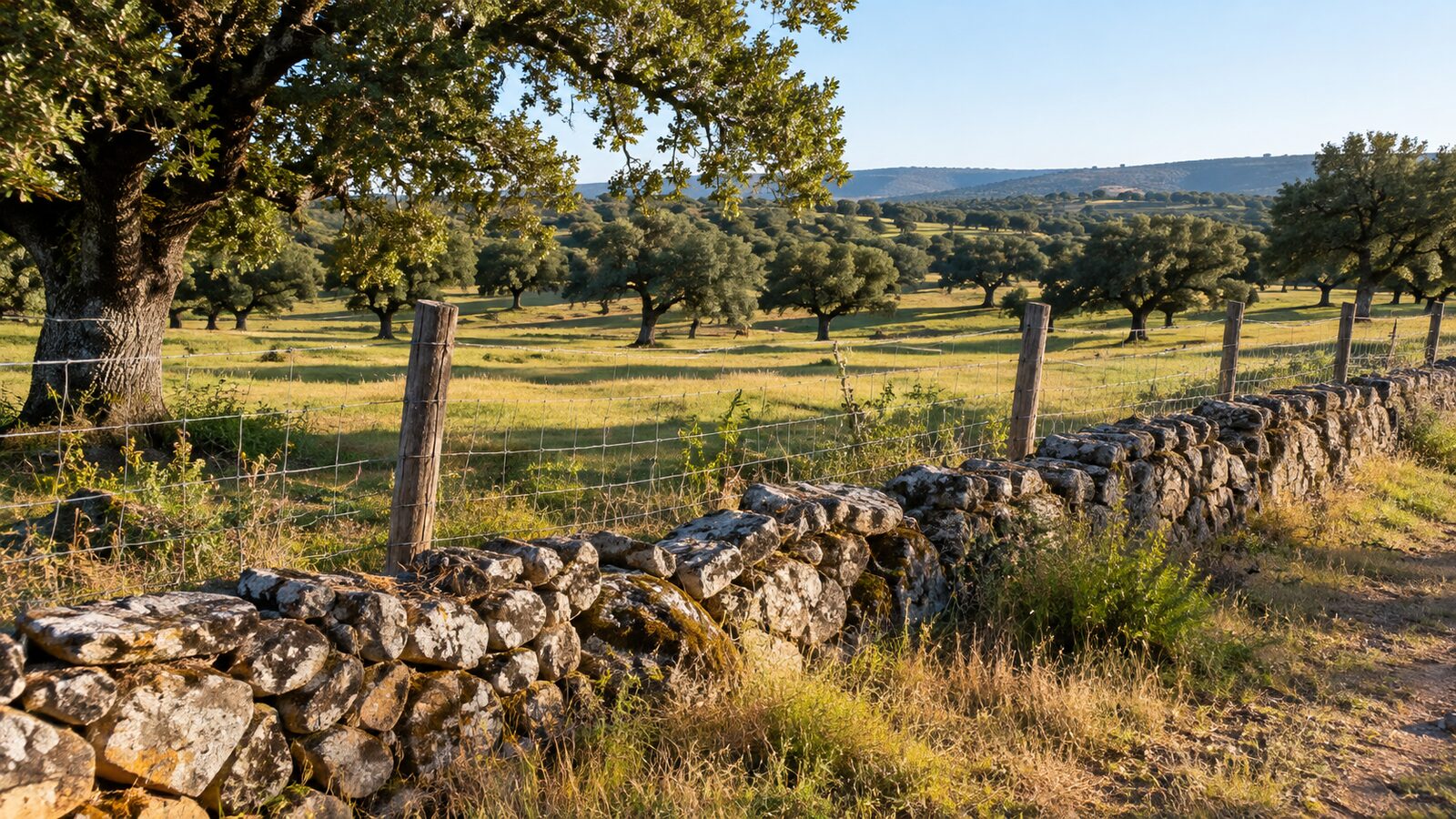
Why fence an estate
Fencing an estate is one of the first decisions of someone who buys a rural plot. A fence marks the limit of what is yours, keeps out other people's livestock, protects crops and young plantations, keeps your own livestock in and gives some security. It is also one of the easiest jobs to get wrong: a badly placed fence may encroach on a neighbour's land, cut a traditionally used path or block the passage of wildlife. Before buying posts and mesh, be clear about what you want to achieve and what legal and physical limits your estate has.
First, the boundaries
A fence only makes sense if you know precisely where the boundaries are. Start with the nota simple, the cadastre and SIGPAC: the land registry description, the cadastral reference and the area are the starting point. Then compare that data with what you see in the field. On many rural estates reality does not quite match the paper: there are old walls, streams, boundary markers and old fences that neighbours have considered the limit for decades.
- Ask the seller to show you the boundaries on the ground and note who the neighbour is on each side.
- If in doubt, a surveyor can measure the plot and mark the points with stakes or markers.
- Talk to the adjoining owners before starting. A conversation in time avoids almost all problems.
- Keep in writing any agreement on shared fences and who pays what.
If the fence is a party fence (medianera), that is, shared with the neighbour, it is advisable to agree the sharing of costs in writing and consult a lawyer before building it. Also read the guide on easements and boundaries on a rural estate.
Permits: what to check before fencing
In Extremadura, the general framework is Law 11/2018 on sustainable territorial and urban planning. Its Article 146 lists the acts subject to a municipal licence for building, construction and installation works: among them, new-build works, earthworks, the opening of private paths or access roads and the siting of prefabricated constructions and installations. The article does not expressly name estate enclosures, but adds that other acts designated by planning instruments and municipal ordinances are also subject to a licence. That means the answer for your plot is in your municipality's rules, not in a general rule.
The right way to find out is to ask in writing. Take the cadastral reference to the town council and ask what procedure the type of fence you want to build requires, what technical conditions apply and whether the plot has any protection. If the estate is next to a watercourse, a public path, a road, a livestock route or inside a protected area, also ask the competent administration in each case.
Common types of fence
- Livestock or hunting mesh on posts, used to close the perimeter of pasture estates and dehesas. There are meshes of different heights and wire spacing.
- Wire fence, barbed or plain, used on boundaries and pasture divisions.
- Stone wall, traditional in many comarcas.
- Electric fence, used to divide pasture plots, not to close the perimeter.
- Masonry wall around the house or the vegetable garden.
The choice depends on what you want to contain or exclude and on the legal conditions in your area, explained below. A local installer can advise you on each option.
Wildlife, hunting and protected areas
The basic national law, Law 42/2007 on Natural Heritage and Biodiversity, establishes in its Article 62.3 f) that land enclosures and fences must be installed so that, along their whole perimeter, they do not prevent the movement of non-game wildlife. In Extremadura, Decree 226/2013 of 3 December regulates the installation, modification and replacement of hunting and non-hunting enclosures, and the decree was amended later, so check the version in force. Among other things, it sets general conditions that apply whether or not they are subject to authorisation: for example, that posts do not exceed the height authorised for the enclosure and that clearing to install it is selective and limited to specific points, without affecting trees or noble scrub, unless the authorisation says otherwise. For hunting enclosures, Extremadura's Hunting Law 14/2010 requires prior administrative authorisation in its Article 40.
If you plan to fence in order to hunt or to protect a crop from game, first read the guide on hunting estates and game reserves in Extremadura. If the estate is in a protected area, read Natura 2000 and rural estates and ask the Junta what conditions apply to your plot.
Paths, livestock routes and easements
Many estates have a path that crosses or borders them, or adjoin a livestock route. Livestock routes are public domain assets, regulated by Law 3/1995, and you cannot close them off or occupy them even if the estate is yours; the guide on livestock routes and public paths explains this. If there is a path, ask the town council to confirm whether it is public or private. If there is a right of way in favour of another estate, you must respect it; check with a lawyer before placing gates or closing an access.
How much fencing costs
The cost depends on the perimeter, the type of fence, the terrain and labour. Ask two or three local installers for a quote and compare what they include: posts, mesh, tensioners, gates, installation and removal of the old fence. Also ask who is responsible for later maintenance.
How to do it well, step by step
- Confirm the boundaries with the documentation and on the ground.
- Talk to the neighbours and agree shared fences in writing.
- Ask the town council about the licence or notification required and the technical conditions.
- Ask the Junta or other bodies whether there are watercourses, livestock routes, roads or protected areas.
- Choose the type of fence according to the use: livestock, crop, hunting, security or simple delimitation.
- Ask for several quotes and require that the boundaries be marked before starting.
- Leave gates and passages where there are paths or easements.
- Keep invoices and the documentation of the procedure.
Common mistakes
The most repeated mistakes are fencing without knowing where the boundaries are, moving the fence a few metres to gain area, closing off a path that was not yours, and not checking the enclosure rules because "in the countryside it's not needed". All are avoided by checking first. Also review the most common mistakes when buying a rural estate, because many boundary problems are inherited from the seller.
If you also want to build
If besides fencing you plan to build a house or a barn, the enclosure is part of the whole and it is better to consult the town council on everything together. The guide on building a house on a rural estate explains how to approach that conversation with technicians and the administration.
Conclusion
Fencing an estate well is an investment that lasts decades, and the important work is done before driving the first post: knowing where the boundaries are, asking what permits your municipality requires and respecting paths, neighbours and wildlife. With those steps done, choosing the material is a simple technical decision. Without them, a fence can become a legal problem and an expense that has to be redone.