What the declaration law says
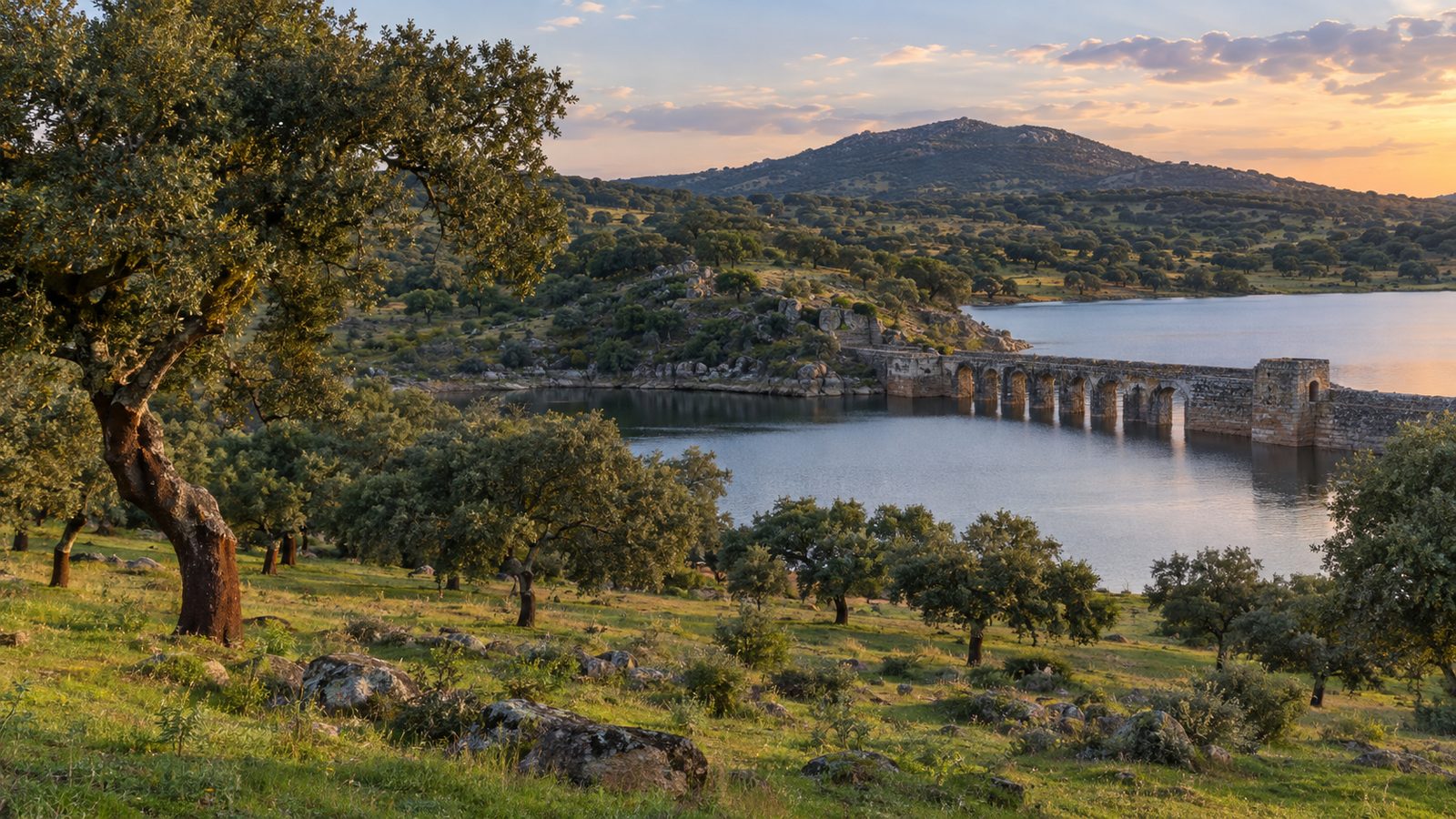
Law 7/2004 of 19 November declared Cornalvo a Natural Park (BOE no. 302, 16 December 2004). Its preamble places it in the geographic centre of the Autonomous Community, between the river Guadiana and the provincial boundary of Cáceres. It describes gentle relief, with the Bermeja and del Moro sierras to the south, and says the most representative habitat is holm oak and cork oak dehesas. It cites as main watercourses the river Aljucén and the streams of Muelas and Fresneda.
Protection figures cited by the law
The same preamble recalls that the site was classified in 1991 as a Special Protection Area for Birds (SPA) and in 1999 as a Site of Community Importance (SCI), so it forms part of the Natura 2000 network. According to the text, 74% of its surface has habitats of Annex I of the Habitats Directive. These are 2004 data, the year of the law. To understand how these figures add up, read Natura 2000 network and rural estates.
Fauna and vegetation cited in 2004
The law records that more than 250 vertebrate species and more than 175 bird species were inventoried. It mentions as species "in danger of extinction" the jarabugo, a fish endemic to the Guadiana basin, and the black stork, with several breeding pairs in the cork oak woods. These data describe the situation recorded by the law in 2004; they are not a current census. For the tree that shapes this landscape, read the cork oak wood and cork stripping and what a dehesa is.
What to check if the estate is inside or nearby
The law itself explains that it was approved exceptionally to avoid risks such as agricultural and livestock intensification or the increase of buildings outside developable land. That indicates land use is a central matter. Before buying:
- Ask the seller for the cadastral reference and ask the Junta de Extremadura in writing whether the parcel is inside the park and which rules apply to it.
- Check the current use and management rules, not only the 2004 law.
- If you want to build, read building a house on a rural estate and consult before paying anything.
- If you are thinking of hunting, see hunting estates and preserves: the law cites game management as part of the site.
Mérida as a base
Cornalvo is near Mérida, where you will find notaries, agencies and technicians. To get to know the city, read Roman Mérida: living or buying an estate nearby. The Cornalvo dam, of Roman origin, is in the heart of the park, according to the preamble, which recalls it was declared a National Monument in 1912.
Documents worth requesting
Before signing anything on an estate near Cornalvo, ask the seller for the land registry extract, the cadastral certificate and the SIGPAC query if there are agricultural parcels. Check that the area, the boundaries and the owner match in all three documents. If there are differences, ask how they will be resolved before the deed. The guide to land registry extract, cadastre and SIGPAC explains what to look at in each one.
Also ask for the property tax receipts, the current contracts and any authorisation or licence for the constructions. An independent lawyer should read the deposit contract before you sign it; the guide to the deposit contract on a rural estate summarises the points to review.
How to visit the estate
Visit the estate at least twice and in different seasons: once in good weather and once in rain or strong heat. Time the real journey from the town where you would do your daily shopping. Check the access track, the mobile coverage, the state of the fences and the buildings, and take photos of everything. Talk to a neighbour without the seller present: they usually know things about water, dry years and tracks that appear in no document.
Costs that do not appear in the listing
Besides the price, an estate has expenses every year: rural property tax, insurance, maintenance of fences and tracks, utilities and, if there is an operation, production costs. There are also purchase costs, such as taxes, notary and registry. The guide to taxes when buying a rural estate helps with the former and the annual maintenance calendar with the latter. Make a sheet with three scenarios and check that your budget survives the worst.
Who to consult
You do not need to know everything, but you do need to know whom to ask. For this topic, consult an environmental or forestry technician. For the legal and purchase side, a lawyer who knows the district. For the planning side, the town hall, in writing and with the cadastral reference. Keep the answers and compare them with what the seller says. If two sources contradict each other, ask both to clarify before moving on.
Common mistakes
- Deciding on the fame of the product or the place without looking at the estate's documents.
- Signing a deposit contract before having the registry extract, the cadastre and the water confirmation.
- Trusting production figures that the seller cannot prove with invoices.
- Visiting the estate only once, in the best season of the year.
- Not asking the town hall and the competent administration in writing what can be done.
They all appear in the guide to mistakes when buying a rural estate.
Questions for the seller
Before negotiating, prepare a list of questions about an estate near Cornalvo and ask for written answers: what is done on the estate today, since when, with what results, what expenses it has, what contracts are in force and what has stopped being done and why. Also ask about the problems of recent years, such as droughts, pests, fires or conflicts with neighbours. If the answers are vague or change from one conversation to another, take it as a sign to ask for more documents or to wait.
Conclusion
Cornalvo is a natural park declared by law, with dehesa and cork oak. If an estate is inside or adjacent to it, land use, works and hunting can have limits. Ask the Junta in writing and do not trust what the listing says.