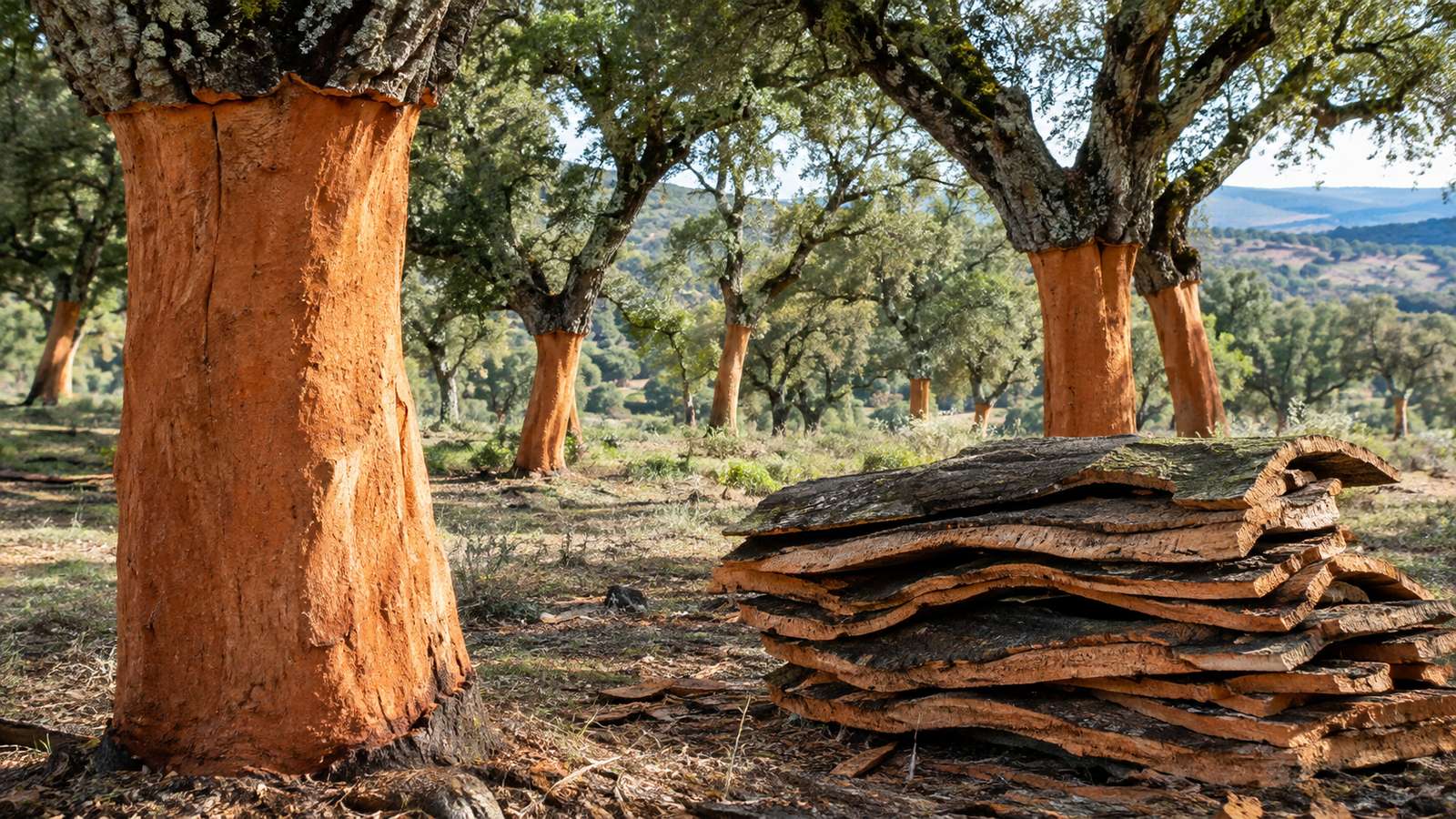
The cork oak is, together with the holm oak, the tree of the dehesa. Unlike the holm oak, it yields a crop sold by weight: cork. Many estates in the Sierra de San Pedro, western Badajoz and the Valencia de Alcántara area have it as their main income.
How cork is harvested
Cork stripping is done by hand, with an axe, in the hot months (roughly June to August), when the cork layer separates well from the trunk. It is done by specialised crews who open the bark without wounding the tree's mother layer. It is a highly skilled trade: a bad cut can damage the tree for years, so the crew is not a cost where it pays to save.
How often it is stripped
Each tree needs at least nine years between one harvest and the next for the cork to reach the right thickness. That is why estates organise their trees into "pelas" or zones stripped in different years, to spread income more evenly. The first harvest of a young tree gives so-called "bornizo" cork, of lower quality; later harvests give "secundero" or reproduction cork, which is the one valued by the stopper industry.
What determines what you are paid
- Number of cork oaks in production and their size.
- Quality and gauge of the cork: the thickest and cleanest is paid better for stoppers.
- Price of the season, which varies with demand from the stopper industry.
- Cost of the harvest and of transport.
Cork is traditionally paid by the quintal. Prices change every season and by gauge, so the only serious reference for a specific estate is its own track record: invoices from the last pelas. Be wary of "a lot of cork is taken" without numbers.
Who buys and how it is sold
The usual chain is: owner or local cork dealer → preparing companies → stopper industry, very present in Extremadura and in neighbouring Portuguese Alentejo. Cork can be sold "on the tree" (the buyer provides the crew), "in bulk" once extracted, or through multi-year contracts that advance several pelas. Selling on the tree is convenient but pays less; a sale managed by the owner requires hiring a crew and transport, and pays more.
What to ask when buying an estate with cork oak woodland
- When the last harvest of each zone was and when the next is due.
- How many quintals were taken and at what price (ask for invoices).
- Whether there is cork sold in advance or pending payment.
- Health of the trees.
Cork in the value of the estate
A cork oak woodland well spread across pelas gives almost annual income with very little investment, and that is discounted in the sale price. When valuing an estate, add cork to the other uses (acorns, pasture, hunting, PAC) and compare the total income with the asking price per hectare (see prices). An estate with documented cork usually justifies a reasonable premium; one with cork "by hearsay", does not.
In the catalogue there are estates with cork at very different prices. Use the AI search and type "cork oaks" or "cork" to see them.
The cork calendar on a well-organised estate
In an orderly cork oak woodland, a different zone is stripped each year, so that the estate has cork in all phases: just harvested, growing and ready for stripping. When visiting, ask for the map of pelas: if the whole estate was stripped in the same year, there will be no cork income for another nine years, and that gap should be reflected in the price. If the pelas are spread out, the estate generates cash almost every season.
Costs that reduce the income
The harvest is the main cost (crew and transport), but not the only one: you have to maintain the firebreaks and the tracks along which the cork leaves, protect stripped trees from livestock damage and watch for pests that take advantage of the freshly stripped trunk. The owner who sells "on the tree" passes part of these costs to the cork buyer in exchange for a lower price; the one who sells in bulk bears them and keeps the margin.
Cork, acorns and pasture: the cork oak does not live alone
The cork oak also gives acorns for montanera - later than the holm oak's, which lengthens the season - and its shade supports the pasture. That is why the best mixed holm and cork oak dehesas combine three incomes on the same hectare. When valuing an estate, do not look at cork as a monoculture: it is one more layer of the dehesa system.
Signs of a well-run cork oak woodland
- Clean stripping cuts, without deep wounds in the trunk.
- Pelas identified with the year of the last harvest.
- No abandoned piles of cork on the estate (a sign of harvests that were not sold).
- Young trees protected: the cork oak woodland also needs generational replacement.
Cork and environmental protection
The cork oak woodland is protected by forestry legislation: cork oaks cannot be freely uprooted nor the woodland transformed without authorisation, and many cork estates are also in Natura 2000 sites. For the buyer this is a guarantee (the main asset cannot be legally degraded) and a limitation (forget about converting it to another crop). Forestry work - thinning, pruning, replanting - is processed with the environment service of the Junta de Extremadura.
An income with a long view
Natural cork keeps its demand because of quality wine stoppers and new uses in construction and design, and Extremadura is one of the most important production areas on the peninsula. For the patient owner, the cork oak woodland is one of the few forestry uses that pays regularly without felling the tree: the same tree produces for decades. That stability is what justifies well-documented cork estates selling at a premium over dehesa without cork.
If you are going to visit a cork oak woodland, do it in summer, when recent harvests are visible: the colour of the freshly stripped trunk, the height of the cuts and the cleanness of the axe marks tell you on a walk how the estate has been worked over the years.