An Extremaduran south that looks to Andalusia
The southern half of the province of Badajoz borders Huelva and Seville, and that shows in the landscape and the economy. Several areas can be distinguished here:
- Tentudía and the Extremaduran Sierra Morena, with Calera de León, Monesterio, Fuente de Cantos and Cabeza la Vaca. Low hills with holm and cork oak dehesa.
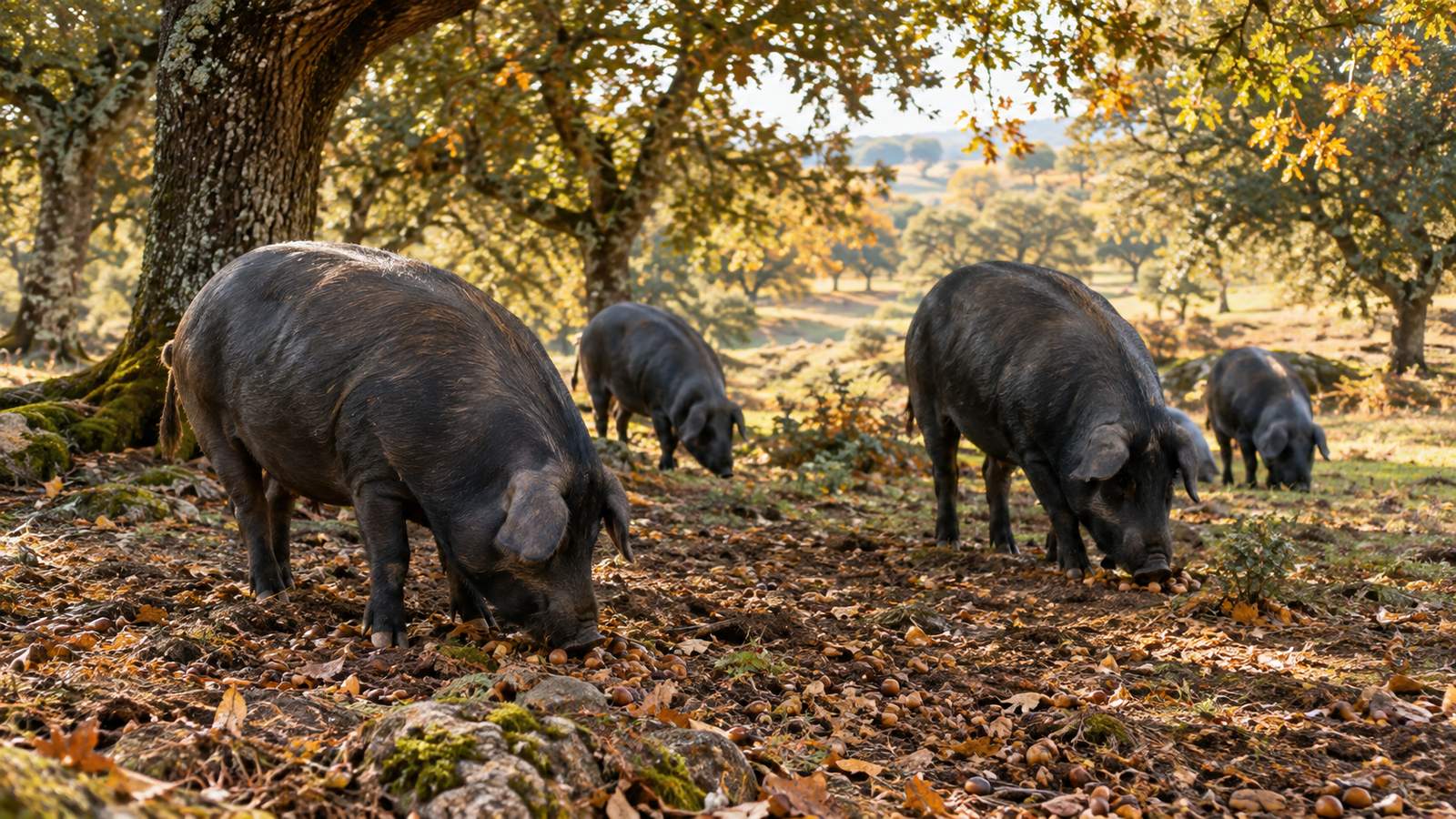
- Sierra Suroeste, with Jerez de los Caballeros, Fregenal de la Sierra and Higuera la Real. Dehesa of cork oak, holm oak and scrub, an area of Iberian pig and woodland.
- Campiña Sur, with Llerena, Azuaga, Berlanga, Fuente del Maestre and Zafra. More open terrain, with cereal, olive groves and vines in places, and dehesa on the hills.
It is crossed by the Ruta de la Plata (A-66) and by the road to Seville, which gives good connection with Mérida, Badajoz and Seville, the last two at reasonable distances for a day visit.
What is bought here
- Holm and cork oak dehesas for Iberian pigs. It is the central product. Its value depends on the trees, the oaks with acorns and whether montanera is possible. The guide to montanera explains how a dehesa's capacity is calculated. The ham of the area is marketed, in large part, under the Dehesa de Extremadura protected designation of origin, something that influences the value chain of livestock farms.
- Cereal and pasture estates on the farmland plain. With sheep or cattle and dryland tillage, flatter and mechanisable.
- Olive groves and vineyards. Towards Zafra and the Almendralejo area there are olive groves and vines, although the main wine-growing area of Tierra de Barros is dealt with in another guide: Tierra de Barros.
- Hunting estates. Estates with big game in the hills and small game on the plain. See hunting estates and hunting grounds.
- Estates with cork oak woodland. In the Sierra Suroeste there is cork oak woodland with cork use (guide).
Price
Although the regional median for dehesas is around 7.000 € per hectare in October 2026 according to our catalogue, the south of Badajoz has a very wide range. A large woodland estate with few oaks and no water is far below; a dehesa with many young productive oaks, ponds, a house and good access can approach or exceed the values of the Llanos de Cáceres. For its part, farmland with olive groves or vines in production works on the logic of agricultural land.
Before accepting a price, do three things: calculate the €/ha, compare it with estates of similar size and use and ask an agricultural technician to value trees and improvements. The guide to valuing a rural estate explains how it is done.
What weighs most in the south of Badajoz
- Condition of the trees. Oak decline ("la seca") in holm and cork oaks is a known problem of dehesas. Ask about dead trees, recent pruning and replacement of young trees.
- Stocking rates. Poor soil supports fewer head. An overgrazed dehesa loses pasture and acorn production.
- Water for livestock. Ponds, wells and watering points. In dry years this is decisive. See water on a rural estate.
- Enclosures and gates. A fence in poor condition is very expensive to replace.
- PAC entitlements. Ask whether they are tied to the estate or whether the seller keeps them (guide).
Legal and document aspects
On large, old estates there are often plots grouped in the same registry estate, areas that do not match and unregistered buildings. Verify the nota simple, the Cadastre and SIGPAC, and look for easements, livestock routes or public tracks, which are very common on these dehesas. Rely on the guides to nota simple, Cadastre and SIGPAC and to easements and boundaries. If the estate has tenants or pasture lessees, ask for the contracts before making an offer.
Life and logistics
Many dehesas in the south are more than half an hour from a large village. That affects day-to-day management: if you are not going to live there, you will need a manager or a reliable tenant. Study the cost of a warden or a cowherd, fire insurance and the usual track repairs after rain. If you plan to build or rehabilitate a house, see the guide to building a house on a rural estate.
Which area to choose within the south
- If you want Iberian pigs and dehesa with good trees: Sierra Suroeste and Tentudía.
- If you prefer flatter, mechanisable land: Campiña Sur.
- If you are interested in a combination of dehesa and proximity to Mérida and Badajoz: A-66 corridors.
- If you are looking for lower prices with large pasture estates: compare with La Serena.
Visit plan
Schedule two day visits, one in summer and another after rains. Walk the estate with someone from the area who knows the trees and the livestock. Ask for the last acorn harvest and the livestock weight data. With that information, go back to the guide how to buy a rural estate in Extremadura to organise arras, deed and taxes.