What eco-schemes are
The 2023-2027 CAP splits its direct payments into two big blocks: the basic payment, which almost every active farmer with entitlements receives, and eco-schemes, annual voluntary payments that pay for specific practices favourable to the climate and the environment. They are not collected for owning land, but for doing: each hectare enrolled must meet commitments that are then checked.
The base rule is Royal Decree 1048/2022 and the FEGA publishes each campaign the final unit amounts, which are paid a year after the application, together with the rest of the campaign's payments.
The eco-schemes that fit a dehesa
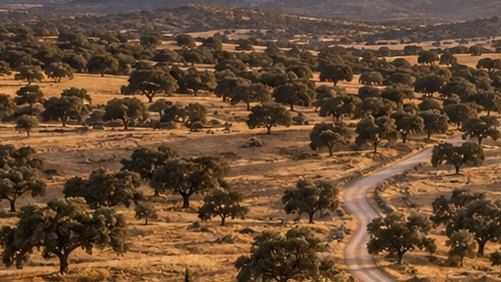
The Extremaduran dehesa is probably the system in all of Spain with the most hectares eligible for grassland eco-schemes. The lines that usually fit are:
- Extensive grazing on grasslands, with stocking limits and bans on the use of plant protection products and fertilisers on the enrolled area.
- Grazing with mowing, which combines livestock use with cutting part of the area.
- Practices on grasslands in wet areas or areas of special environmental value, where dehesas with ponds and peat bogs may fit.
- On the estate's cropland, the eco-schemes for ground cover and rotations in dryland.
The amounts per hectare change with each campaign and are confirmed by the FEGA; the practical reference is that they are tens of euros per hectare added to the basic payment, so on a 200-hectare dehesa the difference between enrolling or not is several thousand euros a year.
Practical requirements that are often overlooked
To collect an eco-scheme you must be an active farmer and have the area declared in SIGPAC with the correct use (grassland, not woodland, in most cases). The usual conditions include a maximum stocking rate per hectare, maintenance of the trees and the characteristic elements of the dehesa, and the obligation to keep a digital farm logbook. Breaches remove the payment and also bring penalties on the whole of the CAP.
Watch out for ownership: the CAP is collected by whoever acts as the farmer on the estate, not necessarily the owner. If you buy a leased dehesa, the tenant is usually the one who declares and collects, and that forms part of the value of their lease. The relationship between ownership and payments is explained in the guide to basic payment entitlements when buying.
How much money it can mean: order of magnitude
The exact amounts depend on the campaign and the adjustments published by the FEGA, but to get an idea of the order of magnitude: a 300-hectare dehesa enrolled in a grassland eco-scheme with a unit amount of a few tens of euros per hectare can add between 6.000 and 15.000 euros a year on top of the basic payment. It is not the farm's main income, but it usually more than pays for the warden, the digital logbook and part of the livestock insurance.
Mistakes that lose the payment
- Declaring plots with the wrong SIGPAC use. A plot declared as woodland or forest may be left out of the grassland eco-scheme even though in the field it is pasture with trees.
- Exceeding the stocking rate. A year of lots of grass tempts you to put in more head than the commitment limit allows.
- Uprooting or felling without authorisation. Maintenance of the trees is part of the commitment.
- Not keeping the farm logbook up to date. Inspections ask for it and its absence is penalised even if the practice has been complied with.
The golden rule: enrol only the hectares whose practices you can document, not all that you have.
How to apply
Eco-schemes are ticked in the CAP single application, which in Extremadura is submitted online normally between February and the end of April each year, with a later amendment period with a penalty. The application states the SIGPAC plots enrolled in each eco-scheme and, in some cases, the area can be distributed among several practices. Then comes compliance: the administration checks by remote sensing and on-the-ground inspections, and the FEGA publishes the final unit amounts at the close of the campaign.
What to check when buying a dehesa with CAP
- How many basic payment entitlements the farm has and whether they are sold with the estate.
- Which eco-schemes it is enrolled in this year and who the declarant is.
- Whether there are open inspection files or penalties.
- Compatibility with other schemes: in Natura 2000 areas eco-schemes are usually compatible and even complementary with agri-environmental payments.
Relationship with other dehesa payments
Eco-schemes do not live alone. A dehesa can add, if it meets the requirements, the basic payment, the redistributive payment on the first hectares, coupled payments for extensive cattle or sheep and the EAFRD agri-environmental payments managed by the Junta de Extremadura, some designed precisely for dehesas. What cannot be done is to collect twice for the same practice on the same hectare: when an area is within an EAFRD agri-environmental commitment, CAP eco-schemes usually exclude or modulate it. Before ticking boxes in the single application, it is advisable to book an appointment at the district agricultural office with the estate's SIGPAC plan and decide the combination that pays most with the least risk of penalty.
And to understand the production system these payments support, the guides to what a dehesa is and to montanera give the livestock context.