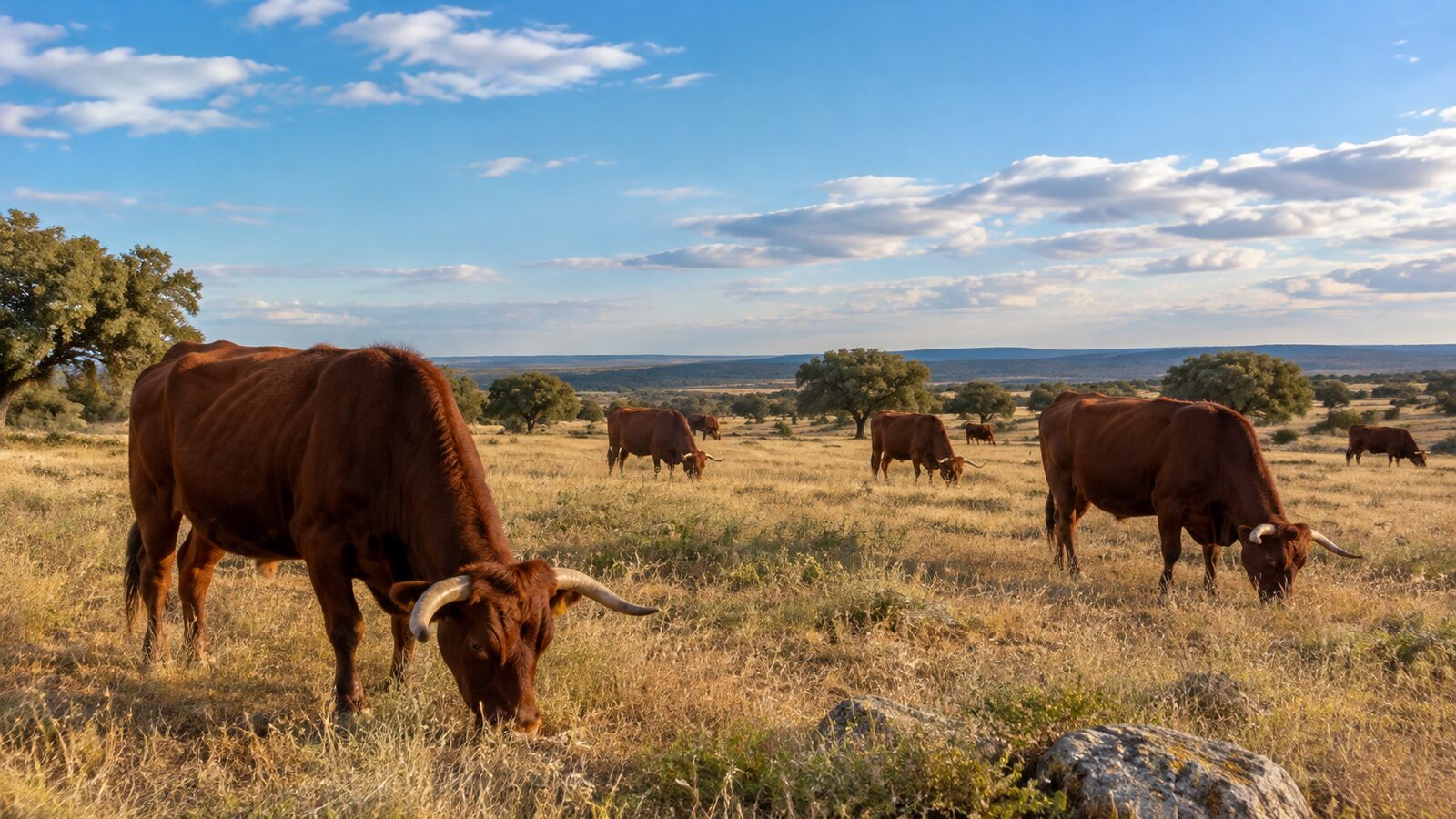
The retinta breed
According to the CICYTEX factsheet on the retinta breed (data without a date), the breed is concentrated mainly in Andalusia and Extremadura: between the two communities they account for close to 95 % of the census. It is one of the native breeds covered by the PGI.
What the PGI says
According to the Regulatory Council, the cattle eligible to supply meat to the PGI come from the native breeds Retinta, Avileña Negra-Ibérica, Morucha, Blanca Cacereña and Berrenda in black and red, and from their crosses with the Charolais and Limousin breeds. Feeding corresponds to the use of natural resources under extensive management, including the use of the dehesa and its fruits, and supplementation is done with feed authorised by the Regulatory Council. The Council is based in Cáceres.
What it means for an estate
- Pasture and dehesa: the specification speaks of dehesa pasture and native resources. Measure the real stocking capacity of the estate in a normal year and in a dry one.
- Water: cows need reliable troughs. Check the water right.
- Installations: fences, handling pens, loading ramps and barns in good condition.
- Breed and crosses: check that the animals fit the breeds and crosses of the specification.
- Registration: holdings that want to sell under the PGI must meet the Council's registration conditions.
Subsidies and contracts
Extensive livestock farming can receive common agricultural policy payments, and their transfer is not automatic. Read CAP and eco-schemes on the dehesa. If the estate has leased pastures, ask for the contracts and check terms and prices.
A prudent estimate
Profitability depends on the price of meat, the cost of feed in a dry year, animal health and labour. There is no general figure. Ask a local stockbreeder to walk you through their full year and calculate a drought scenario. The guide to profitability of a rural estate gives you a method.
Documents worth requesting
Before signing anything on an estate with beef cattle, ask the seller for the land registry extract, the cadastral certificate and the SIGPAC query if there are agricultural parcels. Check that the area, the boundaries and the owner match in all three documents. If there are differences, ask how they will be resolved before the deed. The guide to land registry extract, cadastre and SIGPAC explains what to look at in each one.
Also ask for the property tax receipts, the current contracts and any authorisation or licence for the constructions. An independent lawyer should read the deposit contract before you sign it; the guide to the deposit contract on a rural estate summarises the points to review.
How to visit the estate
Visit the estate at least twice and in different seasons: once in good weather and once in rain or strong heat. Time the real journey from the town where you would do your daily shopping. Check the access track, the mobile coverage, the state of the fences and the buildings, and take photos of everything. Talk to a neighbour without the seller present: they usually know things about water, dry years and tracks that appear in no document.
Costs that do not appear in the listing
Besides the price, an estate has expenses every year: rural property tax, insurance, maintenance of fences and tracks, utilities and, if there is an operation, production costs. There are also purchase costs, such as taxes, notary and registry. The guide to taxes when buying a rural estate helps with the former and the annual maintenance calendar with the latter. Make a sheet with three scenarios and check that your budget survives the worst.
Who to consult
You do not need to know everything, but you do need to know whom to ask. For this topic, consult a veterinarian or livestock technician of the district. For the legal and purchase side, a lawyer who knows the district. For the planning side, the town hall, in writing and with the cadastral reference. Keep the answers and compare them with what the seller says. If two sources contradict each other, ask both to clarify before moving on.
Common mistakes
- Deciding on the fame of the product or the place without looking at the estate's documents.
- Signing a deposit contract before having the registry extract, the cadastre and the water confirmation.
- Trusting production figures that the seller cannot prove with invoices.
- Visiting the estate only once, in the best season of the year.
- Not asking the town hall and the competent administration in writing what can be done.
They all appear in the guide to mistakes when buying a rural estate.
Questions for the seller
Before negotiating, prepare a list of questions about an estate with beef cattle and ask for written answers: what is done on the estate today, since when, with what results, what expenses it has, what contracts are in force and what has stopped being done and why. Also ask about the problems of recent years, such as droughts, pests, fires or conflicts with neighbours. If the answers are vague or change from one conversation to another, take it as a sign to ask for more documents or to wait.
Conclusion
The retinta and the Ternera de Extremadura PGI are part of the livestock landscape of the dehesa. To buy an estate with cows, review pasture, water, installations, breed and contracts with a livestock technician before deciding.