What is a designation of origin?
A protected designation of origin (PDO, or DOP in Spanish) or protected geographical indication (PGI, or IGP in Spanish) is a European quality scheme linking a product to a territory and production method. To use the name, producers must be registered, meet a product specification and undergo inspections by the regulatory council. It is not a commercial brand you can buy: it is a commitment to a set of rules.
According to Extremadura's tourism portal, the region has twelve designations of origin and six protected geographical indications. Here we look at those most relevant to anyone who owns or plans to buy a country estate.
The main designations and their requirements
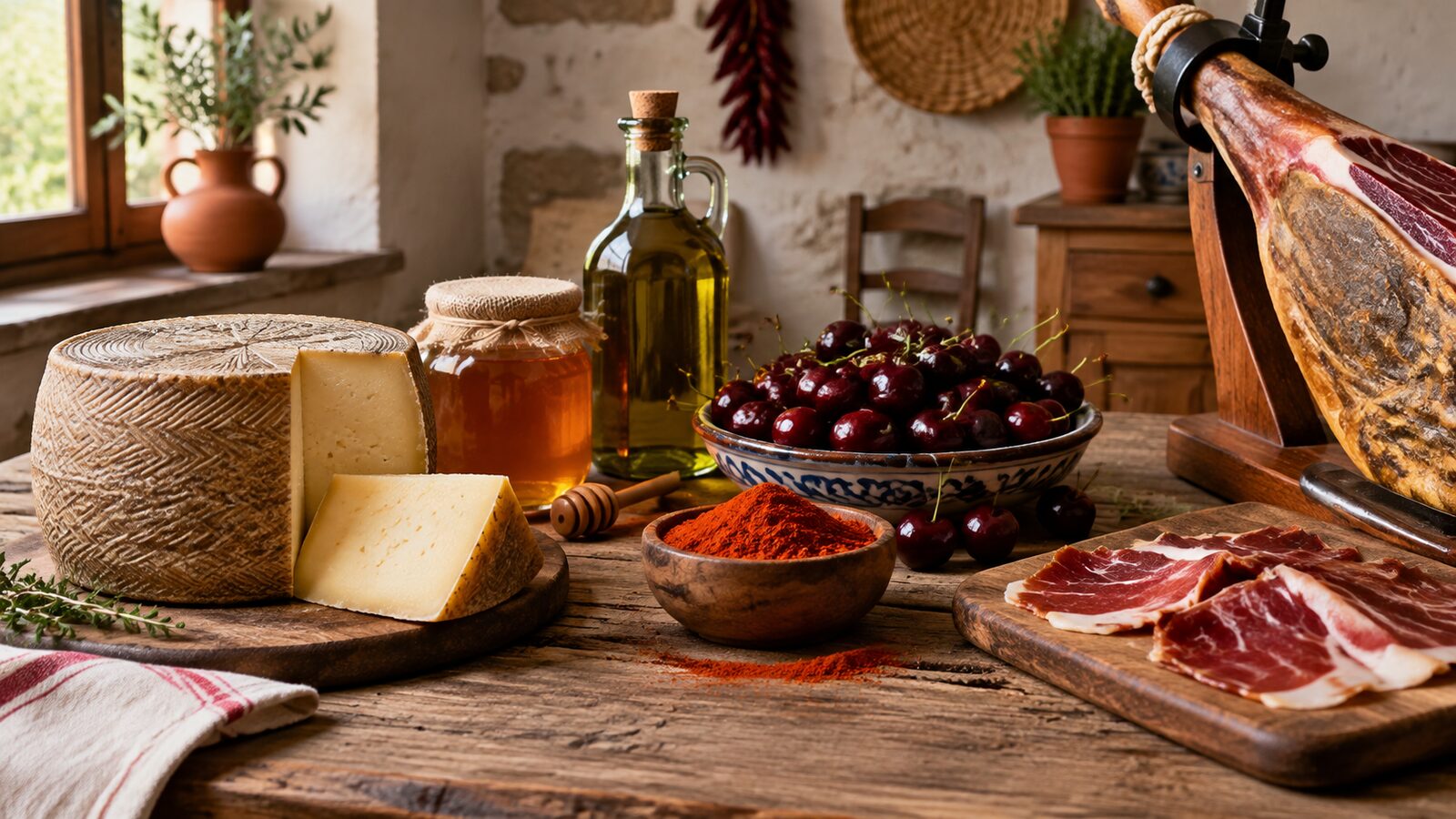
- DOP Dehesa de Extremadura: Iberian hams and shoulders from pigs raised in the dehesa. Linked to the montanera and tree management.
- DOP Ribera del Guadiana: wines from six subzones in Cáceres and Badajoz. See vineyards in Extremadura.
- DOP Queso de La Serena: Merino sheep's cheese from La Serena.
- DOP Queso Ibores: goat's cheese from Los Ibores.
- DOP Torta del Casar: sheep's cheese from the Casar de Cáceres area.
- DOP Pimentón de la Vera: smoked paprika from La Vera.
- DOP Miel Villuercas-Ibores: honey from Las Villuercas and Los Ibores.
- DOP Cereza del Jerte: cherries and picota cherries from Valle del Jerte. See cherry trees in the Jerte.
- DOP Aceite de oliva virgen Gata-Hurdes: oil from the manzanilla cacereña variety in northern Cáceres.
The region's other quality schemes can be consulted on the Extremadura tourism portal. Each designation has a defined geographical area, so an estate can only join if it lies within it.
Why it matters when buying an estate
- Geographical area: check whether the plot is within any designation's defined area.
- Registration: ask whether the estate or current owner is registered and what happens to that registration on sale.
- Compliance with the specification: varieties, yields, rearing or cultivation systems and inspections.
- Contracts: who receives the production and on what terms.
- Costs: regulatory council and inspection fees, which vary by designation.
Advantages
- Access to a market with identity and recognition.
- The possibility of selling under a name consumers associate with quality.
- Support from the regulatory council with promotion and technical services.
Limitations
- The rules are strict and inspections compulsory.
- The price improves, but is not guaranteed; it depends on the market each season.
- A change of owner must be reported and registration updated where required.
Producing without a designation is also possible
Not every product from Extremadura needs a DOP. Many producers sell oil, honey, cheese or preserves directly under their own brands, while complying with health and registration regulations. Before setting up direct sales, check requirements with the relevant authority and consider whether a processing workshop or cooperative would suit you. For olive oil, read the guide to traditional, intensive and super-intensive olive groves.
Food and tourism
Food is one of Extremadura's main attractions. An estate with its own production can combine visits, tastings and rural accommodation, with the appropriate licence; the guide to rural tourism on a country estate summarises the steps. Assess the business cautiously, because demand varies greatly by season.
A practical rule
Before buying an estate with a designation of origin product in mind, speak to that designation's regulatory council and neighbouring producers. They will give you real information on requirements, costs and the market, and tell you whether the estate fits. To understand the dehesa and its livestock, read what a dehesa is.
How to request information from a regulatory council
Each designation has a regulatory council that answers questions from producers and estate buyers. Ask about the defined geographical area, registration procedure, product specification, fees and inspections. Request the requirements in writing and compare them with the estate's actual situation. This information is free and avoids misunderstandings before buying.
Value for the area
Designations sustain activity and employment in small districts and preserve traditional landscapes and practices: the dehesa, the terraces of the Jerte, the vineyards of Tierra de Barros or mountain olive groves. Buying an estate in these areas means joining a production chain with a history. Understanding that context helps you decide whether the project meets your expectations.
Labelling and sales
A designation's name can only be used on certified products that meet its specification. Using it without entitlement is an infringement. If you sell under another brand, you must not imply an origin or quality you cannot prove. Ask an administrative adviser or cooperative for advice on correct labelling.
Common mistakes
- Assuming an estate is "within the designation" without checking the defined area.
- Buying on the basis of a registration that does not transfer automatically.
- Calculating the sale price from the product's best year rather than a multi-year average.
- Ignoring fees and inspection costs.
- Forgetting that compliance with the specification may limit practices you wanted to adopt.
Summary
Designations of origin are a real opportunity for quality producers, but not a shortcut. Ask the regulatory council for information, request the requirements in writing and compare them with the estate's actual situation before deciding.