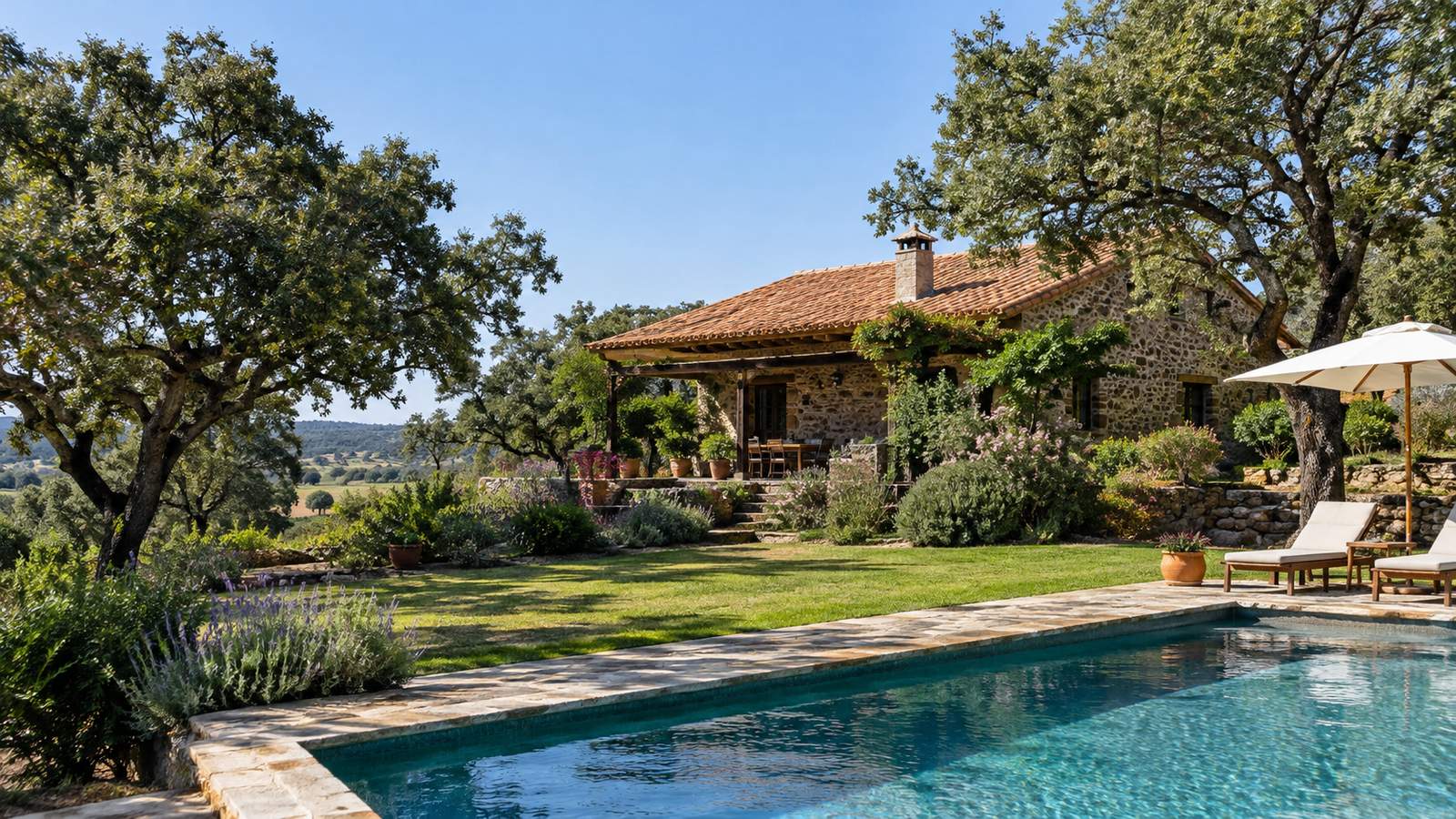
Why the price per hectare is misleading
When an estate includes a house, the price per hectare stops describing the land and mostly describes the building. A 2-hectare plot with a renovated house and a pool can cost the same as 100 hectares of dehesa without a house. That is why the medians by estate type are so different: according to the October 2026 catalogue, in Extremadura dehesas are around 7.500 €/ha, agricultural ones 23.000 €/ha and leisure ones with a house are around 84.500 €/ha.
The practical conclusion is to separate three prices in your mind: that of the land, that of the dwelling and that of the improvements (well, fencing, irrigation, trees). Only then do you know what you are paying for and which part is negotiable.
How to estimate each part
- Land. Look for similar estates without a house in the same district and calculate their €/ha. That will be your reference for the land part. The guide to price per hectare helps with the comparison.
- Dwelling. Estimate the cost of replacing or renovating a similar house: built square metres, condition of the roof, installations and finishes. A local builder or architect can give you an approximate quote before you make an offer.
- Improvements. Well with pump, tank, fencing, solar panels, stables, barn, irrigation and trees.
Subtract from the offer the cost of what remains to be done. If the house needs a full renovation, that renovation is a real part of the price, even if it does not appear in the advert.
What makes a country house worth more or less
- Legality. A house registered in the Registry, licensed and reflected in the Cadastre is worth more than a building without papers.
- Condition. Roof, damp, electrical installation and plumbing are the big expenses.
- Utilities. Electricity grid, mains water or a well with flow, sanitation (authorised septic tank or connection) and internet.
- Access. Paved road versus dirt track.
- Location. Proximity to Cáceres, Mérida, Badajoz, Plasencia or Trujillo, and to health services.
- Surroundings. Views, water, trees and neighbours.
Legality is what costs most
On rural land, many old buildings have no licence, are not in the Registry or are in an irregular situation. That affects the sale, the mortgage, the insurance and renovation works. Before making an offer:
- Ask for the nota simple and see whether the house appears as a declared new build.
- Compare with the Cadastre: built area and year.
- Ask the town council whether the building is legal, out of planning or irregular, and what works it allows.
- Review the guide to building a house on a rural estate.
- Read the one on leisure estate with a house: 12 things to check.
An irregular house does not have to be a bad deal, but the price must reflect the risk and the regularisation costs, and the bank may not finance its purchase.
Entry costs that are forgotten
- Transfer tax, notary, registry and administrative agent. The Extremadura rates are in the guide to how to buy a rural estate.
- Energy efficiency certificate, which is mandatory to sell a dwelling.
- Technical report on the condition of the house.
- Renovation of the roof, electrical installation or bathrooms.
- Septic tank or treatment plant, if there is no authorised system.
- Home insurance or rural building insurance.
- Rustic or urban IBI, depending on how the building is recorded.
What to expect from renovation
There is no price per square metre valid for all of Extremadura. It depends on the condition, the materials and local labour. The sensible thing is to ask for at least two quotes detailed by chapter and add a margin for the unexpected, common in old houses of stone, adobe or rammed earth. There is one useful rule: a cheap house with a lot of renovation pending is rarely cheaper than a more expensive well-kept house.
Water and electricity: the small print
A house without reliable water loses value. Check the flow of the well in summer, the condition of the tank and whether there is a title for the use (water on a rural estate). For electricity, find out whether there is a contract in force, what power there is and whether the line arrives by its own pole or a shared one. A new connection can be expensive if the grid is far away. If you are thinking of self-consumption with panels, bear in mind that installing them on a rural house can be an alternative, but do not replace the supply with a promise from the seller.
How to negotiate
Present the offer with arguments: comparable land price, budgeted renovation cost, legal defects and regularisation costs. Ask for the new build declaration to be reflected in the deed if it is not registered, or for a retention of the price to be agreed until it is regularised. And do not close without reading the arras contract.
When it pays to pay more
Paying more is worthwhile when the house is already legalised, water and electricity work, access is good and the surroundings fit what you are looking for. Paying less is only worthwhile if you have financial room and time to take on the renovation and the paperwork. In both cases, use a comparison with other estates in the district before deciding.