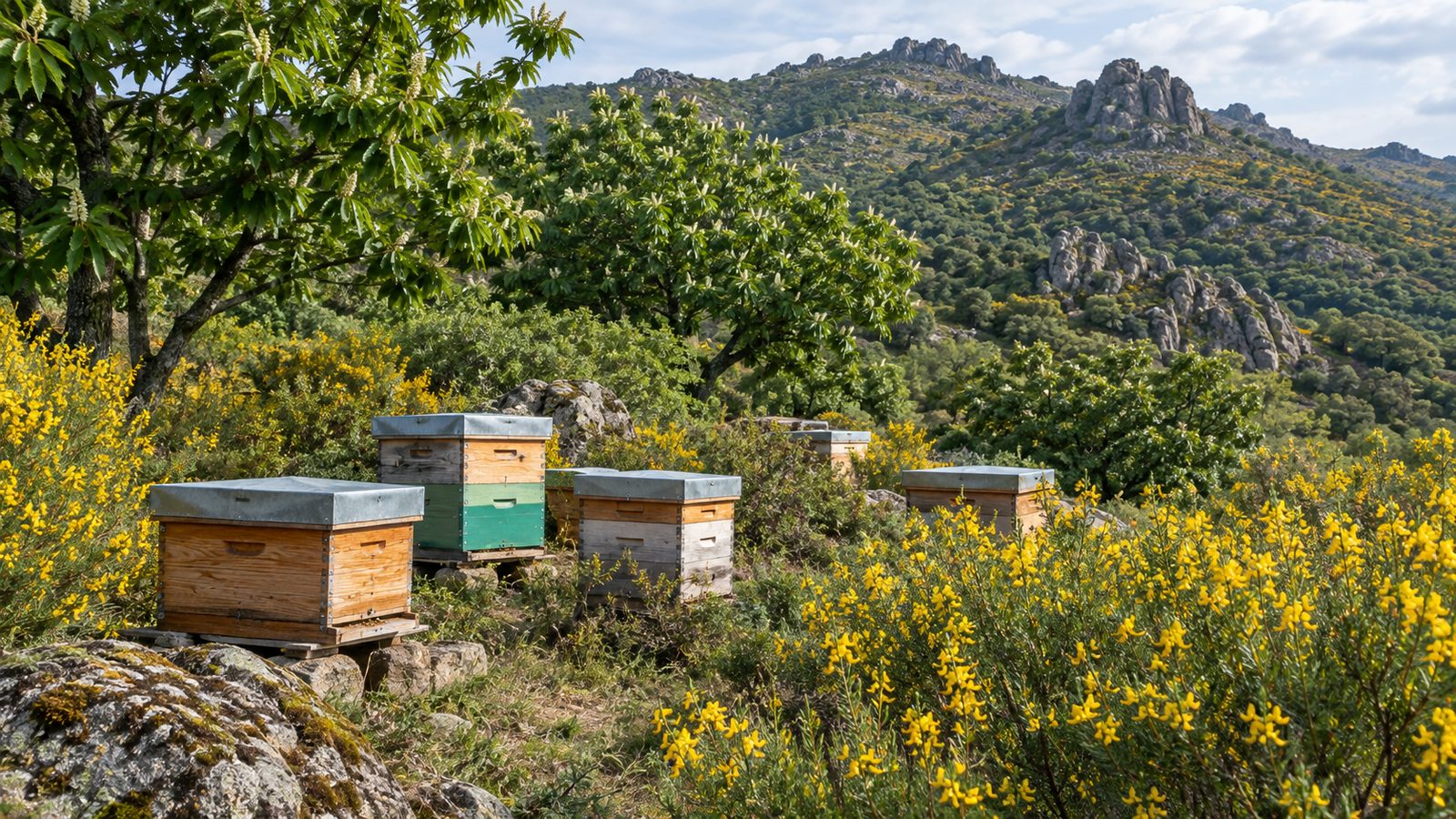
Which honey types the specification covers
According to the consolidated specification (2025) published by the Junta de Extremadura, the PDO distinguishes four types: broom honey, with more than 50% Retama sphaerocarpa pollen; chestnut honey, with more than 70% Castanea sativa pollen; multifloral honey; and honeydew honey.
What it means for your estate
Having hives on an estate does not entitle you to sell under the PDO. You must be registered and comply with the specification. If the beekeeper is someone else, ask what agreement exists with the estate and who is responsible for the hive register. Read the conditions of the area in estates in Villuercas and Guadalupe and the environmental figures in Natura 2000 network and rural estates.
Floral surroundings and climate
Broom and chestnut are wildland plants. Production depends on each year's flowering and on the climate, which changes from year to year; consult the climate of Extremadura for an estate. Do not take a per-hive production figure as reliable without seeing records from several years.
Questions for the seller
Ask whether there are own or third-party hives, whether sanitary and movement records exist, what vehicle access there is and where the water is. On a leisure estate with a house, add distance to neighbours and public tracks.
Documents worth requesting
Before signing anything on beehives on a Villuercas estate, ask the seller for the land registry extract, the cadastral certificate and the SIGPAC query if there are agricultural parcels. Check that the area, the boundaries and the owner match in all three documents. If there are differences, ask how they will be resolved before the deed. The guide to land registry extract, cadastre and SIGPAC explains what to look at in each one.
Also ask for the property tax receipts, the current contracts and any authorisation or licence for the constructions. An independent lawyer should read the deposit contract before you sign it; the guide to the deposit contract on a rural estate summarises the points to review.
How to visit the estate
Visit the estate at least twice and in different seasons: once in good weather and once in rain or strong heat. Time the real journey from the town where you would do your daily shopping. Check the access track, the mobile coverage, the state of the fences and the buildings, and take photos of everything. Talk to a neighbour without the seller present: they usually know things about water, dry years and tracks that appear in no document.
Costs that do not appear in the listing
Besides the price, an estate has expenses every year: rural property tax, insurance, maintenance of fences and tracks, utilities and, if there is an operation, production costs. There are also purchase costs, such as taxes, notary and registry. The guide to taxes when buying a rural estate helps with the former and the annual maintenance calendar with the latter. Make a sheet with three scenarios and check that your budget survives the worst.
Who to consult
You do not need to know everything, but you do need to know whom to ask. For this topic, consult a beekeeper of the district. For the legal and purchase side, a lawyer who knows the district. For the planning side, the town hall, in writing and with the cadastral reference. Keep the answers and compare them with what the seller says. If two sources contradict each other, ask both to clarify before moving on.
Common mistakes
- Deciding on the fame of the product or the place without looking at the estate's documents.
- Signing a deposit contract before having the registry extract, the cadastre and the water confirmation.
- Trusting production figures that the seller cannot prove with invoices.
- Visiting the estate only once, in the best season of the year.
- Not asking the town hall and the competent administration in writing what can be done.
They all appear in the guide to mistakes when buying a rural estate.
Questions for the seller
Before negotiating, prepare a list of questions about beehives on a Villuercas estate and ask for written answers: what is done on the estate today, since when, with what results, what expenses it has, what contracts are in force and what has stopped being done and why. Also ask about the problems of recent years, such as droughts, pests, fires or conflicts with neighbours. If the answers are vague or change from one conversation to another, take it as a sign to ask for more documents or to wait.
How to read a quality designation before buying
A PDO, a PGI or a protection figure is a rule about a product or a territory, not a business guarantee. Before paying for an estate, separate three questions. First: what does the official text say? Ask for the specification or the rule in force and read the date of the last amendment. Second: what does this particular estate meet? Ask the competent body in writing whether the parcel is registered or included and since when. Third: what do the real accounts say? Ask for settlements, invoices and records from several years, not a loose figure from the listing.
Distrust anyone who promises that the seal "raises the value" of the estate without showing data. A seal can help sell a product, but it also implies controls, quotas and paperwork. If in doubt, hire an independent technician and a lawyer before signing the deposit contract, and review the guide to deposit contracts on rural estates.
Conclusion
Villuercas-Ibores honey has a clear specification by types. If you want hives, treat beekeeping as a separate business and ask for paperwork and records.