The first thing is not the land: it is the grid
Extremadura has sun, plains and plenty of dryland. What it does not have everywhere is evacuation capacity: the electricity grid only admits new generation at nodes with free access capacity. Red Eléctrica publishes transmission grid access capacity maps, and the local distributor does the same for its own. Before assessing an offer for your estate, locate the nearby substation and lines: a project 20 km from the node with available capacity is usually unviable because of the cost of the evacuation line, and one 2 km from the same node may be fought over by several developers.
The land developers look for
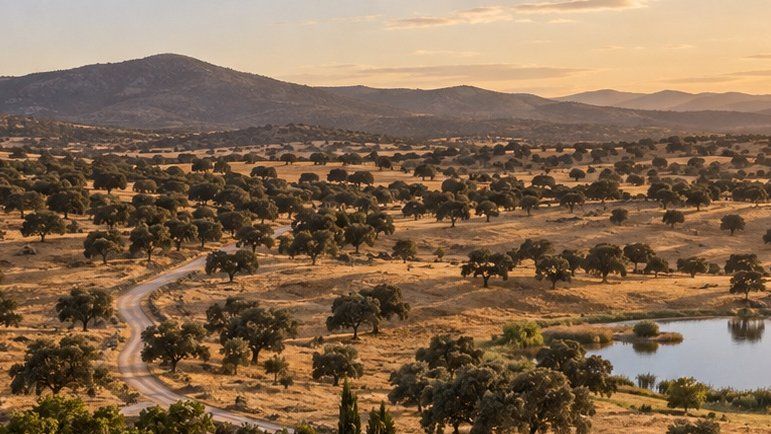
For plants of a certain size they look for estates of tens or hundreds of hectares, flat or gently sloping, compact and with few obstacles. Low-yield dryland soils are preferred; productive irrigated land is practically ruled out because of its value and administrative pressure. Generally excluded are Natura 2000 areas, livestock routes, protective forests and land with special landscape or archaeological value. A well-preserved dehesa oak grove is not a good candidate either: the protected trees make it unviable, and that is one of the reasons why many projects concentrate on dryland without trees.
A project's administrative path
A solar farm is not set up by signing a lease contract: the developer must go through a long file. The main milestones are the grid access and connection permit (which is requested with guarantees and can lapse if there is no progress), the prior administrative authorisation and construction permit, the environmental assessment and, in Extremadura, the declaration of general interest where applicable. Between the option on the estate and the plant running, several years can pass, and most announced projects never get built. That abandonment rate is the first piece of data an owner must keep in mind.
How to tell a serious proposal from one that is not
- Who the developer is: track record, plants built and in operation, versus those only submitted.
- Status of the connection point: whether it already has an access permit granted or only "requested", which is not the same.
- The option: a lease option contract with a term, option price and penalty for not progressing. A free ten-year option immobilises your estate for nothing.
- Who pays for the impacts: evacuation line, easements on neighbouring estates, tracks and works must be borne by the project.
- Registration of the option: if it is registered in the Land Registry, bear in mind it affects future sales and mortgages.
The clauses of the lease contract itself (duration, rent, review, final restoration) are developed in the guide to leasing the estate to a photovoltaic developer.
Indicative numbers
The rents offered in Extremadura for leasing to photovoltaic projects range, according to market offers, around 1.000 to 1.500 euros per hectare per year, sometimes higher in highly contested areas, normally with an annual review linked to the CPI and terms of 25 to 40 years. Compared with the agricultural rent of dryland, it is several times higher; the counterpart is immobilising the estate for decades, accepting the effect on a future sale price and accepting that the project may never be built while the option stays alive.
And if the idea is self-consumption for the estate, not a solar farm
It is not all about leasing to a developer. For the house, the livestock farm or irrigation, self-consumption with panels is a different calculation: installations of a few kilowatts on roofs or ground, with solar pumping for wells and regional and state subsidies that appear in successive calls. The return there is not measured in rent per hectare but in diesel or electricity bill avoided, and on estates irrigated from boreholes the saving can pay for the installation in a few years. It is a project of far smaller size and administrative complexity, and it does not immobilise the estate.
What to ask at the first meeting with a developer
- Do you already have a connection point requested or granted for this area, and at which node?
- Which plants do you have built and operating, versus those only in the pipeline?
- What does the option pay, how long does it last and which milestones renew it?
- Who assumes the restoration of the land at the end of the plant's life and with what guarantees?
- What happens with tracks, easements and impacts on neighbouring estates?
The answers, and above all how concrete they are, say more about the project than any dossier.
Agrivoltaics and compatibility with the estate
More and more projects integrate sheep grazing under the panels or keep agricultural strips. For the owner it can be a way to keep agricultural activity and part of the payments, but the area occupied by infrastructure stops counting as eligible CAP area. If your estate collects payments, review the impact before signing, as the guide to CAP entitlements reminds you. And if your question is which areas of Extremadura concentrate these projects, the dryland of La Serena and the Vegas Bajas are among the most sought after, as seen in the guide to estates in La Serena.