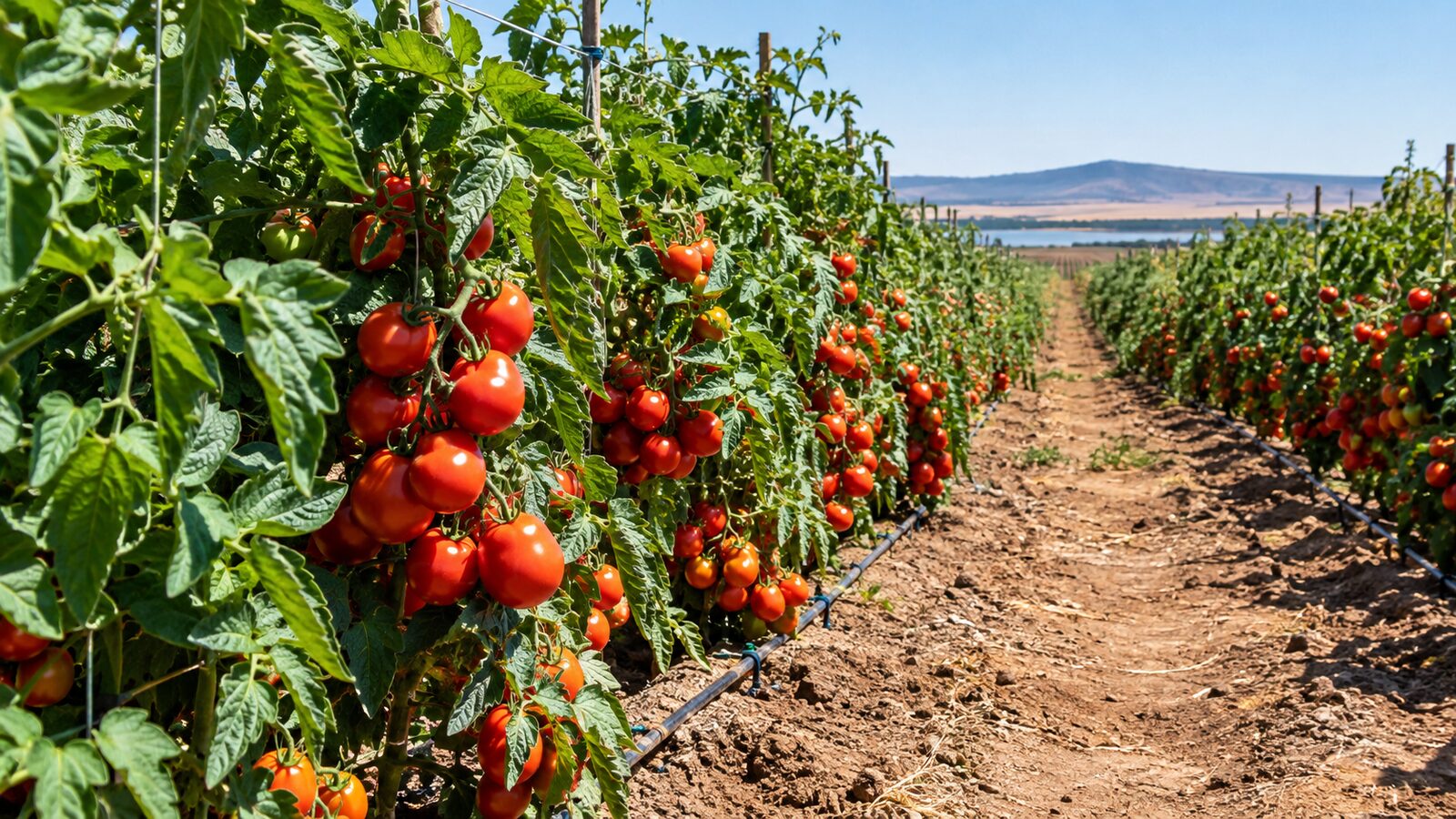
Its weight in Extremadura
According to the Ministry of Agriculture, between the 2016 and 2020 campaigns the Spanish area of tomato for processing was concentrated in Extremadura and Andalusia, with 67 % and 23 % of the national total. In 2020, Extremadura had 23,440 hectares. The CICYTEX factsheet on horticultural crops, consulted in October 2026, states that the processing tomato is the region's main horticultural crop, with 72 % of the horticultural area, and that its area has ranged between 15,000 and 30,000 hectares over the last twenty years, with a recent trend towards about 23,000. The Ministry figures are from those campaigns and may have changed: ask the administration or a producers' organisation for the latest campaign data.
Water is essential
CICYTEX states that irrigation is essential for the commercial development of the crop and is one of the main production factors. For that reason, on an irrigated estate the first thing is the water right: where it comes from, who manages it and how much it costs. Read water on a rural estate and irrigated estates in the Vegas del Guadiana.
The industry and the contracts
According to a CTAEX document on the tomato chain (with 2019 production data), processing in the region is organised with producers' organisations and processing industries: 14 industries and 20 producers' organisations in that document. That is a snapshot of then, not the current number. If you plan to grow tomatoes, ask what delivery contract the current farmer uses, with which industry and under what conditions. Do not assume that an existing contract passes to the buyer.
What to check on the estate
- Documented water right and condition of the ditches or the irrigation system.
- Soil quality and its crop history.
- Area declared in SIGPAC and its match with the real one.
- Machinery included in the sale and its condition.
- Current sales contracts and aid received. Review basic payment entitlements when buying an estate.
Figures and financing
An irrigated crop requires investment and working capital. Make a budget with real local costs and a bad scenario. If you need financing, see loans to finance a farm operation. The guide to profitability of a rural estate gives you a method.
Documents worth requesting
Before signing anything on an irrigated estate, ask the seller for the land registry extract, the cadastral certificate and the SIGPAC query if there are agricultural parcels. Check that the area, the boundaries and the owner match in all three documents. If there are differences, ask how they will be resolved before the deed. The guide to land registry extract, cadastre and SIGPAC explains what to look at in each one.
Also ask for the property tax receipts, the current contracts and any authorisation or licence for the constructions. An independent lawyer should read the deposit contract before you sign it; the guide to the deposit contract on a rural estate summarises the points to review.
How to visit the estate
Visit the estate at least twice and in different seasons: once in good weather and once in rain or strong heat. Time the real journey from the town where you would do your daily shopping. Check the access track, the mobile coverage, the state of the fences and the buildings, and take photos of everything. Talk to a neighbour without the seller present: they usually know things about water, dry years and tracks that appear in no document.
Costs that do not appear in the listing
Besides the price, an estate has expenses every year: rural property tax, insurance, maintenance of fences and tracks, utilities and, if there is an operation, production costs. There are also purchase costs, such as taxes, notary and registry. The guide to taxes when buying a rural estate helps with the former and the annual maintenance calendar with the latter. Make a sheet with three scenarios and check that your budget survives the worst.
Who to consult
You do not need to know everything, but you do need to know whom to ask. For this topic, consult a technician from a producers' organisation or from the irrigation community. For the legal and purchase side, a lawyer who knows the district. For the planning side, the town hall, in writing and with the cadastral reference. Keep the answers and compare them with what the seller says. If two sources contradict each other, ask both to clarify before moving on.
Common mistakes
- Deciding on the fame of the product or the place without looking at the estate's documents.
- Signing a deposit contract before having the registry extract, the cadastre and the water confirmation.
- Trusting production figures that the seller cannot prove with invoices.
- Visiting the estate only once, in the best season of the year.
- Not asking the town hall and the competent administration in writing what can be done.
They all appear in the guide to mistakes when buying a rural estate.
Questions for the seller
Before negotiating, prepare a list of questions about an irrigated estate and ask for written answers: what is done on the estate today, since when, with what results, what expenses it has, what contracts are in force and what has stopped being done and why. Also ask about the problems of recent years, such as droughts, pests, fires or conflicts with neighbours. If the answers are vague or change from one conversation to another, take it as a sign to ask for more documents or to wait.
Conclusion
The processing tomato has an enormous weight in Extremadura and needs secure irrigation. Before buying an irrigated estate, check water, contracts, soil and area with documents and with local technicians.