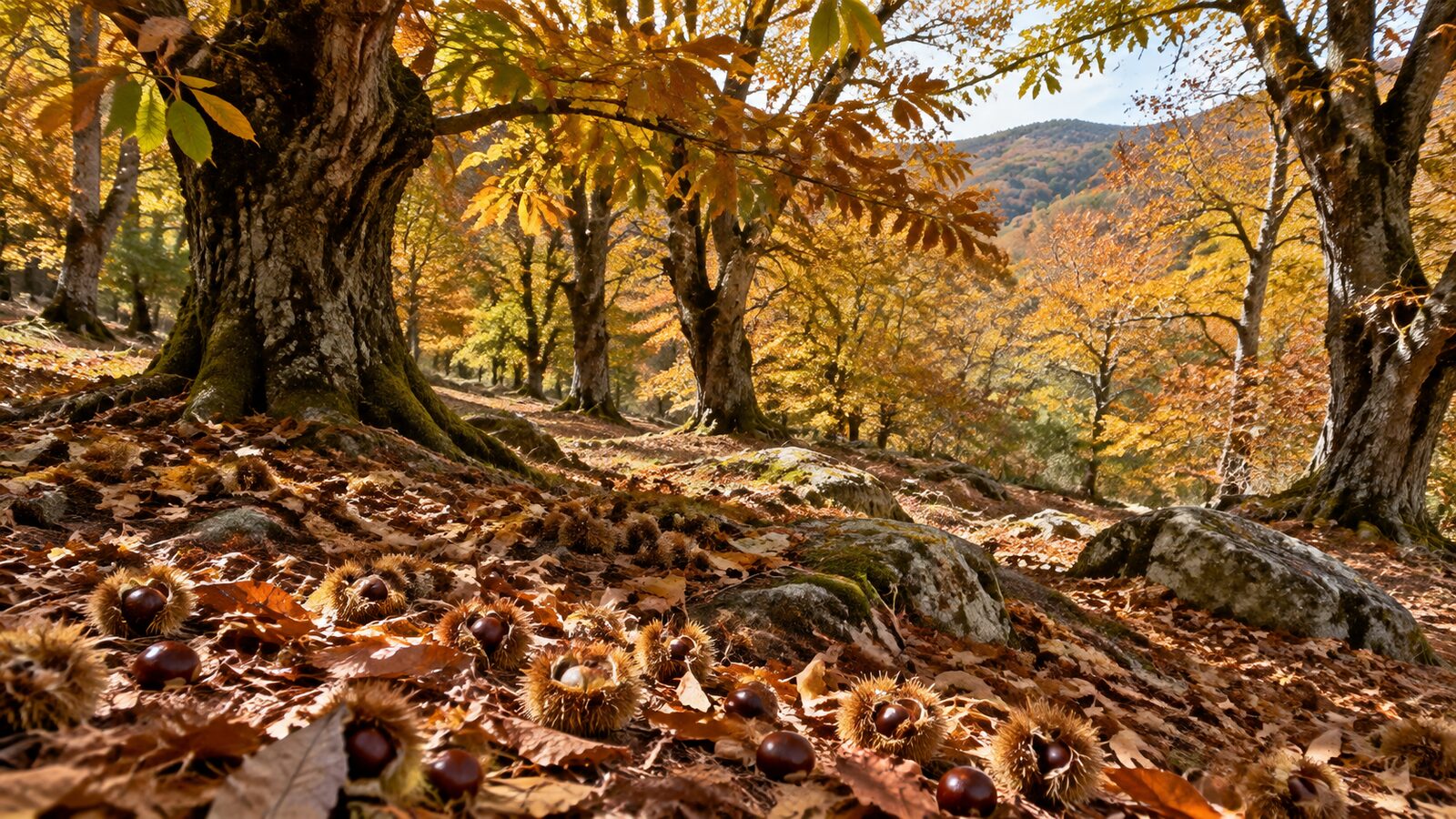
A mountain crop
In Extremadura it is a crop associated with comarcas in northern Cáceres and some ranges in the southeast, where the chestnut-grove landscape is part of local identity. If you like the idea of an estate with centuries-old trees and an autumn harvest, the chestnut grove is one of the most beautiful options, but also one of the most demanding.
Where it is grown
The research centre CICYTEX, of the Junta de Extremadura, describes the chestnut as a crop typical of the region's rural mountain areas, located mainly in northern Cáceres, with the Jerte Valley, the Ambroz Valley and Sierra de Gata, and in the southeast, with the Sierra de las Villuercas. New centres of interest have also emerged in other areas, such as Valencia de Alcántara, La Vera, Las Hurdes and Cabeza la Vaca. According to the same body, chestnuts have gained in value in recent years. If you are looking for an estate in those comarcas, see the guides on buying an estate in Sierra de Gata and Las Hurdes, estates in the Jerte and Ambroz valleys and Guadalupe and Villuercas.
New plantation and old chestnut grove
According to CICYTEX, new chestnut plantations are made with irrigation and new varieties, and irrigation is becoming common in the northern mountain areas. That is why, when looking at an estate, distinguish between old trees and recent plantations and ask which varieties there are, whether they have irrigation and what real production they have given. The choice of variety depends on the area, so ask for local technical advice.
Pests and diseases
CICYTEX points to ink disease (tinta), caused by Phytophthora, and chestnut blight (chancro), caused by Cryphonectria parasitica, as serious chestnut diseases. It also describes the gall wasp (avispilla) as a recently introduced pest, controlled with parasitoids. That is why, when buying a chestnut grove, it is important to ask for information about its health and about the treatments and management it has received. A local agricultural or forestry technician can assess the plantation in a visit. If the estate has very old or diseased trees, the real value may be lower than it seems.
What to check before buying
- Age, variety and condition of the trees, with a technical visit.
- Production in recent seasons and to whom the chestnuts were sold.
- Slope, access and ease of harvesting and removing the crop.
- Available water and irrigation system, if any.
- Fire and pest risk in the surroundings.
- Protection conditions of the site, because many mountain estates are in protected areas.
- Land registry and cadastral status, using the list of common mistakes as a guide.
Fires in the mountains
Wooded mountain estates have a significant fire risk in summer. As an owner, you have prevention obligations, such as keeping the estate and firebreaks clean. Read the guide on wildfire prevention for the estate owner and ask your insurer about coverage.
The harvest and the sale
Before buying, ask when it is harvested on that estate, how it is harvested and to whom it is sold: cooperatives, industry, local markets or direct sale. If you plan to sell directly, check the registration and food safety requirements that apply to your case. Also ask for real data from recent seasons.
Prudent calculations
CICYTEX states that chestnuts have gained in value, but that does not guarantee that your estate will be profitable. Calculate with your own data: the estate's production per hectare, average sale price, labour, pruning, treatment and harvesting costs. Compare with producers in the area and use the guide on profitability of a rural estate as a method. If you prefer to compare with another valley crop, see the guide on the cherry tree in the Jerte Valley.
Questions for the seller and the technician
- Which varieties are there and what year are the trees from?
- Have trees with ink disease or blight been seen, and what was done?
- Has there been gall wasp on the estate and how was it treated?
- Is there irrigation, and with what water right?
- How many chestnuts were harvested in the last three seasons and to whom were they sold, with invoices?
- Is there an access track passable all year for vehicles and machinery?
- Is the estate inside any protected area or does it have limits on felling, pruning or planting?
Write the answers down and check them with a technician who does not earn a commission on the sale. If the answers do not match what you see on the estate, take more time before deciding.
Conclusion
A chestnut grove is a living heritage, with an unmistakable landscape and harvest. For it to also be a good purchase, you need to review the condition of the trees, the production, the fire risk and the protection conditions of the area. With local technical help, you can tell a valuable chestnut grove from one that is merely pretty.