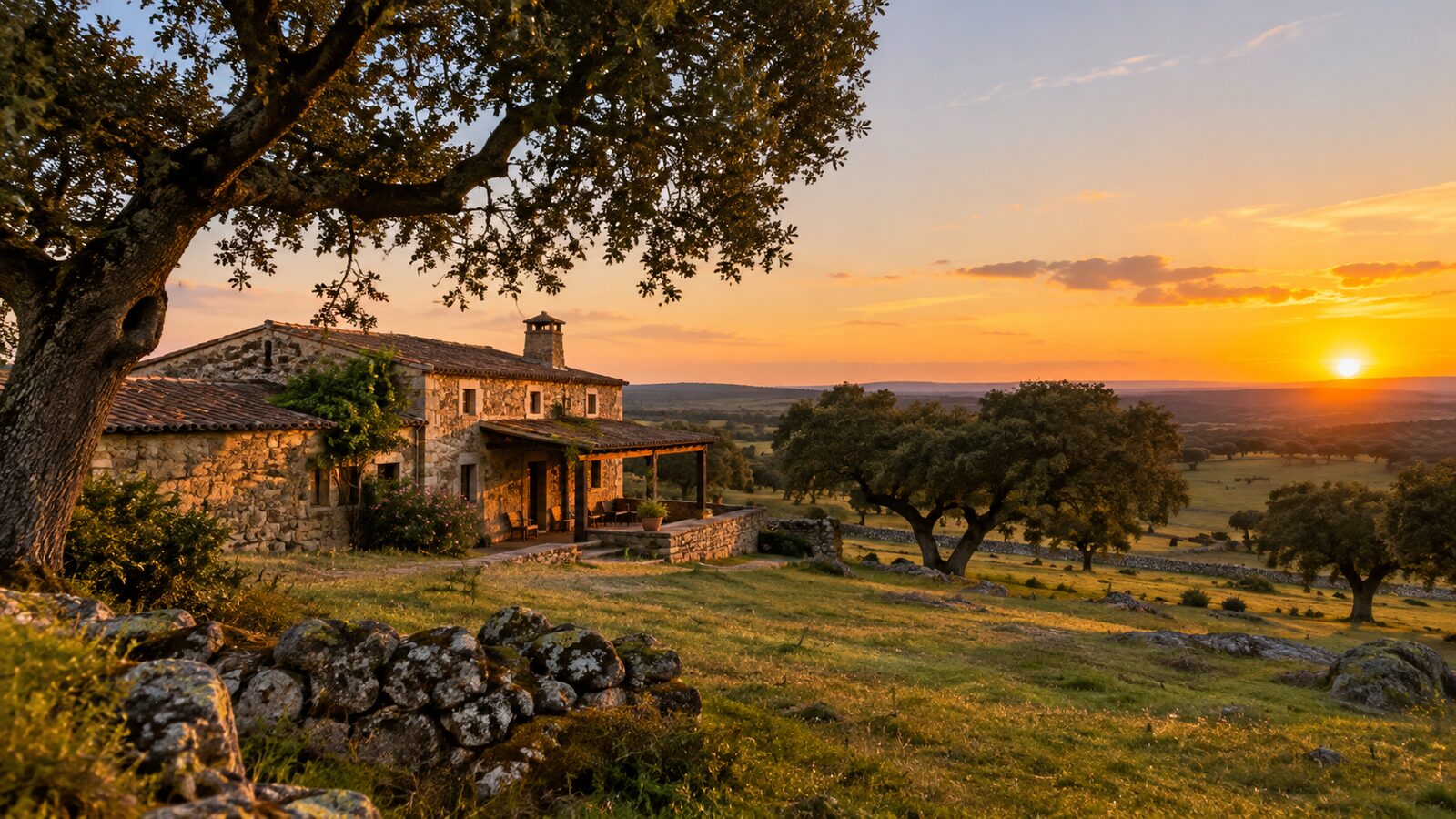
What people are looking for
People considering life on a rural property in Extremadura generally want the same things: more space for less money, nature nearby, peace and a less urban way of life. That combination exists, but brings trade-offs worth knowing from the outset, especially if you come from a large city or another country.
Advantages
- Space: the price of a flat in a large city can buy a house with land. Prices depend heavily on the area; see the guides to price per hectare and rural property prices with a house.
- Scenery and peace: dehesas, mountains, rivers and open skies, with few neighbours.
- Self-sufficiency: a vegetable garden, fruit trees, chickens or firewood, if the land and rules allow.
- Your own projects: rural tourism, small-scale livestock farming, olive growing or beekeeping, provided the property and licence permit them.
Drawbacks
- Distances: the supermarket, doctor or school may be many kilometres away. Life revolves around the car.
- Services: internet, electricity, mains water and refuse collection are not guaranteed on every property.
- Maintenance: woodland, tracks, fences, the well and the house require work and spending every year. In summer, wildfire risk needs attention too.
- Climate: very hot summers and cool winters, with differences between districts.
- Isolation: social life centres on the nearest village.
Everyday essentials to check
- Year-round access: a dirt track may become impassable in rain. Visit in winter.
- Water: mains, a legally authorised well or a tank. See the guide to water on rural property.
- Electricity: a possible supply connection with the distribution company, or your own system.
- Internet: fibre, fixed wireless or satellite; ask neighbours what they use.
- Healthcare and education: actual distance to the health centre, hospital and school.
- The home's legal status: confirm that the house is registered and legally authorised (see land registry extract and cadastre).
Choosing a district to suit your needs
Seeking peace is different from seeking nearby services. For proximity to medium-sized cities, look around Cáceres, Mérida or Badajoz; for isolation and nature, the northern and eastern mountains offer more. To choose between provinces, read Cáceres or Badajoz: where to buy rural property.
If you are moving from outside Spain
International buyers face additional procedures, such as obtaining a foreigner identification number, explained in buying rural property in Extremadura as a foreigner. Plan tax residence and healthcare with an adviser too.
Try it before deciding
A good approach is to rent a rural house in the district for a week or two outside peak season before buying. This lets you experience daily life, travel and isolation. Then review leisure property with a house: what to check.
Budget realistically: beyond the purchase price, allow for transaction taxes, any renovation and annual maintenance, which depends on the property's size and condition.
Annual budget: what to include
Beyond the purchase price, a rural property brings recurring costs. Make an honest list before deciding:
- Local and property taxes, which vary by municipality.
- Insurance for the house and property.
- Utilities: electricity, water, gas or firewood, and internet.
- Maintenance: brush clearance, firebreaks, tracks, fences, roof and well.
- Transport: fuel and maintenance for a car, often more than one.
If the plan includes a business such as olive growing, livestock or tourism, calculate its costs separately and consult the guide to rural property returns.
Security and community
In the countryside, it pays to know your neighbours and town hall. An isolated property needs an alarm, good outdoor lighting and common sense with tools and vehicles. Village life is often close-knit: introducing yourself and joining local celebrations and activities helps you settle in, especially when arriving from elsewhere.
When it is not a good idea
It is not the best option if you depend on public transport, need frequent medical services a few minutes away or are unwilling to spend time on maintenance. In those cases, a house in a village in the same district may offer the Extremadura setting with greater convenience. Consider that alternative before buying an isolated property.
A typical year on the property
To picture the rhythm of life, think of the seasons. Autumn brings the first rains, acorns and countryside outings; it is a good time to plant and check roofs and gutters. In winter, account for cold in poorly insulated houses, firewood and muddy tracks. Spring is the best season: green countryside, flowers and plenty of activity in the vegetable garden. Summer requires managing heat, water and wildfire risk, with brush cleared in good time.
People who adapt to this rhythm tend to enjoy it. Those arriving expecting city convenience in the middle of the countryside are often frustrated. That is why we stress visiting in more than one season before deciding.
House paperwork
A house on rural land may have legal-status problems: undeclared buildings, unlicensed extensions or differences between the cadastre and land registry. Buying without resolving them may lead to future problems with utilities, insurance or resale. Always request the land registry extract, cadastral certificate and, where building work exists, the authorisation supporting it.
Questions to ask yourself
- What will I do if the car will not start or there is a power cut lasting several days?
- Who will look after the property when I travel?
- How much time each week am I willing to spend on maintenance?
- Do I need a school, doctor or on-site job nearby?
If the answers leave you comfortable, you are on the right track. If not, a middle option, such as a house with land on a village's outskirts, may suit you better.