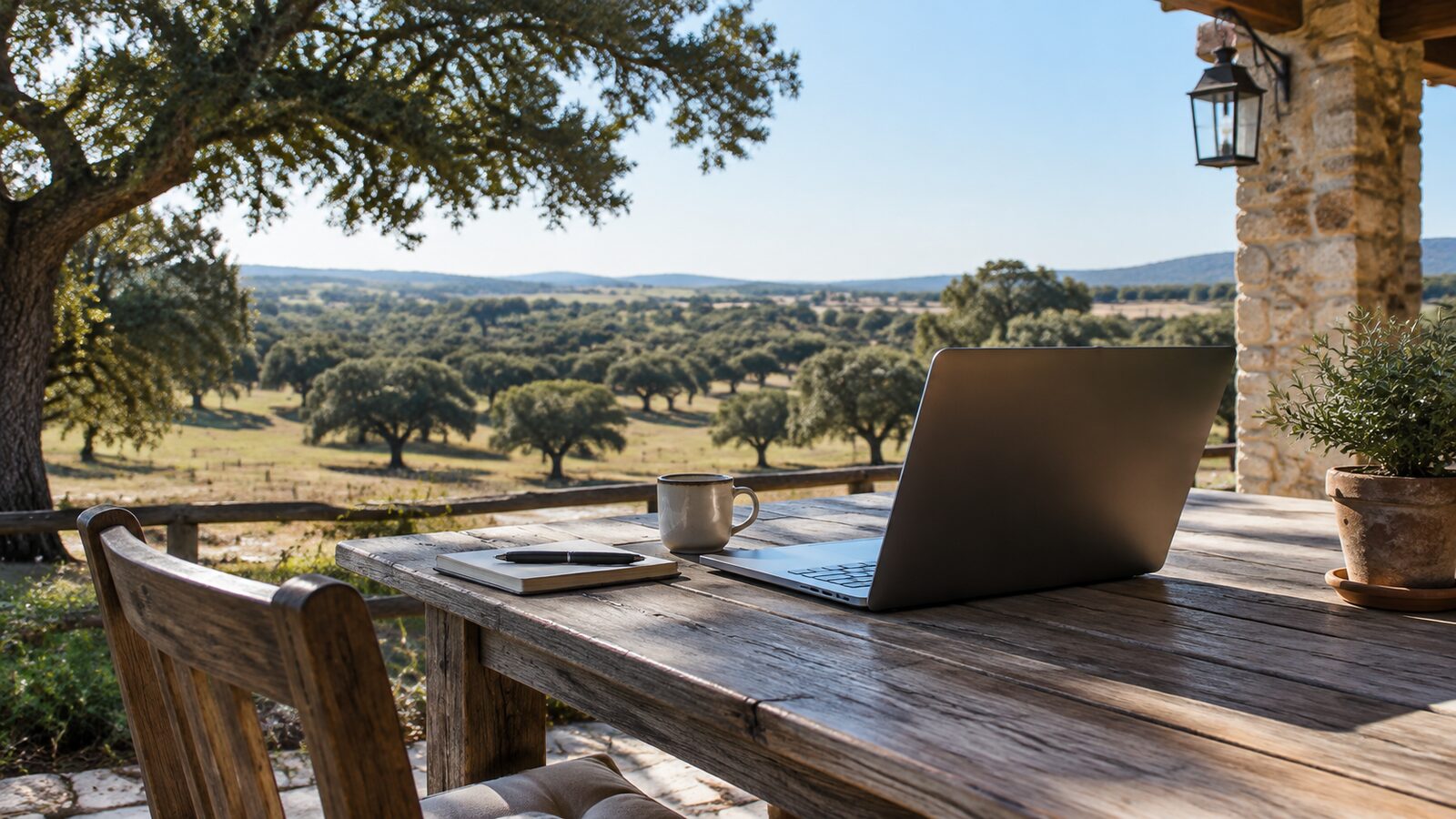
Why it matters so much before buying
Many people looking for rural property in Extremadura want to keep working remotely. A beautiful house without a stable connection can become a serious problem: dropped video calls, uploads that never finish or an inability to use cloud tools. Connectivity is not a detail to sort out later. It is a buying criterion, just like water or access.
The good news is that several technologies are available today and, with a methodical approach, a reasonable solution can almost always be found. The bad news is that every property is different, and two plots a few kilometres apart may have very different coverage.
The main options
Fibre broadband
This is the best option where available. It is usually available in towns and residential developments, but generally does not reach isolated rural properties. Ask providers using the exact address or coordinates, rather than just the municipality name, and request written confirmation. Some properties may be able to pay for a network extension; if so, request a quote and check permits and rights of way.
Fixed wireless internet
Local providers offer wireless connections in rural areas. These need a direct line of sight to a relay antenna, so terrain and trees matter. Performance depends on the provider and distance. It is a common countryside solution; request a technical visit or trial before signing up.
Fixed 4G and 5G
An outdoor antenna and mobile router can provide a connection adequate for remote working where coverage is good. Measure the signal at different points on the plot, as it is usually poorer inside the house. Ask whether the plan has data limits and what happens at busy times.
Satellite
This can be a backup or a main connection where there is no alternative. It requires an antenna with a clear view of the sky and usually has a higher monthly cost. Consider latency if you make video calls or work with remote systems.
How to test actual coverage
- Visit with your mobile and check signals from several providers inside and outside the house.
- Run speed tests at different times, including late afternoon.
- Ask neighbours which connection they use and whether it works in winter and summer.
- Consult providers with the exact location and ask about installation times.
- Check easements if cables must cross other people's land (see easements and boundaries).
Electricity and energy: the other essential
A stable connection also requires stable electricity. Check whether a supply connection is possible with the distribution company, the available capacity and local outages. Some owners combine mains power with solar panels and batteries to work without interruptions; if you are considering this, review the guides to solar panels on rural land and solar farms and requirements.
Where to work on the property
Plan a specific workspace: good light, insulation against summer heat and winter cold, and a reliable network point. If the house needs renovating, include an office and cabling in the plans. Before renovating, check the home's legal status and what work the land classification allows; the guide to building on rural land helps with this.
Always have a backup
Even if the main connection works well, have an alternative: a second mobile provider, a backup 4G router or, as a last resort, a coworking space in the nearest town. A two-day outage should not bring your work to a halt.
Legal and tax considerations
If you work from another country or for a foreign employer, consult an adviser about tax residence and employment status when moving to Spain. For other international buyer procedures, see buying rural property in Extremadura as a foreigner.
Practical summary
Before buying: test the signal on the plot, speak to neighbours, request written confirmation from providers and calculate installation costs. After buying: sign up with a backup plan and record actual speeds. With this preparation, remote working from a rural property in Extremadura is entirely feasible. For the broader context of country life, read living on a rural property in Extremadura.
Questions for the seller and neighbours
- Which provider works best on the property, and for how long has it done so?
- Has fibre or fixed wireless ever been installed? Who arranged it?
- Are power cuts frequent locally, and how long do they last?
- Where on the plot is the signal strongest?
- Are there any easements for cables or poles?
Answers from people living there are worth more than any coverage map. If the seller cannot answer, that is a sign to check for yourself over several visits.
Basic equipment for trouble-free working
With a reasonable connection, a good router, a well-positioned Wi-Fi access point and an uninterruptible power supply (UPS) for the computer and router prevent many problems caused by brief outages. For video calls, connect your computer by network cable whenever possible. A second 4G or 5G router with another provider's SIM serves as a backup and costs little compared with losing a working day.
Installation costs and lead times
Prices and times depend on the provider, technology and distance from the network. Always request a written quote covering installation, monthly fees and minimum contract terms, and confirm timescales before committing. Rural installation may take longer than in a city.
Conclusion
If you work remotely, connectivity is one of the factors that most shapes life on a rural property. Take time to check it before buying, measure the signal on the plot itself and always have an alternative. This preparation helps avoid surprises and lets you enjoy the countryside without giving up your work.