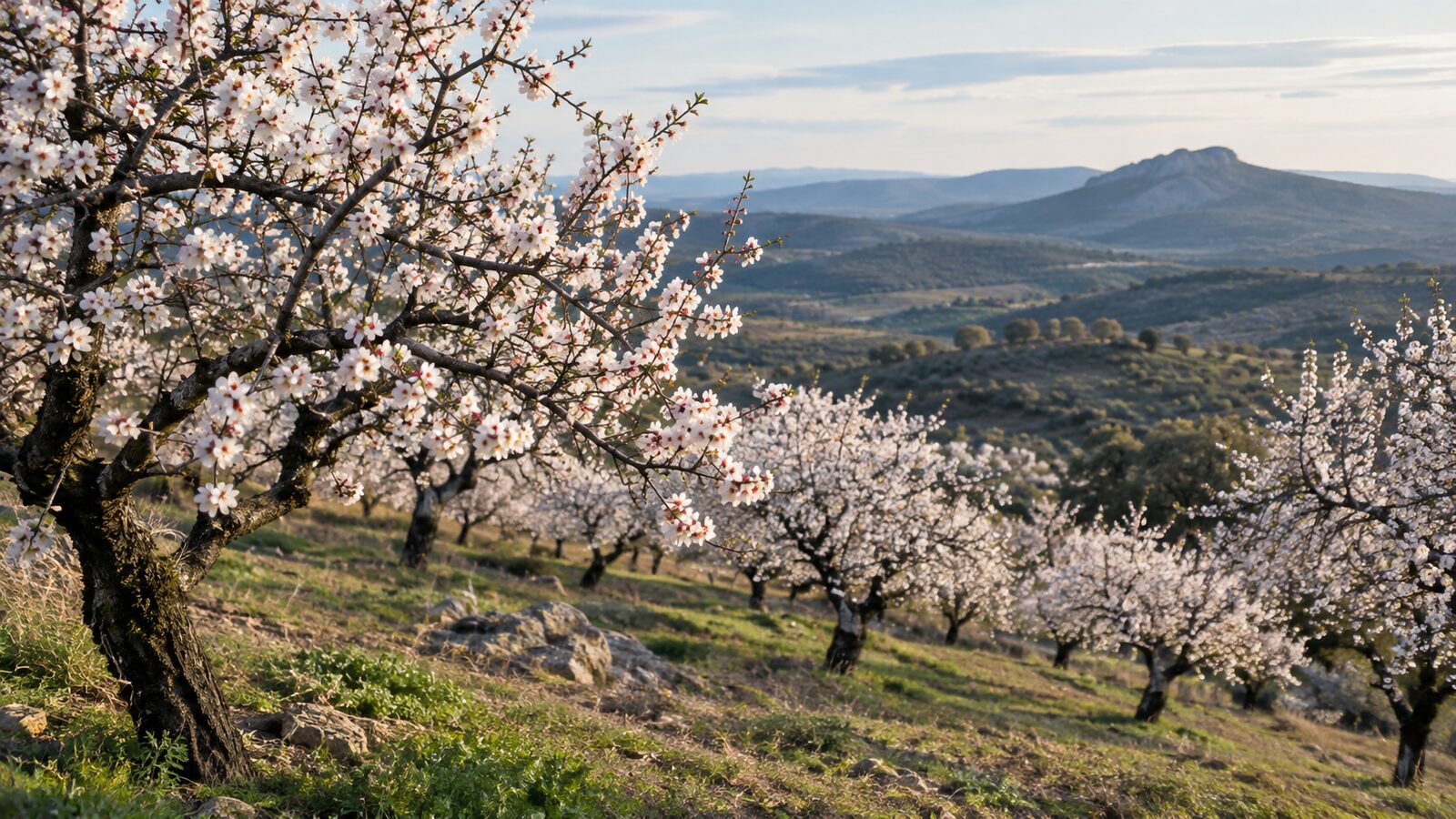
Why nuts are of interest
One of the big novelties in Spanish farming over the last decade has been the advance of nuts, led by almond, pistachio and walnut. Extremadura has not been left out: the area under these crops has grown, above all in zones with irrigation water. According to a report published by the regional outlet Extremadura21 in June 2024, based on data from that year's campaign, almond, pistachio and walnut would exceed 30,000 hectares of cultivation in the region. For someone who wants to buy an estate, what is useful is knowing that young plantations will be for sale and that the water, soil and varieties should be checked with real data for each estate.
A long-term investment crop
Unlike an annual crop, a nut tree takes years to come into production. You must count on an initial investment in plants, irrigation, land preparation and fencing, and on several campaigns without a harvest or with a small one before reaching full production. That period varies with the species, the variety, the planting frame and the management. Do not take as good a figure you hear in an advertisement: ask the technician or the seller for the real production data of that estate or of comparable estates.
Water comes first
According to CICYTEX, almond was traditionally grown in dryland on low-fertility soils and today is also planted in irrigated zones. So, before buying an estate of this type, check where the water comes from and under what right: water concession, irrigation community, legalised well or mains irrigation. An unlegalised well can be a serious problem. Read the guide on water on a rural estate: wells and concessions and, if you are talking about irrigated zones, the one on irrigated estates in the Vegas del Guadiana. Also ask about the cost of water per hectare and about restrictions in dry years.
What CICYTEX says about almond
The Scientific and Technological Research Centre of Extremadura (CICYTEX) explains in its almond fact sheet that this crop was traditionally tied to dryland zones of low fertility, and that today it is also seen in irrigated zones. It also points out that early-flowering varieties are exposed to February frosts, and that its breeding programmes seek self-fertile varieties with late and extra-late flowering. In its trials, sparrows damaged flower buds in December and January.
For walnut and pistachio we have not been able to cross-check Extremadura data of our own here. Ask an agronomist engineer in the comarca for a specific recommendation of species, variety and rootstock, because frosts and soils vary a great deal from one estate to another.
What to look at in an existing plantation
- Age and condition of the trees, planting frame and gaps (spaces left by dead trees).
- Varieties and rootstocks, and whether they are suitable for the area.
- Irrigation system, condition of the pipes, filters and pumps.
- Production of recent campaigns, with sales invoices.
- Health status, pests and diseases detected.
- Current sales contracts with cooperatives or industries.
- Water rights, subsidies received and pending commitments.
- Machinery included in the sale, such as a tractor, a shaker tractor or sprayers.
If you are going to plant
If you are going to plant a bare estate, the decision is more technical. You need soil and water analyses, a planting project, certified plants from a reliable nursery and an irrigation plan. Check whether the soil and the municipality allow the change of crop and whether the estate has rights or subsidies linked to the previous use. A pasture or dehesa estate has rules and environmental values that can limit transformation; first review the guide on CAP and rights when buying an estate. Do not remove trees without consulting the Junta.
Main risks
- Frost at flowering, above all in almond.
- Drought and lack of irrigation water in dry years.
- Diseases and pests that change with climate and management.
- Variable prices, which depend on the international market.
- Labour and machinery for pruning, irrigation and harvest.
Part of these risks can be covered by agricultural insurance; read insurance for a rural estate and agricultural insurance to understand what can be insured. And if you are interested in comparing with another Mediterranean crop, look at traditional, intensive and super-intensive olive groves.
Doing the numbers
Profitability depends on costs, price, yield per hectare and the time until full production. Make three scenarios, a normal one, a bad one with frost or drought and a good one, and check whether the investment withstands the bad scenario. Include the opportunity cost of the money invested and the fixed costs. Use the guide on profitability of a rural estate to organise the figures, and ask an agricultural adviser to review yours.
Conclusion
Nuts can be a good crop in Extremadura, but only when there is secure water, suitable soil and a realistic calculation. To buy well, it is advisable to talk to technicians, see real production and not trust promises of profitability. It is an investment for many years, so every piece of data you check before buying reduces a risk.